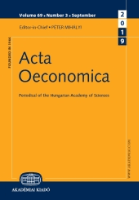
ACTA OECONOMICA
Scope & Guideline
Fostering innovative research for the economics community.
Introduction
Aims and Scopes
- Economic Policy Analysis:
The journal extensively covers the analysis of economic policies, particularly in relation to fiscal and monetary policies, and their impact on economic stability and growth in various regions. - Comparative Economic Systems:
A significant focus is placed on comparative studies of economic systems, particularly the transition from socialism to market economies, and how these systems evolve in different geopolitical contexts. - Socio-Economic Dynamics:
Research often explores the interplay between social factors and economic outcomes, including gender inequality, unemployment, and the effects of socio-political crises on economic performance. - Impact of Global Events on Local Economies:
The journal addresses how global events, such as the COVID-19 pandemic and geopolitical tensions, influence local economic conditions and strategies, highlighting the need for adaptive economic frameworks. - Emerging Markets and Development Issues:
There's a strong emphasis on the economic development challenges faced by emerging markets, including foreign direct investment, innovation, and the role of technology in economic growth.
Trending and Emerging
- Digital Economy and Technological Impact:
Recent publications increasingly focus on the implications of digitalization and technology on economic performance, reflecting the global shift towards digital economies and the need for adaptation in traditional sectors. - Gender and Economic Inequality:
There is a rising interest in exploring the intersections of gender, economic participation, and inequality, particularly in the context of labor markets and social policies. - Crisis Management and Economic Resilience:
The journal is increasingly addressing themes related to crisis management, particularly in light of the COVID-19 pandemic, examining how economies can build resilience against future shocks. - Sustainability and Environmental Economics:
Emerging research trends include a focus on sustainability and the economic impacts of environmental policies, reflecting a growing recognition of the importance of sustainable development in economic planning. - Behavioral Economics and Decision-Making:
There is a trend towards incorporating insights from behavioral economics, examining how psychological factors influence economic decisions, particularly in financial markets and consumer behavior.
Declining or Waning
- Traditional Capitalism Models:
Research focusing solely on traditional capitalist frameworks has diminished, as the journal shifts towards more nuanced analyses of hybrid and emerging economic systems. - Static Economic Theories:
There is a noticeable decline in the publication of papers that rely on static models of economic behavior, with a growing preference for dynamic and complex systems approaches. - Historical Economic Analysis:
While historical perspectives remain relevant, there has been a decrease in studies that primarily analyze historical economic data without connecting to current trends or future implications.
Similar Journals
Metroeconomica
Shaping the Future of Economic Research.Metroeconomica is a prestigious journal published by WILEY, focusing on the dynamic fields of Economics and Econometrics. Known for its rigorous peer-review process, this journal prides itself on disseminating high-quality research that informs and inspires scholars and practitioners alike. With an impact factor reflective of its significance in the discipline, Metroeconomica is categorized in the Q2 quartile for 2023, representing its competitive standing among influential economics publications. Since its inception in 1949 and continuing through a converged publication period until 2024, it has contributed significantly to advancing theoretical and empirical knowledge in economics. Researchers can access its content through traditional avenues, encouraging a wide readership among academics and industry experts. As the journal continues to evolve with the changing landscape of economic research, it remains a vital resource for those seeking to explore contemporary economic issues and foster impactful discussions within the field.

Prague Economic Papers
Unveiling Insights in Economics, Finance, and EconometricsPrague Economic Papers is an esteemed scholarly journal dedicated to the fields of Economics, Finance, and Econometrics, published by UNIV ECONOMICS-PRAGUE. With its ISSN 1210-0455 and E-ISSN 2336-730X, this journal serves as a vital platform for innovative economic research and theoretical advancement. Operating from the scenic backdrop of the Czech Republic, Prague Economic Papers is recognized in Scopus with rankings that place it in quartile Q4 for Economics and Econometrics, as well as Q3 for Finance, reflecting its growing impact in the academic sphere. Though the journal does not currently offer open access, it ambitiously covers a wide expanse of economic theories and empirical studies, contributing significantly to the evolution of economic thought from 2008 to 2024. Researchers, professionals, and students alike will find this journal essential for accessing critical insights and methodologies that shape contemporary economic discourse.
American Economic Journal-Macroeconomics
Exploring the Dynamics of Global EconomiesAmerican Economic Journal-Macroeconomics, published by the American Economic Association, stands at the forefront of economic research, addressing pivotal macroeconomic issues that shape global economies. With an impressive Scopus rank of #8 out of 288 in its field and a notable 97th percentile ranking, this journal is widely regarded as a top-tier publication, specifically categorized in the Q1 category for Economics, Econometrics, and Finance as of 2023. Operating under ISSN 1945-7707 and E-ISSN 1945-7715, it aims to disseminate high-quality research from 2009 through 2024 and beyond, providing crucial insights into macroeconomic theory and policy. Although the journal currently does not operate under an open access model, it remains a vital resource for researchers, economists, and students seeking to deepen their understanding of macroeconomic dynamics and their implications for economic policy worldwide. The journal's impactful contributions make it an essential read for those striving to influence economic thought and practice.
Economic Analysis and Policy
Transforming Policy with Insightful Economic AnalysisEconomic Analysis and Policy is an esteemed academic journal published by ELSEVIER, dedicated to advancing the field of economics and econometrics since its inception in 1970. Based in the Netherlands, this journal plays a pivotal role in disseminating high-quality research that addresses contemporary economic issues and policy challenges. With an impressive Q1 ranking in both the Economics and Econometrics categories, and recognition in the top 91st percentile of Scopus rankings, it is a leading platform for scholars, professionals, and students seeking to contribute to and engage with the evolution of economic thought. The journal does not currently operate on an open access model, allowing it to maintain rigorous peer-review standards that ensure the integrity and impact of published research. As a vital resource for anyone interested in the intersection of theory and policy in economics, Economic Analysis and Policy fosters a community committed to rigorous analysis and innovative solutions in the economic domain.
Journal of Chinese Economic and Foreign Trade Studies
Deciphering the Economic Tapestry of ChinaJournal of Chinese Economic and Foreign Trade Studies is a distinguished academic platform dedicated to exploring the intricate dynamics of China’s economic policies and foreign trade practices. Published by Emerald Group Publishing Ltd, this journal caters to a diverse readership interested in the intersection of business, economics, and international management. With an ISSN of 1754-4408 and an E-ISSN of 1754-4416, it demonstrates its influence in the scholarly community, evidenced by its latest categorization as a Q3 journal in Business and International Management and Q2 in Economics, Econometrics, and Finance for 2023. The journal’s rank of #67/288 in the Scopus database places it in the 76th percentile, affirming its significance in the field. Although it operates under traditional access models, the journal invites rigorous academic discourse and provides a vital source of knowledge for scholars interested in the evolving landscape of Chinese trade and economic strategies from 2010 to 2024.
Comparative Economic Studies
Pioneering Research for a Sustainable Economic FutureComparative Economic Studies is a prominent academic journal dedicated to the field of economics, published by Palgrave Macmillan Ltd. Now in its converged years from 1996 to 2024, this journal provides a robust platform for innovative research and critical analysis within the economics and econometrics arenas. With an ISSN of 0888-7233 and an E-ISSN of 1478-3320, it has established itself as a vital resource for scholars and practitioners interested in comparative economic analysis, policy evaluation, and theoretical advancements. Recognized for its quality, the journal is classified in the Q3 category in 2023, reflecting its solid standing within the field, with a Scopus rank of 390 out of 716 journals in economics and econometrics. Although it currently does not offer open-access options, the journal is committed to disseminating significant findings that influence policy and scholarship globally. Its well-curated articles play an essential role in shaping contemporary economic discourse, making it an indispensable resource for researchers, professionals, and students alike.
Journal of Economics
Connecting historical perspectives with contemporary economic challenges.The Journal of Economics, published by SPRINGER WIEN, serves as a prominent platform for the dissemination of high-quality research in the fields of economics and econometrics, contributing significantly to the academic community since its inception. With its ISSN 0931-8658 and E-ISSN 1617-7134, this journal encompasses a wide range of topics and maintains a robust publication timeline from 1930 to 2024. Recognized for its relevance, the journal currently holds a Q2 ranking in Business, Management and Accounting and a Q3 ranking in Economics and Econometrics, highlighting its vital role in shaping contemporary economic discourse. Researchers will find valuable insights drawn from both historical and contemporary studies, making it an essential resource for professionals, academicians, and students alike. Although the journal is not open access, its commitment to rigorous peer review ensures that published research meets high academic standards, thereby fostering informed decision-making in economic policy and practice.

Economies
Pioneering research in economics, finance, and policy.Economies is a premier open-access journal published by MDPI, dedicated to advancing the fields of economics, econometrics, and finance since its inception in 2013. With an E-ISSN of 2227-7099, the journal plays a vital role in disseminating high-quality research that addresses contemporary global economic challenges, fostering a collaborative platform for scholars, industry professionals, and policymakers alike. The journal is based in Switzerland and has gained significant recognition in the academic community, evidenced by its Q2 ranking in both Development and Economics, Econometrics and Finance categories, along with impressive Scopus rankings—55th out of 242 in Economics and 79th out of 306 in Social Sciences Development. This positions Economies as a key resource for those seeking to stay at the forefront of economic research and thought leadership. The journal’s commitment to open access ensures that valuable insights and findings are readily available to the global research community, enhancing knowledge sharing and innovation in the field.

EKONOMICKY CASOPIS
Cultivating Scholarly Exchange in the Heart of EconomicsEKONOMICKY CASOPIS is a distinguished journal published by the Institute of Economics Research SAS and the Institute of Forecasting CSPS SAS, offering a comprehensive platform for the dissemination of innovative research in the field of economics and econometrics. Since its inception in 1978, the journal has been committed to fostering scholarly discourse, showcasing empirical studies, theoretical advancements, and policy analyses that contribute to the understanding of economic phenomena. Although categorized in the Q4 quartile in 2023 and ranking in the lower percentiles within Scopus, EKONOMICKY CASOPIS remains a critical resource for researchers and practitioners seeking to engage with the economic challenges of our time. As the journal continues to evolve through 2024, it invites contributions that align with its objectives of enhancing economic insights and promoting academic discussion in Slovakia and beyond. For researchers looking to publish their work or expand their knowledge, EKONOMICKY CASOPIS serves as a vital resource in the expanding landscape of economic research.
Economic Journal of Emerging Markets
Bridging Theory and Practice in Emerging MarketsEconomic Journal of Emerging Markets, published by UNIV ISLAM INDONESIA, serves as a pivotal platform for scholars and practitioners focused on the dynamic landscape of emerging economies. With an ISSN of 2086-3128 and an E-ISSN of 2502-180X, this Open Access journal has been dedicated to disseminating high-quality research since 2009, making it accessible to a global audience interested in economic development, policy analysis, and market dynamics. Situated in Yogyakarta, Indonesia, the journal emphasizes innovative research and empirical studies that contribute to the understanding of economic issues faced by emerging markets. Although specific H-index and quartile rankings are pending, the journal aims to establish a strong academic presence and foster interdisciplinary collaborations among researchers, professionals, and students alike, addressing critical economic challenges and opportunities.