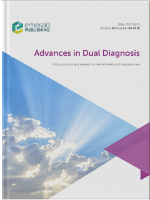
Advances in Dual Diagnosis
Scope & Guideline
Exploring the Intersection of Mental Health and Substance Use
Introduction
Aims and Scopes
- Integrated Treatment Approaches:
The journal highlights research on integrated care models that combine mental health and substance use disorder treatments, aiming to improve patient outcomes and streamline services. - Qualitative Research and Lived Experiences:
A significant focus is placed on qualitative studies that explore the experiences of individuals with dual diagnosis, including their challenges, recovery journeys, and the impact of social factors. - Social Work and Community Engagement:
Research that examines the role of social work in supporting individuals with dual diagnosis is prominent, including social interventions and community-based approaches to care. - Innovative Therapies and Interventions:
The journal publishes studies on emerging therapies, such as transcranial magnetic stimulation and text messaging interventions, that address substance use in specific populations. - Policy and System-Level Analysis:
Contributions focusing on the systemic and policy implications of dual diagnosis treatment, including barriers to access and the role of healthcare systems in delivering comprehensive care.
Trending and Emerging
- Impact of COVID-19 on Mental Health and Substance Use:
A significant number of recent studies focus on how the COVID-19 pandemic has affected individuals with dual diagnoses, particularly in terms of increased substance use and barriers to care. - Focus on Recovery Narratives:
The journal has increasingly featured personal recovery stories, emphasizing the importance of lived experiences in understanding dual diagnosis and informing treatment practices. - Youth and Adolescent Dual Diagnosis:
There is a growing emphasis on research involving adolescents and young adults with dual diagnosis, addressing unique treatment needs and developmental considerations. - Community-Based Interventions:
Emerging research highlights the importance of community involvement and social support systems in the recovery process for individuals with dual diagnosis. - Stigma and Behavioral Health Education:
Recent publications are increasingly addressing stigma associated with dual diagnosis and exploring educational resources aimed at reducing discrimination and improving access to care.
Declining or Waning
- Traditional Substance Use Interventions:
There appears to be a decrease in publications focusing on conventional substance use treatment methods without integration of mental health strategies, as the field moves toward more holistic approaches. - Generalized Studies on Substance Use:
Research that broadly discusses substance use without specific ties to mental health conditions is less frequently published, indicating a trend toward more specialized studies. - Older Models of Dual Diagnosis Care:
Studies that rely on outdated frameworks for understanding dual diagnosis treatment are becoming less common as new models and integrated approaches gain traction.
Similar Journals
JOURNAL OF ADDICTIVE DISEASES
Elevating the Discourse on Addictive DiseasesJOURNAL OF ADDICTIVE DISEASES, published by ROUTLEDGE JOURNALS, TAYLOR & FRANCIS LTD, serves as a pivotal platform for researchers, clinicians, and students in the realms of clinical psychology, psychiatry, and addiction studies. With a distinguished history dating back to its inception in 1991, this journal spans critical research developments with its current scope covering converged years from 2018 to 2024, ensuring a robust repository of knowledge. Notably, it holds a respectable impact factor and is categorized in Q2 quartiles across several disciplines including Clinical Psychology, Medicine (miscellaneous), and Psychiatry and Mental Health for 2023, reflecting its impactful contributions to the scientific community. Despite the journal not currently offering Open Access, it remains highly ranked, occupying positions in the top percentiles of Scopus rankings. This journal emphasizes the importance of disseminating high-quality research focused on addictive behaviors and diseases, thereby addressing vital clinical and public health challenges.
Journal of Addiction Medicine
Navigating the Complexities of Addiction MedicineWelcome to the Journal of Addiction Medicine, a premier academic resource devoted to the field of addiction studies, published by LIPPINCOTT WILLIAMS & WILKINS. Since its inception in 2007, this esteemed journal has become a leader in disseminating groundbreaking research, with impressive rankings in the Q1 quartile across key disciplines such as Medicine (Miscellaneous), Pharmacology (Medical), and Psychiatry and Mental Health, reflecting its significance in the scholarly community. With an ISSN of 1932-0620 and an E-ISSN of 1935-3227, it caters to a diverse audience of researchers, clinicians, and students seeking to expand their understanding of addiction medicine. The journal's articles are primarily published in a non-open access format, ensuring high-quality research is accessible through institutional subscriptions. With a Scopus ranking that positions it within the top tiers of several relevant categories, the Journal of Addiction Medicine is essential for anyone committed to advancing knowledge in the field and addressing the complexities surrounding addiction.
ADDICTIVE BEHAVIORS
Bridging Research and Practice in Addiction StudiesADDICTIVE BEHAVIORS is a prestigious journal published by PERGAMON-ELSEVIER SCIENCE LTD, specializing in the critical examination and exploration of addiction-related issues across diverse fields including Clinical Psychology, Psychiatry and Mental Health, and Toxicology. With a robust history dating back to 1975 and convergence extending to 2024, the journal is esteemed for its rigorous peer-reviewed research that contributes significantly to understanding addiction phenomena. Ranked in the Q1 category for its focus areas, it stands out within the academic community, evidenced by its impressive Scopus rankings—25th in Clinical Psychology and 14th in Toxicology—placing it in the top tier of its disciplines. This journal offers valuable insights into addiction behaviors, treatment methodologies, and public health implications, making it an essential resource for researchers, practitioners, and students seeking to advance their knowledge and impact the field. Although not Open Access, it provides vital access options for institutions and individuals invested in addiction studies.
COMMUNITY MENTAL HEALTH JOURNAL
Fostering connections for better mental health outcomes globally.Community Mental Health Journal is a leading publication in the field of mental health, managed by Springer and based in the United States. Since its inception in 1965, this journal has provided a critical platform for advancements in mental health research and community practices, with a convergence set to continue until 2024. It boasts an impressive impact factor and ranks in the first quartile (Q1) for Health (Social Science) as well as Public Health, Environmental and Occupational Health, underscoring its significance in interdisciplinary scholarship. The journal caters to a diverse audience, including researchers, practitioners, and students, fostering a deeper understanding of community mental health issues. With a commitment to highlighting innovative research and practical applications, the Community Mental Health Journal serves as an invaluable resource for those dedicated to improving mental health outcomes in communities globally.

Substance Abuse
Elevating the understanding of complex substance use issues.Substance Abuse is a premier scholarly journal published by SAGE Publications Inc, dedicated to advancing the understanding and treatment of substance use disorders. With an established presence from 1995 to 2023, the journal boasts an impressive Q1 ranking in both Medicine (miscellaneous) and Psychiatry and Mental Health, positioning it among the top tier of academic publications in these fields. Researchers and professionals will find its articles, which are grounded in rigorous empirical studies and innovative interventions, essential for addressing the complex and multifaceted nature of substance abuse. Although not an open access publication, Substance Abuse maintains a commitment to sharing valuable insights and findings, making it a vital resource for those looking to enhance their knowledge and practice. Located in Thousand Oaks, CA, this journal serves as a critical forum for international dialogue and research dissemination, ensuring that current trends and challenges in substance use are thoughtfully examined and discussed within the academic community.
Substance Abuse-Research and Treatment
Exploring global perspectives on substance abuse research.Substance Abuse: Research and Treatment is a premier open-access journal published by SAGE Publications Ltd, focusing on the multifaceted aspects of substance use and its impact on mental health. Since its establishment in 2008, this journal has been dedicated to disseminating innovative research findings, case studies, and reviews that enhance understanding and treatment of substance-related disorders. With an impact factor that reflects its standing in the field, currently ranked in the Q2 category of Psychiatry and Mental Health, Substance Abuse: Research and Treatment strives to foster interdisciplinary dialogue among researchers, practitioners, and students. By making its content freely accessible, the journal encourages widespread engagement and application of evidence-based practices to mitigate substance abuse issues. The journal’s diverse global perspectives make it a vital resource for anyone invested in advancing knowledge and improving treatment outcomes in this critical area of public health.
JOURNAL OF PSYCHOACTIVE DRUGS
Decoding the Effects of Psychoactive Drugs on Human BehaviorJOURNAL OF PSYCHOACTIVE DRUGS, published by Routledge Journals, Taylor & Francis Ltd, stands as a leading resource in the fields of psychology and medicine, focusing on the intersection of psychoactive substances and their impact on human behavior. With an ISSN of 0279-1072 and E-ISSN 2159-9777, this esteemed journal has been a pivotal platform for rigorous research since its inception in 1967, contributing to the understanding of drug use, its societal implications, and therapeutic potentials. It currently holds a Q2 ranking in both the miscellaneous categories of Medicine and Psychology for 2023, reflecting its significant standing within academic circles. Moreover, its Scopus rankings place it at the 49th percentile in General Psychology and 101st in Medicine, underscoring its relevance in contemporary research. Although it is not available via Open Access, the journal maintains a commitment to advancing knowledge through its annual publications until 2024. JOURNAL OF PSYCHOACTIVE DRUGS is essential for researchers, professionals, and students seeking to explore the complexities of psychoactive substances and their effects in various contexts.
PSYCHOLOGICAL MEDICINE
Exploring the intricate connections between mind and medicine.PSYCHOLOGICAL MEDICINE is a leading journal in the field of psychiatry and psychology, published by Cambridge University Press. With its ISSN 0033-2917 and E-ISSN 1469-8978, this journal has firmly established itself as a premier platform for cutting-edge research since its inception in 1970. It consistently ranks in the top quartile for both Applied Psychology and Psychiatry and Mental Health, reflecting its exceptional impact in the field, with a 2023 Scopus ranking of #36 out of 567 in Psychiatry and Mental Health, and #21 out of 249 in Applied Psychology. The journal aims to publish comprehensive studies that explore the interplay between psychological phenomena and medical health, contributing vital insights that advance both theoretical understanding and clinical practice. Although it is not an Open Access journal, PSYCHOLOGICAL MEDICINE remains a vital resource for researchers, professionals, and students committed to the scientific investigation of mental health issues.
JOURNAL OF SUBSTANCE ABUSE TREATMENT
Pioneering Insights for a Substance-Free FutureJOURNAL OF SUBSTANCE ABUSE TREATMENT, published by Pergamon-Elsevier Science Ltd, is a leading peer-reviewed journal that spans a wide range of topics related to substance abuse and addiction treatments. With an impressive impact factor, this esteemed journal ranks in the Q1 quartile across multiple disciplines including Clinical Psychology, Medicine (miscellaneous), and Psychiatry and Mental Health, making it a vital resource for researchers and practitioners alike. Covering convergence years from 1984 to 2023, it publishes cutting-edge research that informs treatment methodologies and policy development in the field of substance abuse. With access options that adapt to both traditional and modern academic needs, the journal seeks to advance the understanding and effectiveness of substance abuse treatment through comprehensive studies and innovative approaches. Be part of a global dialogue that shapes the future of addiction treatment by engaging with the latest findings and expert analyses that help bridge the gap between research and clinical practice.

Substance Abuse and Rehabilitation
Advancing knowledge for a healthier tomorrow.Substance Abuse and Rehabilitation, published by DOVE MEDICAL PRESS LTD, is a leading open-access journal dedicated to the study and treatment of substance abuse and related rehabilitation practices. With its ISSN 1179-8467, this journal provides a vital platform for researchers, clinicians, and students to disseminate their findings and insights in a field increasingly relevant to public health. Since becoming open access in 2010, the journal has enhanced its reach, allowing for a broader audience to engage with cutting-edge research and reviews that address the complexities of substance abuse disorders. The journal aims to foster innovation and interdisciplinary collaboration by publishing high-quality peer-reviewed articles that cover a wide range of topics, including addiction therapy, policy implications, and the social determinants of substance use. As a vital resource within the realm of addiction research, Substance Abuse and Rehabilitation plays a crucial role in driving forward knowledge and practices that can improve outcomes for individuals and communities affected by substance use issues.