African Security
Scope & Guideline
Bridging theory and practice in the realm of security.
Introduction
Aims and Scopes
- Security Studies in Africa:
The journal focuses on the unique security challenges that African nations face, including conflicts, terrorism, and military interventions, aiming to contribute to the discourse on how these issues impact regional and national stability. - Interdisciplinary Approaches:
Research published in 'African Security' often employs interdisciplinary methodologies, integrating insights from political science, sociology, history, and economics to provide a holistic understanding of security issues. - Historical and Sociological Analysis:
The journal emphasizes the importance of historical context and sociological factors in understanding contemporary security challenges, promoting studies that explore the legacies of colonialism, governance, and social dynamics. - Regional Security Governance:
A significant focus is placed on regional organizations, such as the African Union and ECOWAS, examining their roles in conflict resolution, peacekeeping, and the promotion of security policies across member states. - Human Security Frameworks:
The journal advocates for the use of human security frameworks, examining how issues like poverty, human rights, and social justice intersect with traditional notions of national security.
Trending and Emerging
- Maritime Security:
With increasing concerns about piracy and illegal fishing, there is a growing emphasis on maritime security issues, particularly in regions like the Gulf of Guinea, highlighting the importance of safeguarding maritime trade routes. - Violent Extremism:
The journal is increasingly addressing the rise of violent extremism and its implications for national and regional security, with a focus on understanding the root causes and recruitment mechanisms of groups like Boko Haram and Al-Shabaab. - Impact of COVID-19 on Security:
Emerging research on the effects of the COVID-19 pandemic on security dynamics, governance, and conflict has gained prominence, reflecting an urgent need to analyze how global health crises intersect with security challenges. - Urban Violence and Political Instability:
There is a rising interest in urban violence and its relationship with political instability, as cities become key battlegrounds for both conflict and security interventions. - Gender and Security:
An increasing number of studies are exploring the intersection of gender and security, emphasizing the role of women in conflict resolution and peacebuilding efforts.
Declining or Waning
- Traditional Military Conflicts:
There is a noticeable decline in research focusing solely on traditional state-to-state military conflicts, as the journal increasingly emphasizes non-state actors and broader security dynamics. - Colonial Legacy Studies:
While historical analyses remain important, the specific focus on colonial legacies in current security challenges appears to be diminishing, possibly due to a shift towards more contemporary issues. - Static Security Models:
Research that utilizes static or outdated security models is becoming less frequent, as scholars seek more dynamic and responsive frameworks that address the complexities of modern security environments.
Similar Journals
INTERNATIONAL SECURITY
Unraveling contemporary challenges in global security.INTERNATIONAL SECURITY is a premier academic journal published by MIT PRESS, dedicated to advancing scholarly discourse in the fields of Law, Political Science, and International Relations. With an ISSN of 0162-2889 and an E-ISSN of 1531-4804, this highly regarded publication has established itself as a critical resource for researchers, professionals, and students since its inception in 1984. Renowned for its rigorous peer-review process and impactful articles, INTERNATIONAL SECURITY consistently ranks within the top quartile across multiple disciplines, achieving a remarkable Q1 classification in the latest 2023 metrics. Notably, it holds impressive positions in Scopus Ranks, including Rank #24 in Law and Rank #25 in Political Science and International Relations, reflecting its significant contribution to the field. Unfortunately, the journal does not currently offer open access options, but its comprehensive analyses of global security issues make it an invaluable tool for those seeking to deepen their understanding of contemporary challenges in the international arena. Whether you are a seasoned researcher or an emerging scholar, INTERNATIONAL SECURITY serves as a vital platform for exploring the intersections of security, policy, and global affairs.

Revista de Estudios en Seguridad Internacional-RESI
Connecting Scholars and Practitioners in Security DiscourseRevista de Estudios en Seguridad Internacional (RESI) is a distinguished academic journal dedicated to the exploration and analysis of international security issues. Published by the University of Granada's Faculty of Political Science and Sociology, this journal has been on the forefront of critical security studies since its Open Access inception in 2015, providing a platform for researchers, practitioners, and students to share innovative ideas and scholarly work. With a focus on contemporary themes in international security, RESI encourages interdisciplinary dialogue and engagement, fostering a deeper understanding of global challenges. As a vital resource for those involved in political science and security studies, the journal aims to disseminate rigorous research that contributes to both academic scholarship and practical applications in policy-making. Researchers and professionals alike will find RESI an invaluable space for advancing their inquiries and sharing their findings with a global audience.
Conflict Security & Development
Navigating the Intersections of Power, Peace, and ProgressConflict Security & Development is a premier academic journal published by Routledge Journals, Taylor & Francis Ltd, focusing on the intricate intersections of conflict, security, and development in a global context. With a commitment to advancing critical scholarship, this journal serves as an essential resource for researchers, practitioners, and students in the fields of Political Science, International Relations, and Sociology. Achieving impressive rankings in both Q1 and Q2 categories for 2023, it holds prominent positions within its disciplines, including a commendable rank of #164 out of 706 in Political Science and International Relations and #395 out of 1466 in Sociology. Although it operates under a subscription model, the significant impact factor underscores its role in disseminating groundbreaking research and insights that address pressing global challenges. The journal's objectives include fostering interdisciplinary dialogue and promoting innovative approaches to understanding complex social phenomena, making it an indispensable publication for anyone invested in the nexus of security and development.
European Journal of International Security
Fostering critical dialogue on pressing security matters.The European Journal of International Security, published by Cambridge University Press, stands as a premier platform for scholarly discourse within the realms of political science, international relations, sociology, and safety research. With its esteemed Q1 ranking in multiple categories for 2023, this journal is recognized for its high-impact research contributions, positioned within the top percentile of its field. Covering a broad spectrum of topics, from security policy analysis to sociopolitical dynamics, the journal aims to foster a deeper understanding of contemporary security challenges while advancing academic inquiry. Notably, with its ISSN 2057-5637 and E-ISSN 2057-5645, the journal provides essential insights for researchers, practitioners, and students alike, affirming its commitment to excellence in the academic landscape of the United Kingdom and beyond. With a converged focus spanning from 2016 to 2024, the journal encourages contributions that critically address the evolving nature of international security in a complex world.
Obrana a Strategie-Defence & Strategy
Exploring the Intersection of Theory and Practice in Security Studies.Obrana a Strategie-Defence & Strategy is a prominent academic journal dedicated to the critical fields of Political Science and International Relations, as well as Safety Research. Published by the esteemed UNIV DEFENCE, CENTER SECURITY & MILITARY STRATEGIC STUDIES in the Czech Republic, this open access journal has been offering unrestricted visibility to its research outputs since 2001, fostering a culture of knowledge sharing among scholars and practitioners. While currently positioned in the Q4 quartile in its categories and maintaining a Scopus rank that places it in the lower percentiles, the journal serves as a vital platform for emerging discussions on military strategy, defense mechanisms, and global security issues. With an aim to bridge the gap between theoretical frameworks and practical applications, Obrana a Strategie-Defence & Strategy contributes to shaping insights that are essential for informed decision-making in contemporary defense and strategic studies. Whether you are a researcher looking to publish your findings or a student seeking to engage with current academic debates, this journal represents an invaluable resource in the ongoing exploration of security dynamics.
MIDDLE EAST JOURNAL
Advancing Understanding of Middle Eastern Socio-PoliticsThe Middle East Journal, published by the esteemed Middle East Institute, serves as a vital platform for scholarly discourse on the complexities of the Middle East, encompassing rich analyses in the fields of Sociology, Political Science, and Geography. With a legacy dating back to 1976, this journal continues to shape contemporary dialogues, offering rigorous research and insights that influence policy-making and academic studies alike. Academic readers will note its Scopus rankings, positioning it within the lower quartiles of Geography, Planning and Development and Sociology and Political Science, reflecting an opportunity for growth and increased visibility within these fields. Although the journal is not open access, it remains an essential resource for those aiming to enhance their understanding of the historical and current dynamics of the Middle East. The Middle East Journal stands as a testament to the region's complex socio-political landscape and offers a comprehensive lens for both established scholars and aspiring researchers.
MIDDLE EAST POLICY
Bridging Theory and Practice in Regional Policy AnalysisMIDDLE EAST POLICY stands as a notable journal in the fields of Political Science and International Relations, published by Wiley in the United Kingdom. With a rich publication history dating back to 1992, this journal provides a critical platform for scholarly exploration and dialogue surrounding Middle Eastern political dynamics and policies. It ranks in the Q3 category in the 2023 evaluations for both Political Science and International Relations and Sociology, indicating its influential role in these academic fields. While it does not offer open access, it is recognized for its rigorous peer-reviewed articles that contribute valuable insights and analyses on pressing regional challenges and institutional frameworks. Researchers, professionals, and students engaged in Middle Eastern studies will find MIDDLE EAST POLICY essential for understanding the complex socio-political landscapes of the region and for fostering informed discussions that advance both scholarship and practice.
INTERNATIONAL STUDIES QUARTERLY
Exploring the Frontiers of Global DiscourseINTERNATIONAL STUDIES QUARTERLY, published by OXFORD UNIVERSITY PRESS, is a premier scholarly journal in the domains of Political Science and International Relations. With an esteemed Q1 ranking in both fields as of 2023, this journal stands out as a significant contributor to the academic discourse on global issues, diplomacy, and the socio-political challenges facing international systems. Covering a spectrum of interdisciplinary research since its inception in 1978, it provides a vital platform for researchers, practitioners, and students alike to engage with contemporary theoretical frameworks and empirical studies. Although it operates under a traditional subscription model, its high visibility in the academic community ensures that it reaches a wide audience. With a Scopus ranking that positions it in the top percentile of its fields, INTERNATIONAL STUDIES QUARTERLY remains essential for anyone seeking to deepen their understanding of the complexities of international relations.
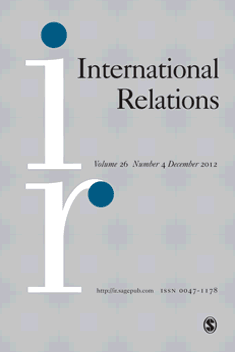
International Relations
Exploring the complexities of international dynamics.International Relations is a premier journal dedicated to advancing the field of political science and international relations, published by SAGE Publications Ltd in the United Kingdom. With its ISSN 0047-1178 and E-ISSN 1741-2862, this journal has served as a critical platform for scholarly discourse since its inception, covering a wide range of themes from global governance to security studies. Having achieved a Q1 ranking in the 2023 category quartiles for Political Science and International Relations, it stands out among a selective group of influential academic publications, ranking #145 out of 706 in its field, placing it in the 79th percentile according to Scopus metrics. The journal operates under a traditional subscription model, catering to a diverse audience of researchers, academics, and professionals who seek to contribute to and engage with emerging ideas and debates. The objective of International Relations is to foster innovative research that addresses the intricate dynamics shaping international interactions, thus providing vital insights that inform policy-making and theoretical developments alike. As such, it remains an essential resource for anyone committed to understanding and influencing the future of global affairs.
Revista UNISCI
Exploring Critical Issues in an Interconnected WorldRevista UNISCI is a distinguished open-access journal published by UNIV COMPLUTENSE MADRID, SERVICIO PUBLICACIONES, dedicated to advancing the discourse in the fields of Political Science and International Relations. Since its inception in 2005, it has established a platform for emerging scholars and seasoned researchers alike to share innovative ideas and findings. With an E-ISSN of 2386-9453, Revista UNISCI is accessible to a global audience, facilitating knowledge dissemination in an increasingly interconnected world. The journal has been categorized in Q4 quartile for 2023, highlighting its relevance in the competitive landscape of academic publishing, while its Scopus rank of 566 out of 706 positions it among the prominent voices in the discipline. As the journal enters its converged years from 2015 to 2024, it aims to foster interdisciplinary dialogue and contribute to ongoing research debates, ultimately enriching the academic community’s understanding of critical global issues.