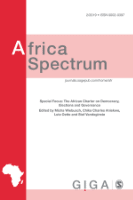
Africa Spectrum
Scope & Guideline
Exploring the Depths of African Perspectives
Introduction
Aims and Scopes
- Interdisciplinary Research on African Studies:
The journal encompasses a wide range of disciplines including politics, sociology, history, cultural studies, and economics, thereby promoting a holistic understanding of African issues. - Focus on Agency and Identity:
There is a consistent emphasis on exploring the concepts of agency, identity, and belonging, particularly in the context of marginalized groups and communities in Africa. - Critical Examination of Historical Narratives:
The journal seeks to challenge and reinterpret historical narratives related to colonialism, post-colonialism, and contemporary socio-political dynamics, highlighting African perspectives. - Analysis of Governance and Political Dynamics:
Research often investigates governance structures, political participation, and the impact of global influences on local politics, with a focus on both state and non-state actors. - Sustainability and Development Issues:
The journal addresses topics related to sustainable development, resource management, and the socio-economic challenges facing African nations, often from a critical lens. - Cultural and Social Movements:
It engages with the dynamics of cultural production, social movements, and the impact of digital media on public discourse and political engagement.
Trending and Emerging
- Digital Politics and Media Influence:
There is a growing trend towards analyzing the role of digital platforms, such as TikTok, in shaping political discourse and engagement, reflecting the importance of new media in contemporary African politics. - Transnational Relationships and Globalization:
Emerging themes focus on the interconnectedness of African nations with global powers, particularly in the context of Sino-African relations, showcasing the impact of globalization on local contexts. - Youth and Demographic Changes:
Research increasingly addresses the implications of Africa's youthful population, with a focus on youth agency, activism, and the socio-economic challenges they face, thus highlighting the demographic transition. - Decolonial Perspectives and Knowledge Production:
A significant trend is the exploration of decoloniality and the critique of traditional knowledge production frameworks, emphasizing the need for African voices and perspectives in academia. - Gender and Sexuality in Contemporary Contexts:
There is an emerging focus on gender and sexuality, particularly in relation to masculinity studies, reflecting a more nuanced understanding of gender dynamics in African societies.
Declining or Waning
- Traditional Ethnographic Studies:
There appears to be a reduction in the focus on traditional ethnographic studies, which may be due to a shift towards more contemporary issues and methodologies that emphasize quantitative analysis or digital engagement. - Historical Colonial Studies:
While historical perspectives remain relevant, the frequency of articles solely dedicated to colonial studies has diminished, likely as scholars seek to connect historical contexts to current issues. - Regionalism and Localized Studies:
There is a noticeable decrease in papers centered on specific regional studies within Africa, indicating a potential move towards broader, pan-African analyses or comparative studies. - Gender Studies in Isolation:
Although gender issues are still present, there seems to be less emphasis on gender studies as standalone topics, with a trend towards integrating gender analysis within broader socio-political discussions. - Single-issue Environmental Studies:
The journal has shifted from focusing on isolated environmental issues towards more integrated discussions that include socio-economic and political dimensions of environmental challenges.
Similar Journals

African Journal of Rhetoric
Fostering Critical Conversations Across CulturesThe African Journal of Rhetoric, ISSN 1998-2054, is a leading publication dedicated to the study and advancement of rhetorical theory and practice within the African context. Published by the African Association of Rhetoric, this journal seeks to amplify diverse voices and perspectives, fostering critical dialogue and innovative research in the fields of communication, linguistics, and social sciences. With a commitment to promoting open discourse, the journal provides valuable insights into rhetorical strategies, cultural narratives, and their implications on society, making it an indispensable resource for researchers, professionals, and students alike. The journal is based in Cape Town, South Africa, an epicenter of cultural and intellectual exchange, and encourages submissions that explore the intersection of rhetoric and contemporary issues. As we embrace the evolving landscape of communication, the African Journal of Rhetoric aims to be a pivotal platform for scholarship that bridges local and global dialogues in the study of rhetoric.
International Journal of Korean History
Unlocking the Secrets of Korea's Cultural LegacyInternational Journal of Korean History, published by Korea University, Center for Korean History, is a leading academic journal dedicated to the exploration and dissemination of research on Korean history, culture, and literature. Since its establishment in 2000, the journal has embraced an Open Access model, ensuring that groundbreaking scholarship is freely accessible to researchers, professionals, and students worldwide. With an ISSN of 1598-2041 and an E-ISSN of 2508-5921, the journal has shown impressive rankings, currently holding a Q3 category in both Cultural Studies and History, and a Q2 category in Literature and Literary Theory as of 2023. Its Scopus rankings further highlight its academic significance, sitting in the 81st percentile for Literature and Literary Theory and maintaining a strong presence in related fields. Operating from Seoul, South Korea, the International Journal of Korean History serves as a vital platform for scholarly dialogue and research dissemination, contributing significantly to the global understanding of the intricate narratives that shape Korean history.
JOURNAL OF CONTEMPORARY ASIA
Connecting Scholars to the Heart of Asian Socio-Cultural DiscourseThe Journal of Contemporary Asia, published by Routledge Journals, Taylor & Francis Ltd, is an esteemed academic platform that explores pivotal issues and developments within the fields of Cultural Studies and Social Sciences. With an impressive impact factor signified by its Q1 category rankings in both domains and its remarkable positions of Rank #38 in Cultural Studies and Rank #59 in Social Sciences (miscellaneous) as per Scopus, this journal has emerged as a leading source of interdisciplinary research since its inception in 1970. Spanning relevant topics in contemporary Asian studies, it serves as an essential resource for researchers, professionals, and students aiming to deepen their understanding of the socio-cultural dynamics of the region. While currently offering subscription-based access options, its invaluable insights contribute significantly to advancing scholarship and informed discourse in contemporary Asian studies.
Telos
Fostering critical analysis across the humanities and social sciences.Telos is a leading academic journal published by TELOS PRESS LTD, specializing in the interdisciplinary fields of cultural studies, philosophy, sociology, and political science. With an ISSN of 0090-6514 and E-ISSN 1940-459X, Telos has carved out a significant niche in contemporary discourse, providing a platform for critical analysis and innovative thought. The journal, based in the United States, has demonstrated its impact through its classification in the Q2 category for both cultural studies and philosophy, and is recognized within the Q3 category in sociology and political science. Its Scopus rankings further affirm its influence in the academic community, emphasizing its commitment to advancing scholarly debate and engagement. Although not an open-access publication, it fosters a rich environment for researchers, professionals, and students seeking to explore the intersections of culture, ideology, and social structures. With converged years from 2010 to 2024, Telos remains a pivotal repository of knowledge and a catalyst for dialogue in the humanities and social sciences.

LATIN AMERICAN RESEARCH REVIEW
Empowering scholars with open access to vital research.LATIN AMERICAN RESEARCH REVIEW, published by Cambridge University Press, is a premier open-access journal dedicated to advancing scholarship in the field of Latin American studies. Established in 1970, the journal has consistently evolved to address critical interdisciplinary issues, encompassing a broad spectrum of topics from anthropology and cultural studies to economics and political science. With its strong impact reflected in 2023's quartile rankings, including Q1 in both Cultural Studies and History, LATIN AMERICAN RESEARCH REVIEW ranks among the top-tier journals in multiple disciplines, capturing the interest of scholars worldwide. This journal not only fosters a deeper understanding of Latin America's diverse cultures, histories, and socioeconomic landscapes but also serves as a vital platform for innovative research and discussions. By offering open access since 2017, it ensures that its valuable contributions are widely disseminated, making it an indispensable resource for researchers, professionals, and students alike who are looking to engage with contemporary Latin American issues.

Comunicacion y Sociedad-Guadalajara
Empowering voices through accessible academic discourse.Comunicacion y Sociedad-Guadalajara is a distinguished peer-reviewed journal published by UNIV GUADALAJARA that plays a vital role in the field of communication studies. With an ISSN of 0188-252X and an E-ISSN of 2448-9042, this journal has embraced Open Access since 2023, ensuring that groundbreaking research is accessible to a wider audience. Hailing from Mexico, it serves as a platform for innovative research and critical discourse in communication, ranking Q2 in the Communication category and securing a notable Scopus rank of #[232/511, positioning it within the top 54th percentile of its field. Covering converged years from 2009 to 2010 and from 2013 to 2024, the journal's objective is to foster scholarly dialogue and advance knowledge across diverse aspects of communication. With a commitment to excellence, Comunicacion y Sociedad-Guadalajara stands as an essential resource for researchers, professionals, and students seeking to engage with contemporary issues in communication.
Connectist-Istanbul University Journal of Communication Sciences
Advancing Communication Through Open DialogueConnectist-Istanbul University Journal of Communication Sciences is a distinguished academic publication under the auspices of Istanbul University, Faculty of Communication, dedicated to advancing the field of communication studies. Since its inception, this Open Access journal has facilitated the dissemination of groundbreaking research and innovative methodologies, particularly since it embraced an open access model in 2017, promoting wider accessibility and engagement. As a pivotal resource for researchers, practitioners, and students alike, Connectist fosters interdisciplinary dialogue, exploring contemporary issues in communication, media studies, and related disciplines. With a commitment to rigorous peer review and scholarly excellence, the journal serves as an essential platform for cutting-edge insights and developments in communication sciences, thereby contributing significantly to the academic community and beyond.

Bresil-s
Advancing Knowledge on Brazil's Dynamic LandscapeBresil-s is a premier scholarly journal dedicated to the multidisciplinary exploration of Brazilian studies, encompassing socio-economic, political, and cultural dimensions. Published by the Ecole Hautes Etudes & Sciences Sociales, Centre Recherches Bresil Contemporain, this journal has established itself as a vital platform for researchers, professionals, and students interested in contemporary Brazil. With its Open Access policy in place since 2012, Bresil-s ensures that high-quality research is readily available to a global audience, promoting knowledge dissemination and collaboration. The journal thrives to bridge the gap between academic inquiry and real-world implications, making significant contributions to the understanding of Brazilian society and its complexities. The ISSN 2257-0543 and E-ISSN 2425-231X provide easy access to its diverse array of articles, which contribute to ongoing discussions within the field. Whether you are a researcher seeking to publish your findings or a student eager to learn from the latest studies, Bresil-s offers invaluable insights into Brazil's contemporary landscape.

Historia y Comunicacion Social
Exploring the Intersections of History and Communication.Historia y Comunicación Social is a distinguished academic journal published by UNIVERSIDAD COMPLUTENSE MADRID, SERVICIO PUBLICACIONES, dedicated to the interdisciplinary exploration of history and communication. With a notable impact factor reflected in its impressive rankings across various categories—Q1 in History and Q2 in Communication and Sociology/Political Science—this journal stands out as a critical resource for scholars and practitioners alike. Established as an Open Access platform since 1996, it has broadened accessibility to research, fostering innovative discussions and insights from the historical and communicative realms. Spanning from 2010 to 2024, the journal encourages contributions that challenge conventional narratives and offer fresh perspectives. With its significant recognition in Scopus rankings, inclusive of a remarkable 88th percentile in Arts and Humanities History, Historia y Comunicación Social serves as a vital hub for those seeking to deepen their understanding of the complex interplay between history and communication.

Anaquel de Estudios Arabes
Bridging Cultures Through Academic InquiryAnaquel de Estudios Arabes is a distinguished academic journal dedicated to the field of Arab studies, offering a platform for original research and critical discussions that span various disciplines. Published by UNIV COMPLUTENSE MADRID, SERVICIO PUBLICACIONES, this journal has established itself as a vital resource since it became Open Access in 2014, facilitating global dissemination of knowledge. With an ISSN of 1130-3964 and E-ISSN 1988-2645, the journal operates from Madrid, Spain, and supports a diverse range of topics related to history, linguistics, literature, and religious studies, earning esteemed Q2 and Q3 rankings in these categories as of 2023. Researchers, professionals, and students alike benefit from the journal's commitment to quality, reflected in its Scopus rankings across several related fields. As it approaches a pivotal period from 2019 to 2024, the Anaquel de Estudios Arabes continues to contribute significantly to the intellectual landscape of Arab studies, engaging scholars who seek to deepen their understanding of the complex cultural and linguistic heritage of the Arab world.