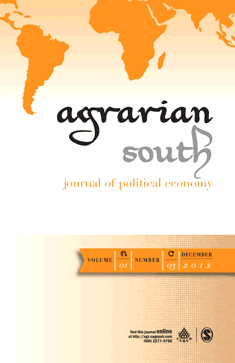
Agrarian South-Journal of Political Economy
Scope & Guideline
Uncovering the Socio-Political Dimensions of Agrarian Challenges
Introduction
Aims and Scopes
- Agrarian Transformations and Political Economy:
The journal explores the dynamics of agrarian change and its implications for political economy, particularly in the Global South. This includes examining land reforms, agrarian policies, and their socio-economic impacts on rural populations. - Social Movements and Collective Action:
A core focus is on grassroots movements, resistance, and the role of collective action in shaping agrarian relations. The journal highlights case studies of social movements advocating for land rights, labor rights, and environmental justice. - Ecological and Environmental Justice:
The journal aims to address the socio-ecological dimensions of agrarian issues, exploring topics such as sustainability, ecological transitions, and the impacts of climate change on rural livelihoods. - Cultural and Historical Analyses:
It provides a space for historical and cultural analyses of agrarian societies, investigating how cultural identities, race, and gender intersect with agrarian issues and political economy. - Comparative and Contextual Studies:
The journal frequently publishes comparative studies that analyze agrarian issues across different geographical and socio-political contexts, enriching the understanding of global agrarian dynamics.
Trending and Emerging
- Ecological Transition and Sustainability:
A growing number of articles focus on ecological transitions, emphasizing sustainable agricultural practices, climate resilience, and the interplay between agrarian systems and environmental justice. - Intersectionality in Agrarian Studies:
There is an increasing emphasis on intersectionality, particularly concerning gender, caste, and ethnicity within agrarian contexts. This trend highlights the diverse experiences and challenges faced by different groups in rural areas. - Global South Solidarity and Movements:
Emerging themes include discussions on solidarity among Global South countries, particularly in the context of social movements and collective action against neoliberal policies and imperialism. - Value Chains and Economic Imperialism:
Recent publications are critically analyzing agricultural value chains, exploring how they are structured by global economic forces and their implications for local farmers and communities. - Political Ecology and Environmental Justice:
The journal is increasingly focusing on political ecology frameworks that address the relationships between power, ecology, and agrarian struggles, highlighting the importance of environmental justice in rural contexts.
Declining or Waning
- Traditional Agricultural Practices:
There has been a noticeable decline in publications focusing on conventional agricultural methods and practices. The current trend emphasizes innovative approaches and sustainability, overshadowing discussions on traditional agriculture. - Rural Industrialization:
The theme of rural industrialization appears to be waning, with fewer studies exploring the relationship between industrial development and rural communities. Recent publications are more inclined toward social movements and ecological aspects. - Individual Land Ownership Issues:
Discussions centered around individual land ownership disputes are becoming less frequent. The journal's focus has shifted toward collective land rights and community-based approaches, reflecting broader social movements. - Global North Perspectives:
Articles focusing on agrarian issues from a Global North perspective have diminished, as the journal increasingly prioritizes voices and perspectives from the Global South to address its core mission. - Historical Agrarian Economies:
While historical analyses remain important, there is a reduction in focus on agrarian economies of the past. The journal now leans more toward contemporary issues and current transformations in agrarian societies.
Similar Journals
Critical Historical Studies
Illuminating Historical Methodologies for Tomorrow's ScholarsCritical Historical Studies is a distinguished peer-reviewed journal published by University of Chicago Press, dedicated to advancing the discourse in the field of history. Since its inception in 2015, it has carved out a significant niche, achieving a remarkable Q1 ranking in the history category for 2023 and placing 219th out of 1760 in the Scopus Arts and Humanities History rankings, reflecting its profound impact and reputation in the field. The journal's scope encompasses a wide range of historical analyses, fostering critical engagement with historical methodologies and interpretations. Although not an open access publication, Critical Historical Studies provides a valuable platform for researchers, professionals, and students alike, encouraging scholarly dialogue and the exploration of innovative perspectives in historical study. With a vibrant editorial board and a commitment to publishing high-quality research, this journal is essential for those looking to deepen their understanding of historical processes and narratives.
South Asia Research
Connecting Scholars to South Asia's Rich Tapestry of KnowledgeSouth Asia Research, published by SAGE Publications India Pvt Ltd, is a prestigious academic journal dedicated to the exploration and analysis of socio-economic, cultural, and political dynamics within South Asia. Established in 1981, this journal has become a vital resource for scholars, researchers, and practitioners interested in the region's multifaceted issues. With an impressive reputation reflected in its Q2 category rankings across various disciplines—Arts and Humanities, Economics, and Social Sciences—it maintains a commendable position within the academic community. Although it is not an open-access journal, the insights published are invaluable for advancing knowledge and sparking dialogue about South Asia's development and challenges. By providing a platform for rigorous research and interdisciplinary collaboration, South Asia Research plays a crucial role in shaping contemporary discourse in the region and beyond.
Journal of Agrarian Change
Advancing Interdisciplinary Insights into Agrarian StudiesJournal of Agrarian Change is a premier academic journal published by WILEY, dedicated to advancing the understanding of agrarian studies within the fields of anthropology, archaeology, and environmental science. With an impressive convergence of scholarly contributions since its inception in 2001 and extending through 2024, the journal proudly holds a Q1 ranking in Anthropology and Archaeology, reflecting its commitment to high-impact research. With an ISSN of 1471-0358 and an E-ISSN of 1471-0366, the Journal strives to foster interdisciplinary dialogue and innovation, providing a reputable platform for researchers, professionals, and students alike. Although it currently does not offer open access, the journal's extensive reach and significant citation metrics, evidenced by its high Scopus rankings—such as Rank #12 in Social Sciences & Archaeology and Rank #19 in Anthropology—underscore its vital role in shaping discourse on agrarian change. The Journal of Agrarian Change is essential reading for those seeking to explore the intricate relationships between social, cultural, and environmental dimensions of agrarian systems.
Social Movement Studies
Connecting Theory and Practice in Social MovementsSocial Movement Studies, published by ROUTLEDGE JOURNALS, TAYLOR & FRANCIS LTD, is a premier academic journal dedicated to the interdisciplinary exploration of social movements, their dynamics, impacts, and the sociopolitical contexts in which they arise. With an ISSN of 1474-2837 and an E-ISSN of 1474-2829, this journal plays a pivotal role in the fields of Cultural Studies, Sociology, and Political Science, as evidenced by its impressive Q1 ranking in these categories for 2023. The journal's significant position is further underscored by its Scopus rankings, placing it in the 99th percentile for Cultural Studies and the 95th for Sociology and Political Science, indicating its substantial contribution to scholarly discourse. Although not open access, the journal fosters a rich publication environment from 2010 to 2024, encouraging rigorous empirical research and theoretical innovation that enriches our understanding of grassroots mobilization and collective action. Scholars, professionals, and students alike will find a wealth of insights and critical analyses that empower them to engage effectively with contemporary social issues.

Global Labour Journal
Empowering voices in global labor discourse and policy.Global Labour Journal is a prominent interdisciplinary publication dedicated to advancing the understanding of labor issues in a global context. Published by McMaster University, this open-access journal has been facilitating the sharing of innovative research since 2010, allowing unrestricted access to a diverse audience of researchers, professionals, and students. With its commitment to fostering dialogue on labor rights, social justice, and employment trends worldwide, the journal aims to serve as a crucial platform for the dissemination of knowledge and policy suggestions that address the contemporary challenges facing workers across various sectors. Engaging articles and empirical studies featured in the Global Labour Journal not only contribute to academic discourse but also have practical implications, influencing policymakers and stakeholders in the field. As the conversation around labor issues continues to evolve, this journal remains an essential resource for anyone seeking to deepen their understanding of the complexities of work in a globalized world.
Pampa
Fostering Innovation: Your Gateway to Research in the Pampas.Pampa is a distinguished academic journal dedicated to the exploration and dissemination of research across various disciplines, with a special focus on regional studies and environmental issues prevalent in the Pampas region of Argentina. Published by EDICIONES UNL, this open access journal has been providing researchers, professionals, and students with vital insights and current developments in the field since its inception in 2005. With its ISSN 1669-3299 and E-ISSN 2314-0208, Pampa prioritizes accessibility and visibility, ensuring that scholarly work is freely available to a global audience. Researchers are encouraged to submit their findings and contribute to the ongoing dialogue within this vibrant and critical area of study. By promoting open access to significant research, Pampa enhances collaborative efforts and fosters innovation within the academic community.
Rural History-Economy Society Culture
Exploring the Tapestry of Rural Life Through History, Economy, and Culture.Rural History: Economy Society Culture is a vital academic journal dedicated to exploring the multifaceted aspects of rural history from economic, societal, and cultural perspectives. Published by Cambridge University Press, this journal contributes substantially to the field by presenting innovative research that spans a range of disciplines, including history, geography, and urban studies. With a convergence of scholarship from 1990 through 2024, this journal holds significant rankings in the top quartiles of its categories, particularly excelling in History where it ranks in the Q2 quartile. It also demonstrates respectable positions in other arts and humanities domains, reflecting its considerable impact, especially in history-related studies, where it sits in the 76th percentile. While not open access, it provides valuable insights for researchers, professionals, and students passionate about understanding the dynamics of rural societies and their historical underpinnings. For scholars aiming to contribute to this rich dialogue, Rural History serves as an essential platform for disseminating significant findings and advancing knowledge in the field.

LATIN AMERICAN PERSPECTIVES
Illuminating Diverse Perspectives in Latin AmericaLATIN AMERICAN PERSPECTIVES is a leading academic journal dedicated to the critical examination of Latin American social, political, and economic issues. Published by SAGE Publications Inc, this journal boasts an impact in the disciplines of Geography, Planning and Development, Sociology, and Political Science, as reflected in its Q2 rankings for 2023. With its subscription model, it ensures broad accessibility to cutting-edge research and diverse perspectives on Latin American studies. Established in 1977 and converging in publication years from 1984 to the present, the journal features articles that advance scholarly discourse and foster interdisciplinary dialogue among researchers, professionals, and students alike. Recognized in Scopus for its contributions, LATIN AMERICAN PERSPECTIVES continues to be a pivotal resource for those seeking to deepen their understanding of complex regional dynamics and contribute to the global conversation surrounding Latin America.
Mundo Agrario
Connecting history with contemporary agricultural practices.Mundo Agrario is a reputable open-access journal published by Universidad Nacional de La Plata, Facultad de Humanidades y Ciencias de la Educación, specializing in the interdisciplinary fields of Agricultural and Biological Sciences, Geography, History, and Urban Studies. Established in 2000, this journal has become an essential platform for scholars and practitioners alike, promoting innovative research and discussions that address critical issues in the agricultural and social landscapes of Argentina and beyond. With a commitment to enhancing accessibility to scholarly work, Mundo Agrario is indexed in multiple categories, including a Q4 ranking in Agricultural and Biological Sciences and Geography, and a Q2 ranking in History, reflecting its diverse scholarly contributions. The journal encourages submissions that explore the intersection of agricultural practices, urban development, and historical perspectives, thus fostering a comprehensive understanding of the societal implications of these disciplines. For researchers, professionals, and students looking to stay informed about trends and discoveries in these areas, Mundo Agrario remains a vital resource for knowledge dissemination and academic exchange.
SOCIOLOGICAL INQUIRY
Fostering Scholarly Excellence Since 1961Sociological Inquiry is a premier journal in the field of sociology, published by Wiley, which has established its reputation through rigorous peer review and scholarly excellence since its inception in 1961. The journal carries the ISSN 0038-0245 and E-ISSN 1475-682X, and is located in the vibrant academic landscape of the United Kingdom. With a notable impact factor and ranked in the Q1 category in Sociology and Political Science, it stands among the top 17% of journals in its field, as indicated by its Scopus rank of 250 out of 1466, reflecting an impressive 82nd percentile. The objective of Sociological Inquiry is to advance the understanding of social phenomena through empirical and theoretical contributions, aiming to foster dialogue among sociologists, political scientists, and interdisciplinary scholars. Despite not offering open access options, this journal remains vital for anyone looking to engage with cutting-edge research that shapes contemporary sociological thought and practice.