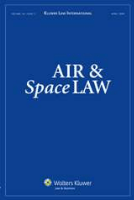
Air & Space Law
Scope & Guideline
Navigating the Legal Skies and Beyond
Introduction
Aims and Scopes
- Aviation Law and Passenger Rights:
The journal extensively covers legal issues related to aviation law, including passenger rights, liability under international conventions such as the Montreal Convention, and recent case law developments. - Space Law and Governance:
It focuses on the evolving landscape of space law, addressing regulatory challenges, international treaties, and the implications of new technologies in outer space. - International and Comparative Law:
The journal provides comparative analyses of legal systems, particularly in the context of EU and US law, exploring how different jurisdictions address similar issues in aviation and space. - Emerging Technologies and Cybersecurity:
A significant area of focus is the legal implications of emerging technologies, including drones and cybersecurity in aviation and space, highlighting the need for new regulatory frameworks. - Environmental and Sustainability Issues:
The journal discusses the intersection of aviation and space law with environmental concerns, exploring sustainable practices and regulatory measures to address climate change.
Trending and Emerging
- Cybersecurity Regulations:
Recent publications indicate a growing emphasis on cybersecurity within aviation and space law, highlighting the need for robust regulatory frameworks to address potential threats. - Commercial Space Activities and Liability:
There is an increasing focus on the legal frameworks surrounding commercial space activities, particularly concerning liability and regulatory compliance for new space ventures. - Sustainability and Environmental Regulations:
Emerging themes include discussions on sustainability and environmental impact, particularly in aviation, as regulatory bodies seek to align with global environmental goals. - Impact of COVID-19 on Aviation Law:
The journal has explored the legal ramifications of the COVID-19 pandemic on aviation, including state aid, passenger rights, and operational adjustments, reflecting the industry's adaptive responses. - Drones and Unmanned Systems Regulation:
The regulation of drones and unmanned systems is increasingly prominent, addressing legal challenges unique to this rapidly developing sector and its integration into existing aviation frameworks.
Declining or Waning
- Traditional Aviation Liability Issues:
There appears to be a waning focus on traditional aviation liability topics, such as basic contractual disputes and classic negligence cases, as newer, more complex issues emerge. - General International Relations in Aviation:
Discussions surrounding general international relations and diplomatic issues in aviation have decreased, possibly replaced by more specific regulatory and legal challenges. - Historical Analyses of Aviation Law:
The journal has shifted away from historical analyses of aviation law, indicating a preference for contemporary issues and practical legal applications rather than retrospective examinations.
Similar Journals
International Journal of Law and Information Technology
Navigating the Nexus of Law and Technology.The International Journal of Law and Information Technology, published by Oxford University Press, stands as a leading forum for the exploration of the evolving intersection between law and information technology. With its ISSN 0967-0769 and E-ISSN 1464-3693, this esteemed journal has been at the forefront of academic discourse since its inception in 1993 and is poised to continue influencing the landscape of legal scholarship and information sciences until at least 2024. With a prestigious categorization in the Q2 quartile for both Law and Library and Information Sciences, the journal is prominently ranked in the 76th and 64th percentiles respectively within Scopus rankings. Offering insights on vital themes such as privacy, intellectual property, and technological regulation, the International Journal of Law and Information Technology provides a valuable resource for researchers, practitioners, and students alike, facilitating a deeper understanding of the legal challenges and opportunities presented by technological advancements. While not an open-access publication, the rigorous peer-reviewed articles serve to enrich the global academic community’s knowledge in this critical and dynamic field.

VIRGINIA LAW REVIEW
Exploring the Intersection of Theory and PracticeVIRGINIA LAW REVIEW is a preeminent legal journal published by the University of Virginia Law Review Association, recognized for its rigorous scholarship and intellectual discourse in the field of law. With an ISSN of 0042-6601, this journal has maintained a prominent position in academia, reflected in its Q1 category ranking in law and a Scopus ranking of #167 out of 1025, placing it in the top 17% of its field. Drawing upon a rich tradition dating back to its inception in 1967 and covering a broad spectrum from legal theory to practical applications, the Virginia Law Review aims to foster innovative legal thought and engage both scholars and practitioners. While it does not currently operate under an open access model, its contributions to scholarly research are invaluable, providing insights that significantly influence legal practices and policies. Situated in Charlottesville, Virginia, at 580 Massie Road, this esteemed publication appeals to researchers, legal professionals, and students alike, making it an essential resource for anyone eager to delve into the complexities of contemporary legal issues.
BRICS Law Journal
Bridging Legal Perspectives in a Dynamic RegionBRICS Law Journal is a prominent peer-reviewed publication dedicated to the exploration and critical analysis of legal issues pertinent to the BRICS nations—Brazil, Russia, India, China, and South Africa. Published by LLC V EM PUBLISHING HOUSE, this journal has established itself as an essential resource since its inception in 2014, offering Open Access to foster global research dissemination and collaboration. With an impact factor that reflects its academic rigor, the journal has achieved a commendable Q2 ranking in the field of Law as per the 2023 category quartiles. It is indexed in Scopus, where it holds a rank of #615/1025 in Social Sciences—Law, showcasing its relevance and influence within the legal scholarly community. The BRICS Law Journal aims to address contemporary legal challenges and policy developments in the region, making it a vital resource for researchers, practitioners, and students seeking to engage with the evolving legal landscape and contribute to the discussions that shape the future of law in these diverse nations.

CORNELL INTERNATIONAL LAW JOURNAL
Empowering practitioners with essential insights in international law.CORNELL INTERNATIONAL LAW JOURNAL, published by CORNELL LAW SCHOOL, is a premier academic journal dedicated to advancing scholarship in the fields of law, political science, and international relations. Established with a commitment to fostering critical dialogue, this journal provides a platform for innovative research and legal analysis on pressing global issues. With an ISSN of 0010-8812 and an E-ISSN of 1930-7977, CORNELL INTERNATIONAL LAW JOURNAL holds a respectable Q3 ranking in the 2023 categories of Law, and Political Science and International Relations, underscoring its relevance within the academic community. The journal is indexed in Scopus, achieving a rank of #416 in Law and #345 in Political Science, illustrating its significant impact and accessibility. By providing essential insights, this journal aims to serve not only academics but also practitioners and policymakers interested in the evolving landscape of international law and governance.

Revista General de Derecho Europeo
Championing Quality Scholarship in European Legal StudiesRevista General de Derecho Europeo is a prestigious academic journal dedicated to the study of European law, published by IUSTEL, a notable publisher recognized for its commitment to legal scholarship. This journal serves as a vital platform for the dissemination of cutting-edge research, fostering dialogue among scholars, practitioners, and policymakers in the field of European legal studies. With an ISSN of 1696-9634, it provides no-cost access to a diverse range of articles, ensuring that the latest developments in European jurisprudence are readily available to a broad audience. Although specific impact metrics such as the H-index are not detailed, the journal’s emphasis on quality and relevance positions it as an essential resource for anyone engaged in exploring the complexities of European law, its implications, and its evolution within a global context. Revista General de Derecho Europeo not only contributes to academic discourse but also equips its readers with critical insights necessary for navigating contemporary legal challenges in Europe.
China-EU Law Journal
Illuminating the Intersection of Law and GeopoliticsChina-EU Law Journal, published by SPRINGER HEIDELBERG, serves as a pivotal platform for discourse in the field of international law, particularly focusing on the legal dynamics between China and the European Union. With its ISSN 1868-5153 and E-ISSN 1868-5161, the journal caters to a growing audience interested in understanding the complexities of legal relations, policy frameworks, and regulatory challenges that arise within this crucial geopolitical arena. Although currently not labeled as open access, the journal strives to provide rigorous peer-reviewed articles that contribute significant insights into the evolving legal landscape, making it an essential resource for researchers, practitioners, and students alike. By fostering scholarly dialogue, the China-EU Law Journal aims to enhance the academic community's understanding of cross-cultural legal perspectives, further cementing its role in shaping modern legal thought.

European Journal of International Law
Elevating scholarly excellence in international legal studies.The European Journal of International Law (EJIL), published by Oxford University Press, stands as a leading platform for the dissemination of innovative research in the realms of International Law and Political Science. With an impressive ISSN of 0938-5428 and E-ISSN of 1464-3596, this prestigious journal has achieved Q1 rankings in both Law and Political Science and International Relations categories as of 2023, emphasizing its significance among contemporary scholarly publications. Spanning contributions from a diverse range of disciplines, the EJIL serves as an essential resource for researchers, professionals, and students alike, promoting critical dialogue on pressing international legal issues. Although currently not offered as an open-access journal, it continues to retain a high impact factor, as evidenced by its substantial Scopus rankings, placing it within the top percentiles in multiple categories. Its commitment to scholarly excellence is reflected in a convergence of research trends from 2005 to 2024, and it remains dedicated to fostering informed discourse on global legal frameworks and their implications.

Journal of East Asia and International Law
Innovating Legal Thought for a Changing International LandscapeThe Journal of East Asia and International Law, published by the YIJUN Institute of International Law, serves as a vital platform for scholarly discourse in the field of law, with a particular focus on the complexities of East Asian legal systems and their interactions within the global context. Established in 2011 and based in Seoul, South Korea, this journal has been pivotal in fostering research that examines legal issues impacting East Asia, making significant contributions to the understanding of international law in this dynamic region. With its ISSN 1976-9229, the journal provides a valuable resource for researchers, professionals, and students interested in the evolving legal landscapes of East Asia. Though currently categorized in the Q4 quartile for law in the Scopus rankings, its dedication to enhancing legal scholarship positions it as a relevant player among emerging international law journals, encouraging submissions that explore innovative legal approaches and analyses. As ongoing interdisciplinary discussions deepen, the Journal of East Asia and International Law aims to enrich the academic community's understanding of international legal frameworks within East Asian contexts.

Utrecht Journal of International and European Law
Pioneering Research for a Global CommunityUtrecht Journal of International and European Law, published by UBIQUITY PRESS LTD, serves as a dynamic platform for the dissemination of scholarly research in the realms of international and European law. Since its inception as an open-access journal in 2013, it has provided unrestricted access to cutting-edge legal scholarship, fostering global dialogue among legal professionals, researchers, and students. With a notable Scopus rank of 249 out of 1,025 in the law category and a commendable Q3 rating, the journal emphasizes innovative legal theories and practices relevant to contemporary global challenges. Located in the heart of the United Kingdom, the Utrecht Journal is committed to maintaining high academic standards while also promoting the exchange of knowledge across borders, which is crucial given the ever-evolving landscape of international law. As it converges its focus from 2020 to 2024, the journal seeks to become an essential reference for those dedicated to the exploration and expansion of legal discourse in this vital field.
Revista Electronica de Estudios Internacionales
Navigating the Complexities of Global AffairsRevista Electronica de Estudios Internacionales is a prominent academic journal dedicated to the exploration of international studies, published by the esteemed ASOC ESPANOLA PROFESORES DERECHO INT & RELACIONES INT-AEPDIRI. Based in Spain, this journal has embraced an Open Access model since its inception in 2000, allowing researchers, students, and professionals to freely access and disseminate significant findings in the field. With an ISSN of 1697-5197, the journal highlights critical issues surrounding international law and relations, maintaining a vital role in the ongoing discourse within the academic community. Currently categorized as Q4 in the Law field and ranked #755 out of 1025 within the Scopus database, the journal offers a platform for innovative thinking and scholarly contributions, which are particularly important in today's rapidly evolving global scenario. Explore the latest research and insights from 2019 to 2023 in this essential resource for those engaged in the study and practice of international relations.