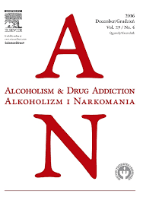
Alkoholizm i Narkomania-Alcoholism and Drug Addiction
Scope & Guideline
Transforming addiction research through open access.
Introduction
Aims and Scopes
- Substance Use Disorders:
The journal addresses various aspects of substance use disorders, including alcohol dependence, drug addiction, and gambling addiction, emphasizing the need for comprehensive treatment approaches. - Psychosocial Factors:
Research often explores psychosocial determinants of addiction, such as family dynamics, emotional regulation, and social stigma, providing insights into the complex interplay between individual behavior and societal influences. - Preventive and Therapeutic Interventions:
The journal highlights innovative therapeutic interventions and prevention strategies for addiction, including group therapy, self-help methods, and community programs. - Public Health Perspectives:
Public health implications of substance use, including epidemiological studies, impact of policy changes (e.g., taxation), and awareness campaigns, are critical areas of focus. - Methodological Diversity:
A range of methodologies is utilized, from qualitative studies exploring personal experiences to quantitative research assessing prevalence and treatment efficacy.
Trending and Emerging
- Co-occurring Disorders:
There is an increasing focus on the treatment of co-occurring disorders, such as gambling and substance use, highlighting the complex nature of addiction and the need for integrated treatment strategies. - Impact of New Psychoactive Substances:
Research on the recreational use and societal impact of emerging drugs, particularly fentanyl, has gained traction, emphasizing the urgent need for public health responses. - Gender and Addiction:
Explorations of gender differences in addiction experiences and treatment responses are becoming more prevalent, reflecting a broader understanding of how addiction affects diverse populations. - Digital and Online Behaviors:
The rise of internet-related issues, including problematic internet use and its relationship to mental health, is increasingly featured, particularly among adolescents. - Community and Family Dynamics:
Studies examining the influence of family factors and community support systems on addiction recovery are trending, indicating a shift towards understanding addiction in broader social contexts.
Declining or Waning
- Historical Perspectives on Substance Use:
Research focusing on historical analyses of substance use, such as drug use trends in past decades, has become less common, possibly overshadowed by contemporary issues and emerging substances. - Simple Prevalence Studies:
Basic prevalence studies are being phased out in favor of more nuanced analyses that consider psychological, social, and environmental factors influencing substance use. - Single-Dimensional Approaches to Treatment:
There has been a noticeable decline in the publication of studies advocating for single-dimensional treatment approaches, as the field moves towards integrated and multi-faceted treatment models. - Stigmatization Research:
While still relevant, research solely focused on stigma without addressing its interaction with treatment outcomes or recovery processes appears to be waning.
Similar Journals
Suchttherapie
Empowering Minds Through Cutting-Edge ResearchSuchttherapie, an esteemed journal published by GEORG THIEME VERLAG KG, serves as a critical platform within the fields of Applied Psychology and Psychiatry and Mental Health. Established in 2000 and continuing through 2024, this journal is committed to advancing the understanding and treatment of addiction and related psychological issues. Although it currently stands in the Q4 Quartile ranking and is categorized as low percentile in both Scopus Ranks and impact metrics, its significance lies in its dedication to disseminating cutting-edge research and clinical findings that contribute to the evolving landscape of therapeutic practices. Published in Germany, the journal facilitates unlimited access to the vital discourse surrounding mental health and addiction treatment, making it a valuable resource for researchers, professionals, and students alike seeking to enhance their knowledge and skills in this important area of study. As the field continues to grow, Suchttherapie plays a pivotal role in bridging practice with academic rigor, ensuring that readers remain informed on the latest methodologies and insights.

Current Addiction Reports
Elevating addiction research to new heights.Current Addiction Reports, published by SPRINGERNATURE, is a leading journal dedicated to the comprehensive study of addiction in its various dimensions, with a particular focus on the latest clinical developments and research in Clinical Psychology and Psychiatry and Mental Health. Since its inception in 2014 and through to 2024, the journal has established itself as a pivotal resource for researchers, professionals, and students alike, currently holding a prestigious Q1 ranking in both relevant categories. With an impressive Scopus rank of #46 in Clinical Psychology and #129 in Psychiatry and Mental Health, it occupies a significant position within the field, reflecting its commitment to high-quality scholarship and impactful findings. The journal offers open access options, ensuring that vital research is readily available to a global audience. By fostering a deeper understanding of addiction trends and innovative treatment methodologies, Current Addiction Reports plays an essential role in advancing knowledge and improving clinical practices.
Journal of Substance Use
Pioneering critical insights in health and social sciences.The Journal of Substance Use is a vital resource for researchers, professionals, and students in the fields of health and social sciences, published by Taylor & Francis Inc.. With an ISSN of 1465-9891 and E-ISSN of 1475-9942, this journal has been at the forefront of substance use research since its inception in 1996 and continues to provide a platform for the dissemination of innovative findings and critical analysis up to the year 2024. Ranking in the Q3 category for both Health (Social Science) and Medicine (Miscellaneous) in the 2023 quartiles, the journal encapsulates a broad spectrum of issues related to substance use, including addiction, intervention strategies, and policy implications. Although not an open-access journal, it remains accessible to a wide audience. With its substantial role in enhancing understanding and addressing the multi-faceted challenges of substance use, the Journal of Substance Use is essential for all stakeholders aiming to contribute to research and practice in this crucial area.

PSYCHOLOGY OF ADDICTIVE BEHAVIORS
Unlocking Insights into Addictive BehaviorsPsychology of Addictive Behaviors, published by the Educational Publishing Foundation of the American Psychological Association, is a distinguished peer-reviewed journal dedicated to advancing the understanding of addiction through rigorous psychological research. With an impressive impact factor and a reputation for excellence, this journal holds a prestigious Q1 quartile ranking in Clinical Psychology, Medicine (miscellaneous), and Psychiatry and Mental Health as of 2023. Since its inception in 1993, it has provided a vital platform for the dissemination of high-quality studies, fostering collaboration and knowledge exchange amidst researchers, clinicians, and students in the mental health arena. The journal is particularly noted for its comprehensive coverage of diverse topics related to addictive behaviors, thereby contributing significantly to the field's evidence base and clinical practices. Although currently not open access, its commitment to scholarly excellence ensures that subscribers benefit from invaluable insights into the complexities of addiction. With the culmination of research spanning from 1993 to 2024, Psychology of Addictive Behaviors stands as a cornerstone for those striving to understand and combat the challenges of addiction.
Adolescent Psychiatry
Illuminating the path to better psychiatric care for youth.Adolescent Psychiatry, an esteemed publication by Bentham Science Publishers, focuses on the intricate and evolving field of adolescent mental health, covering a broad spectrum of topics relevant to both psychiatry and pediatrics. With its ISSN of 2210-6766 and E-ISSN of 2210-6774, this journal contributes significantly to its fields through rigorous research articles, clinical studies, and comprehensive reviews that enhance our understanding of adolescent psychological well-being. Operating out of the United Arab Emirates, this journal's impact is reflected in its Scopus rankings, placing it within the Q3 category of Pediatrics and Q4 in Psychiatry and Mental Health for 2023. Although not an open-access journal, it remains a vital resource for researchers, clinicians, and students seeking to advance their knowledge and practice regarding mental health issues in adolescents. With converged publication years from 2014 to 2015 and from 2019 to 2024, it continues to strive for excellence in publishing high-quality research that tackles contemporary challenges in adolescent psychiatry.
Journal of Mental Health and Human Behaviour
Connecting global minds to foster mental well-being.The Journal of Mental Health and Human Behaviour is a distinguished publication dedicated to advancing the field of mental health, focusing on innovative research and practical applications that enhance human behaviour and overall well-being. Published by WOLTERS KLUWER MEDKNOW PUBLICATIONS, this journal has been an open-access platform since 2014, enabling wider dissemination of knowledge and fostering collaboration among researchers, professionals, and students globally. With an ISSN of 0971-8990 and E-ISSN 2543-1897, it aims to provide a comprehensive array of peer-reviewed articles that cover various facets of mental health, including psychological theories, therapeutic practices, and sociocultural influences. The journal plays an integral role in bridging the gap between research and practice, making it essential for those who are committed to improving mental health outcomes and advocating for human behaviour change. Published in India, the journal not only highlights regional issues but also contributes to international discussions on mental health trends and interventions, affirming its importance in a rapidly evolving field.
DRUG AND ALCOHOL REVIEW
Transforming research into impactful practices.DRUG AND ALCOHOL REVIEW, published by Wiley, is a leading journal dedicated to advancing the scholarship in the fields of drug and alcohol research. Since its inception in 1989, this esteemed publication has provided a critical platform for the dissemination of innovative research findings, reviews, and theoretical papers, addressing pressing issues in substance use and addiction. With an impact factor that places it in the Q1 category in both Health (social science) and Medicine (miscellaneous), it ranks #78 out of 371 in the Scopus index for Health and #115 out of 398 in Medicine, reflecting its significant influence and high citation rates among scholars. The journal is committed to fostering a multidisciplinary approach, integrating perspectives from psychology, sociology, public health, and medicine, to inform policy and practice. Accessible to researchers and practitioners alike, *DRUG AND ALCOHOL REVIEW* serves as an essential resource for anyone invested in understanding and addressing the complexities of drug and alcohol use in society.
ADDICTION BIOLOGY
Unraveling the Complexities of Addictive BehaviorsADDICTION BIOLOGY, published by Wiley, is a leading peer-reviewed journal dedicated to advancing the understanding of addiction science. With an impressive impact factor and recognized as a Q1 journal in Medicine, Pharmacology, and Psychiatry and Mental Health, ADDICTION BIOLOGY occupies a crucial position in the scientific discourse surrounding the biological and neurochemical underpinnings of addictive behaviors. Since its inception in 1996, the journal has been at the forefront of research, fostering interdisciplinary collaborations and promoting innovative studies that explore the complexities of addiction. Researchers and professionals benefit from the journal's commitment to high-quality manuscripts, offering essential insights into prevention, treatment, and rehabilitation strategies for substance use disorders. Although it does not offer open access, ADDICTION BIOLOGY remains accessible through various academic libraries, ensuring that groundbreaking studies reach a global audience. This journal is indispensable for anyone seeking to deepen their knowledge in the rapidly evolving field of addiction research.

SUBSTANCE USE & MISUSE
Innovative research shaping the discourse on substance use and misuse.SUBSTANCE USE & MISUSE, published by Taylor & Francis Inc, is an esteemed academic journal dedicated to the multifaceted study of substance use and its implications on health and society. With a notable impact factor and categorized in the Q2 quartile across multiple fields—including Health (Social Science), Medicine (Miscellaneous), Psychiatry and Mental Health, as well as Public Health—this journal serves as an essential platform for researchers, professionals, and students alike. Spanning from 1966 to 2024, it provides a rich archive of peer-reviewed articles that explore current trends, innovative research, and evidence-based practices in the management and understanding of substance use. The journal offers various access options, catering to the diverse needs of its audience and affirming its commitment to fostering scholarly discourse in the United Kingdom and beyond. By engaging with this journal, readers can enhance their understanding of the complexities surrounding substance use, making it a crucial resource for advancing knowledge and informing policy in this critical area of public health.
International Journal of Mental Health and Addiction
Exploring New Frontiers in Psychiatry and RecoveryThe International Journal of Mental Health and Addiction, published by Springer, stands as a premier resource within the field of psychiatry and mental health. With an impressive impact factor placing it in the Q1 category and ranking #17 out of 567 journals in its discipline according to Scopus, this journal plays a crucial role in advancing scholarly research and practices related to mental health and addiction. Since its inception in 2006, the journal has committed to disseminating high-quality, peer-reviewed work that addresses contemporary challenges in mental health, including innovative treatment strategies, policy implications, and psychosocial dynamics. Operating from New York, USA, the journal also aims to foster interdisciplinary collaboration, providing a platform for researchers, clinicians, and policymakers. While it does not offer open access, the publication is dedicated to making impactful research accessible to its audience by ensuring that content is widely disseminated. The International Journal of Mental Health and Addiction, with its rigorous editorial standards and dedication to mental health advancement, remains an essential journal for anyone pursuing knowledge in the ever-evolving landscape of mental health and addiction.