
Annales Fennici Mathematici
metrics 2024
Elevating Mathematical Discourse Worldwide
Introduction
Annales Fennici Mathematici is a prestigious academic journal published by Suomalainen Tiedeakatemia based in Helsinki, Finland. With an ISSN of 2737-0690 and an E-ISSN of 2737-114X, this journal has quickly established itself as an essential resource in the field of mathematics since its inception in 2021. It boasts an impressive Q1 categorization in Mathematics (miscellaneous) for 2023, highlighting its impact among top-tier mathematical publications. Currently, it holds a Scopus rank of #135 out of 399 in General Mathematics, placing it in the 66th percentile among its peers, ensuring visibility and relevance for its published works. The journal is committed to providing a platform for innovative research and the dissemination of mathematical discoveries, making it an invaluable resource for researchers, professionals, and students looking to expand their knowledge and engage with contemporary mathematical challenges.
Metrics 2024
 0.860.900.9040
Metrics History
Rank 2024
Scopus
IF (Web Of Science)
JCI (Web Of Science)
Quartile History
Similar Journals

Dissertationes Mathematicae
Advancing Mathematical Frontiers.Dissertationes Mathematicae is a prestigious academic journal published by the Polish Academy of Sciences Institute of Mathematics (IMPan), renowned for its contributions to the field of mathematics since its inception. With an impressive Q1 ranking in the miscellaneous mathematics category for 2023 and positioned at Rank #73 out of 399 in General Mathematics according to Scopus, this journal serves as a pivotal platform for disseminating high-quality research and innovative theoretical developments. Spanning from 2000 to 2024, it focuses on a broad range of mathematical disciplines, encouraging interdisciplinary collaboration and advancing mathematical understanding globally. While it currently does not offer open access, the journal is highly regarded in academic circles and continues to attract submissions from respected researchers and institutions. With a commitment to excellence and a notable impact factor, Dissertationes Mathematicae plays a crucial role in the ongoing development of mathematical theories and applications, making it an essential resource for researchers, professionals, and students alike.
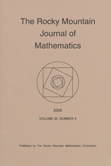
ROCKY MOUNTAIN JOURNAL OF MATHEMATICS
Fostering Collaboration in Diverse Mathematical FieldsROCKY MOUNTAIN JOURNAL OF MATHEMATICS, published by the Rocky Mountain Math Consortium, serves as a critical platform for researchers and practitioners in the field of mathematics since its inception in 1971. With a notable presence in the academic community, this journal covers a broad spectrum of mathematical disciplines, positioning itself in the Q2 category for Mathematics (miscellaneous) as of 2023. Despite being a subscription-based journal, it is recognized for its rigorous peer-review process and contributions to theoretical and applied mathematics, helping to advance knowledge and foster collaboration among mathematicians. The journal's ISSN number is 0035-7596 and its E-ISSN is 1945-3795, reflecting its commitment to accessibility and dissemination of high-quality research. Based in Tempe, Arizona, at Arizona State University, the journal continues to play an important role in shaping contemporary mathematical discourse through well-researched articles and innovative studies, aiming to bridge gaps between various mathematical subfields and engage a diverse audience, including students and established researchers alike.

Advances in Operator Theory
Advancing Knowledge in Algebra and Number TheoryAdvances in Operator Theory is a premier journal dedicated to the exploration of innovative and foundational research within the disciplines of Algebra and Number Theory, as well as Analysis. Published by SPRINGER BASEL AG, this journal provides a vital platform for the dissemination of high-quality research and theoretical advancements in the realm of operator theory. With a commendable impact factor and categorized in the Q3 quartile for both Algebra and Number Theory and Analysis in 2023, it holds significant standing in the Scopus rankings, substantiating its relevance in the mathematical community. The journal encourages open discussions and lively exchange of ideas among researchers, professionals, and students alike, fostering an environment conducive to scholarly growth and collaboration. Based in Iran at PICASSOPLATZ 4, BASEL 4052, SWITZERLAND, it has been actively publishing since 2016, making substantial contributions to its field through rigorous peer-reviewed articles. As an essential resource for anyone invested in the forefront of mathematical research, Advances in Operator Theory continues to illuminate complex topics and inspire future inquiries.

HOUSTON JOURNAL OF MATHEMATICS
Fostering Innovation in Miscellaneous MathematicsHOUSTON JOURNAL OF MATHEMATICS, published by the University of Houston, serves as a valuable platform for disseminating significant findings in the field of mathematics, specifically within the realm of miscellaneous mathematics. Despite its current categorization in Q4 for 2023, the journal plays a crucial role in fostering academic discussion and exploration among researchers, professionals, and students alike. With its ISSN 0362-1588, the journal has been publishing original research since 1996, with a recent gap filled from 2022 to 2023, thereby continuing to contribute to the mathematical community. While it does not currently offer open access options, the journal's commitment to quality research maintains its relevance within the field and invites submissions that can elevate its standing. Located in the vibrant city of Houston, Texas, the journal not only emphasizes theoretical advancements but also encourages applied mathematical research that intersects with other disciplines, enhancing its significance and reach.
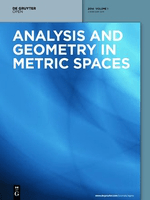
Analysis and Geometry in Metric Spaces
Fostering breakthroughs in analysis and geometry.Analysis and Geometry in Metric Spaces is a distinguished open-access journal published by DE GRUYTER POLAND SP Z O O, dedicated to advancing the fields of analysis, geometry, and applied mathematics. Since its inception in 2013, the journal has established itself as a vital resource for researchers and practitioners, consistently achieving high rankings in its categories, including Q1 in Analysis and Q2 in Applied Mathematics and Geometry and Topology, with notable Scopus rankings reflecting its impact within the mathematical community. The journal aims to foster scholarly exchange by publishing rigorous research articles that explore innovative trends and significant developments in metric space theory. With continuous open-access accessibility, it ensures that the latest findings are readily available to academics across the globe, thus contributing to the broader discourse within mathematics. As the journal prepares to bridge the years to 2024, it remains committed to serving as a cornerstone for advancements in its scope and a beacon for methodological breakthroughs.
Collectanea Mathematica
Showcasing transformative research in applied and theoretical mathematics.Collectanea Mathematica is a distinguished academic journal published by SPRINGER-VERLAG ITALIA SRL, dedicated to the field of mathematics, with a specific focus on both applied and theoretical aspects. Renowned for its rigorous peer-review process, the journal aims to advance knowledge in various mathematical disciplines, showcasing high-quality research that significantly contributes to the understanding of mathematical principles. With an impressive impact factor, and categorized in Q1 and Q2 quartiles for miscellaneous and applied mathematics respectively, Collectanea Mathematica plays a vital role in the academic community, catering to researchers, professionals, and students alike. The journal spans its convergence years from 2006 to 2024, reflecting a rich history of excellence and innovation in mathematical literature. With its strategic position within the Scopus rankings, it remains a pivotal resource for those seeking to stay at the forefront of mathematical research.
St Petersburg Mathematical Journal
Connecting Minds through Cutting-edge Mathematical ResearchSt Petersburg Mathematical Journal, published by the American Mathematical Society, is a distinguished platform that fosters research and discourse in the fields of mathematics, specifically focusing on Algebra and Number Theory, Analysis, and Applied Mathematics. With an ISSN of 1061-0022 and an E-ISSN of 1547-7371, this journal has been a reliable source of cutting-edge mathematical research since its inception in 2003 and continues to publish high-quality content through 2024. Although not open-access, it offers valuable insights and advances the mathematical community's understanding, as indicated by its respectable impact factor and Scopus rankings across various categories—landing in the Q3 quartile across three significant mathematical disciplines. Researchers, professionals, and students are encouraged to contribute and engage with this journal, as it remains a vital resource for promoting collaboration and discovery within the ever-evolving field of mathematics.
Computational Methods and Function Theory
Exploring the intersection of theory and computation.Computational Methods and Function Theory is a distinguished journal published by SPRINGER HEIDELBERG, dedicated to advancing the fields of computational mathematics and functional analysis. With its ISSN 1617-9447 and E-ISSN 2195-3724, this journal serves as a vital resource for researchers, professionals, and students seeking to explore state-of-the-art methodologies and theoretical developments from 2011 to 2024. Its robust ranking positions it in the Q3 category for Analysis and Computational Theory and Mathematics, and Q2 for Applied Mathematics, reflecting the journal's influence and credibility within the scientific community. Residing in Germany, the journal promotes open dialogue and innovative solutions to complex mathematical problems, making significant contributions to both theoretical and applied disciplines. Its impact is evidenced by strong Scopus rankings, asserting its relevance and rigorous peer-review processes, which ensure high-quality publications. This journal stands as a key platform for disseminating groundbreaking research and fostering collaboration across disciplines.

Space
Pioneering Discussions in the Arts and HumanitiesSpace is a distinguished journal within the realms of Visual Arts and Architecture, published by the reputable SPACE MAGAZINE. Although its coverage in major indexing databases such as Scopus has ceased since 2016, the journal played a significant role from its inception in 2008, contributing valuable insights during its publication years. Featuring a broad interdisciplinary approach, Space explored the intersections of artistic and architectural expression, offering a platform for researchers and practitioners to exchange innovative ideas. The journal's impact within the field of Arts and Humanities is reflected in its Scopus rankings, where it holds significant positions, albeit with lower percentiles, in both relevant categories. Although it currently does not offer open access, the journal remains a reference point for scholars interested in the evolving dynamics of space in the arts. As such, Space continues to be an essential resource for individuals who strive to understand and explore the relationship between human creativity and spatial design.

Journal of Mathematical Analysis
Empowering Researchers Through Open Access InsightsThe Journal of Mathematical Analysis, published by UNIV PRISHTINES in Serbia, offers a dedicated platform for the dissemination of innovative research in the fields of mathematical analysis and applied mathematics. With an ISSN of 2217-3412 and a convergence period from 2020 to 2024, this journal aims to foster significant advancements in both theoretical and practical aspects of mathematics. Categorized in the Q4 quartile for Analysis, Applied Mathematics, and miscellaneous Mathematics as of 2023, it serves as an essential resource for researchers and professionals alike, providing key insights into the evolving landscape of mathematical inquiry. Although it is an open access journal, facilitating global readership, its Scopus rankings reflect its emerging status, with rankings indicating a 51st percentile in Mathematics (miscellaneous) and 28th percentile in Applied Mathematics. This journal not only aims to contribute to academic discourse but also seeks to bridge gaps between mathematical theory and real-world applications, making it a vital resource for students and professionals engaged in the complexities of mathematical research.