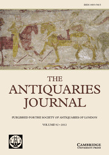
Antiquaries Journal
Scope & Guideline
Unveiling the Past Through Scholarly Discourse.
Introduction
Aims and Scopes
- Architectural History:
The journal frequently publishes studies on the architectural heritage of various periods, highlighting significant buildings, their designs, and their cultural implications. - Archaeological Discoveries:
Research articles often center around archaeological excavations and findings, providing insights into ancient societies and their practices through material culture. - Cultural Heritage and Practices:
There is a strong emphasis on the examination of cultural practices, including art, rituals, and societal structures, particularly in relation to historical communities and their legacies. - Interdisciplinary Approaches:
The journal encourages interdisciplinary research, integrating perspectives from history, art history, archaeology, and anthropology to foster a holistic understanding of the past. - Social and Political Contexts:
Many articles explore the socio-political contexts of historical events and structures, examining how power dynamics and cultural exchanges shaped historical narratives.
Trending and Emerging
- Postcolonial Perspectives:
An increasing number of articles are examining historical narratives through postcolonial lenses, reflecting a growing awareness of the complexities of cultural heritage in a globalized world. - Digital Humanities:
There is a notable rise in the integration of digital tools and methodologies in research, allowing for innovative analyses of historical data and enhancing accessibility to antiquarian studies. - Environmental Archaeology:
Research focusing on the relationship between past societies and their environments is on the rise, emphasizing the importance of ecological contexts in understanding historical dynamics. - Gender and Identity Studies:
Emerging themes related to gender and identity in historical contexts are becoming more prevalent, as scholars explore the roles and representations of diverse groups in antiquity. - Community Engagement and Heritage:
There is a growing trend towards incorporating community perspectives in heritage studies, emphasizing the importance of local narratives and participatory approaches in understanding the past.
Declining or Waning
- Classical Antiquity:
There appears to be a decline in publications specifically centered on classical antiquity, possibly as scholars shift towards more localized or contemporary historical studies. - Medieval Studies:
Although still present, the volume of research specifically dedicated to medieval studies has diminished, suggesting a potential shift towards early modern and modern history. - Colonial and Imperial Studies:
The focus on colonial and imperial histories has become less pronounced, as the journal's contributors increasingly engage with themes of local heritage and identity rather than broader imperial narratives. - Material Culture of the 19th Century:
Research on the material culture specifically from the 19th century has waned, possibly as scholars prioritize earlier periods or more contemporary analyses. - Traditional Antiquarian Practices:
There is a noticeable decrease in studies that strictly adhere to traditional antiquarian methodologies, as more researchers adopt innovative and interdisciplinary approaches.
Similar Journals

Pamatky Archeologicke
Exploring cultural heritage through impactful archaeological inquiry.Pamatky Archeologicke is a premier journal dedicated to the field of archaeology, published by the Academy of Sciences of the Czech Republic, Institute of Archaeology. Renowned for its rigorous scholarship and insightful contributions, the journal holds a distinguished position within the academic community, featured in the Q1 category of both archaeology and arts and humanities as of 2023. With impactful research articles that span a broad spectrum of archaeological inquiry, Pamatky Archeologicke serves as an essential resource for researchers, professionals, and students dedicated to understanding cultural heritage and archaeological methodologies. The journal enjoys a significant Scopus ranking, having achieved an impressive percentile ranking in both arts and humanities and social sciences disciplines. Although it currently does not offer open-access options, the journal remains committed to advancing the field of archaeology through high-quality research and critical discussions. Its scholarly contributions are crucial for fostering knowledge and innovation in the understanding of human history and prehistory.
Anatolian Studies
Illuminating the Richness of Anatolian HistoryAnatolian Studies, published by Cambridge University Press, stands as a premier forum for research in the fields of archaeology, cultural studies, and history. Established in 1951, this esteemed journal has consistently contributed to the academic discourse surrounding the rich and multifaceted history of Anatolia, earning its place in the Q1 category across multiple disciplines. With a notable impact factor reflected in its Scopus rankings, it ranks among the top journals in its fields: 78th in History, 155th in Cultural Studies, and 55th in Archaeology, showcasing its significant influence and recognition. This journal serves as an invaluable resource for researchers and scholars seeking to delve into the intricacies of Anatolian heritage, providing a platform for innovative research and critical discussion within the academic community. While it currently does not offer open access, Anatolian Studies continues to enrich scholarly resources and advance knowledge within its key areas of focus.
International Journal of Historical Archaeology
Illuminating Discoveries: Insights into Our Shared Historical JourneyInternational Journal of Historical Archaeology, published by SPRINGER, stands at the forefront of archaeological scholarship, focusing on the intricate relationship between historical events and archaeological findings. With an impressive impact factor underscored by its ranking in the Q1 quartiles across various categories, including Archeology and History, this journal serves as a premier platform for researchers, professionals, and students alike to disseminate groundbreaking findings and theoretical advancements in the field. Although it is not an Open Access publication, the journal provides valuable insights through its rigorous peer-review process, enhancing the quality of contributions. Covering a breadth of topics from 1997 to 2024, it is vital for advancing knowledge in historical archaeology and offers an essential resource for those invested in understanding our shared past through the lens of material culture. The journal's commitment to fostering interdisciplinary discussions enriches the scholarly community and supports the evolution of methodologies and perspectives within the domain.

Slovenska Archeologia
Uncovering insights that shape our understanding of the past.Slovenska Archeologia is a prominent journal published by the Slovak Academy of Sciences, Institute of Archaeology, dedicated to advancing the field of archaeology through rigorous scholarly research and insightful scholarship. With an ISSN of 1335-0102 and an E-ISSN of 2585-9145, this journal has been a vital platform for archaeologists and academics since its inception, converging its insightful publications from the years 2017 to 2023. Awarded a Q2 ranking in the field of archaeology across both arts and humanities categories, it holds a respectable position in the Scopus rankings, recognizing its contributions to the discipline. Based in Slovakia, the journal is an essential resource for professionals, researchers, and students interested in archaeological findings and methodologies. While it does not currently offer Open Access options, its commitment to promoting high-quality research makes it a valuable addition to the academic community.

Radovi Instituta za Povijest Umjetnosti-Journal of the Institute of Art History
Bridging Theory and Practice in Art Scholarship.Radovi Instituta za Povijest Umjetnosti-Journal of the Institute of Art History is a distinguished academic journal dedicated to the exploration and critical analysis of art history, with a special emphasis on the visual arts and performing arts. Published by INST POVIJEST UMJETNOSTI-INST ART HISTORY in Croatia, this journal provides an essential platform for researchers and practitioners to disseminate their findings and engage in scholarly discourse. Since its transition to Open Access in 2008, it has significantly increased the accessibility of its content, fostering a global exchange of ideas. The journal is indexed in notable databases, reflecting its impact within its field, with a current ranking that places it in the Q4 category for History and in Q3 for Visual Arts and Performing Arts. As it spans its converged years from 2015 to 2024, Radovi is poised to expand its influence and continue contributing to the understanding of art historical narratives. Researchers, professionals, and students alike will find this journal a valuable resource for contemporary discussions and theoretical advancements in the study of art.
METROPOLITAN MUSEUM JOURNAL
Illuminating Innovations in Art ConservationMETROPOLITAN MUSEUM JOURNAL, published by the University of Chicago Press, serves as a vital platform for researchers, professionals, and students in the fields of Conservation and Museology. With an ISSN of 0077-8958 and an E-ISSN of 2169-3072, this journal emphasizes the importance of scholarly discourse on art preservation and museum practices. Although it currently holds a Q4 ranking in both Conservation and Museology according to the 2023 category quartiles, the journal continues to contribute to advancements and discussions within these vital fields. Located in Belgium, the journal's mission is to illuminate best practices, innovative techniques, and significant case studies that inform the future of museum work. As an indispensable resource for those dedicated to the arts and humanities, METROPOLITAN MUSEUM JOURNAL fosters a community for exchanging ideas and insights, crucial for the ongoing development and understanding of museum methodologies.

Journal of Ancient History and Archaeology
Unveiling the Secrets of Our PastJournal of Ancient History and Archaeology is a premier, open-access academic journal published by MEGA PUBLISHING HOUSE since 2014, dedicated to exploring the rich tapestry of ancient civilizations and archaeological discoveries. With ISSN 2360-266X, this journal has made significant strides in the field, achieving elevated rankings across multiple categories, including Q1 in Classics and Q2 in History as of 2023. Positioned in Romania, the journal serves an international audience of researchers, professionals, and students who seek to disseminate and access influential scholarship in ancient history and archaeology. As a prominent resource within the Scopus rankings, it reflects a robust commitment to advancing knowledge through quality research, making it a vital platform for the sharing and discussion of innovative ideas and methodologies. The journal covers a wide array of topics related to ancient societies, enhancing our understanding of their cultural, historical, and archaeological significance.

Vinculos de Historia
Bridging Perspectives in the Study of HistoryVinculos de Historia, published by the University of Castilla-La Mancha, is a distinguished open-access journal that has been contributing to the field of history since its inception in 2012. Based in Spain, it serves as a vital scholarly platform for historians and researchers alike, engaging with various historical methodologies and perspectives. With an impressive Q2 ranking in the 2023 Scopus Arts and Humanities Category, it ranks at #803 out of 1760 journals, placing it in the top 54th percentile of its field. The journal is committed to disseminating high-quality research articles that foster a deeper understanding of historical narratives and their implications. By providing unrestricted access to peer-reviewed content, Vinculos de Historia not only enhances scholarly discourse but also encourages collaboration among academics, professionals, and students globally. Located at FAC Letras Ciudad Real, the journal stands as a testament to the robust intellectual tradition of the University of Castilla-La Mancha.
Archivo Espanol de Arqueologia
Connecting scholars to the rich tapestry of history.Archivo Español de Arqueología is a prestigious journal published by the Consejo Superior de Investigaciones Científicas (CSIC), dedicated to the field of archaeology and the historical sciences. Since its transition to Open Access in 1991, this journal has been a significant resource for scholars and practitioners in Spain and beyond, ensuring the dissemination of high-quality research to a broad audience. With an impressive Scopus ranking that places it within the top 20% of journals in the disciplines of History and Archaeology, Archivo Español de Arqueología plays a crucial role in advancing academic discourse and promoting innovative archaeological methodologies. The journal has maintained rigorous standards, reflected in its placement within the Q2 and Q3 quartiles, enabling it to establish a reputation for excellence and reliability in archaeological scholarship. Researchers, professionals, and students are encouraged to explore the journal's diverse array of articles from its foundation year of 2009 to the present, enriching their understanding of the past through the latest findings and theoretical advancements in archaeology.

Conimbriga-Revista de Arqueologia
Illuminating the Past with Cutting-Edge Archaeological StudiesConimbriga-Revista de Arqueologia is a distinguished open-access journal dedicated to the field of archaeology, published by COIMBRA UNIVERSITY PRESS. Since its inception, the journal has fostered a vibrant intellectual community focused on the exploration and dissemination of archaeological research, particularly emphasizing studies relevant to the rich historical and cultural heritage of Portugal and beyond. With its open access model established in 2014, it has become a vital resource for researchers, professionals, and students to share their findings without access barriers, encouraging collaboration and knowledge exchange. Despite the absence of specific metrics such as the HIndex and Scopus rankings, the journal is recognized for its commitment to high-quality scholarship and its role in advancing archaeological discourse. Positioned within the scholarly landscape, Conimbriga-Revista de Arqueologia serves as a crucial platform for the publication of innovative research, reviews, and critical essays, making it an essential journal for those invested in the archaeological sciences.