Argument & Computation
metrics 2024
Empowering Research in Argument and Computational Science
Introduction
Argument & Computation is an esteemed academic journal dedicated to the interdisciplinary exploration of formal structures of argumentation and their computational applications. Published by IOS PRESS based in the United Kingdom, this Open Access journal, since its inception in 2010 and particularly impactful since 2016, serves as a pivotal platform for researchers and practitioners seeking to advance the fields of Artificial Intelligence, Computational Mathematics, Computer Science Applications, and Linguistics. With its current categorization in Q3 in Artificial Intelligence, Q2 in Computational Mathematics, and Q1 in Linguistics and Language for 2023, the journal maintains a commendable position within the scholarly community, evidenced by its high Scopus rankings, notably in Linguistics and Language where it ranks in the 92nd percentile. By fostering innovative research and discussions, Argument & Computation plays an essential role in bridging theoretical insights with computational practices, making it indispensable for academics, students, and professionals invested in the evolution of argumentation frameworks and their implications in technology and society.
Metrics 2024
 0.581.701.7025
Metrics History
Rank 2024
Scopus
IF (Web Of Science)
JCI (Web Of Science)
Quartile History
Similar Journals
INFORMATION AND COMPUTATION
Unveiling Insights in Computational ResearchINFORMATION AND COMPUTATION is a peer-reviewed academic journal published by Academic Press Inc., Elsevier Science, dedicated to advancing the fields of computational theory and mathematics, computer science applications, and information systems. With an ISSN of 0890-5401 and an E-ISSN of 1090-2651, the journal provides a platform for innovative research that spans theoretical and applied perspectives. Acknowledged for its impact in the community, it holds a Q2 quartile ranking in several categories, including Computational Theory and Mathematics and Computer Science Applications, as of 2023. These rankings place it among the leading journals in its field, making it an essential resource for researchers, professionals, and students aiming to stay abreast of cutting-edge developments. While it does not currently offer Open Access options, the journal intends to foster scholarly communication and knowledge sharing from its inception in 1987 to its future issues expected through 2024. Located in the United States, at 525 B ST, STE 1900, SAN DIEGO, CA 92101-4495, INFORMATION AND COMPUTATION is committed to publishing high-quality research that influences the theoretical foundations and practical applications of its diverse disciplines.
Journal of Argumentation in Context
Advancing interdisciplinary insights in argumentation dynamics.The Journal of Argumentation in Context, published by John Benjamins Publishing Co, is a leading interdisciplinary journal that explores the dynamics of argumentation across various contexts, integrating insights from the fields of communication, linguistics, and social sciences. With an ISSN of 2211-4742 and an E-ISSN of 2211-4750, the journal serves as a crucial platform for researchers and practitioners aiming to deepen their understanding of argumentative practices in both verbal and non-verbal communication. The journal, which has an impressive ranking with a Q2 quartile in Linguistics and Language and a Q3 in Communication, reflects its high impact within the academic community, evidenced by its Scopus rankings placing it in the top 20% of its fields. Although access options remain limited, the journal’s objective is clear: to foster dialogues that bridge theory and practice, and to contribute meaningfully to the ongoing conversation about argumentation strategies in diverse contexts. As the journal converges its focus from 2015 to 2024, it is poised to remain an invaluable resource for scholars, professionals, and students dedicated to advancing the study of argumentation.
THEORY AND PRACTICE OF LOGIC PROGRAMMING
Fostering Scholarly Dialogue in the Realm of Logic Programming.THEORY AND PRACTICE OF LOGIC PROGRAMMING, published by Cambridge University Press, is a premier academic journal that delves into the evolving field of logic programming, offering insights and advancements from 2001 to 2024. With an ISSN of 1471-0684 and an E-ISSN of 1475-3081, this journal serves as a vital resource for researchers, professionals, and students interested in areas such as artificial intelligence, computational theory, and software development. In 2023, the journal was recognized for its excellence, achieving Q1 status in Computational Theory and Mathematics and Q2 in several other categories, underscoring its significant impact within the academic community. Despite not being open access, its robust content, curated by esteemed scholars, guarantees high-quality research and innovative methodologies that are crucial for advancing the field. The journal's rigorous peer-review process and its standings in Scopus rankings further emphasize its relevance and authority, making it a quintessential platform for disseminating key findings and fostering scholarly dialogue.
Dialogic Pedagogy
Empowering Educators with Dialogic Insights.Dialogic Pedagogy is an esteemed open-access journal published by the University of Pittsburgh, University Library System, focusing on innovative and transformative approaches in education and linguistics. Since its inception in 2013, the journal has gained recognition for its commitment to fostering dialogic practices that enhance learning and communication across diverse educational contexts. With an impressive impact in the fields of education and language, it has achieved a Q2 ranking in Linguistics and Language and a Q3 ranking in Education as of 2023, illustrating its relevance and contribution to ongoing scholarly discourse. The journal’s notable Scopus rankings further highlight its influence, placing it in the 77th and 74th percentiles in the respective categories of Arts and Humanities and Social Sciences. Operating from the heart of the United States, the journal serves as a vital platform for researchers, educators, and students aiming to explore and implement dialogic pedagogical methods. With its open-access model, Dialogic Pedagogy ensures that valuable insights and research findings are readily available to a global audience, encouraging collaboration and further inquiry in this dynamic intersection of education and linguistics.

Prolegomena
Illuminating Contemporary Philosophical IssuesProlegomena is a distinguished open-access journal in the field of philosophy, published by the SOC ADVANCEMENT PHILOSOPHY-ZAGREB. Since its inception in 2006, this journal has fostered a vibrant academic community dedicated to the exploration and advancement of philosophical discourse. Based in Croatia and associated with University Zagreb-Croatian Studies, Prolegomena provides a platform for scholars to disseminate their research and engage with contemporary philosophical issues. The journal's impact is reflected in its Scopus ranking, positioning it in the 13th percentile within the Arts and Humanities category, evidencing its contributions despite a Q3 classification in the philosophy quartiles. Covering a wide spectrum of philosophical inquiries, Prolegomena invites rigorous analyses and innovative perspectives, making it an essential resource for researchers, professionals, and students eager to enrich their understanding of philosophical thought. With its commitment to accessibility, the journal is poised to continue influencing philosophical scholarship until 2024 and beyond.
Natural Language Engineering
Innovating the Future of Natural Language ProcessingNatural Language Engineering is a premier journal published by Cambridge University Press, dedicated to advancing the field of artificial intelligence and its intersection with linguistics and software. Since its inaugural publication in 1995, the journal has established itself as a vital platform for innovative research and development in natural language processing (NLP) and engineering. With a notable impact factor reflecting its influential contributions, it ranks in the top tiers across various categories, including Q1 in Linguistics and Language and Q3 in Artificial Intelligence. Researchers and practitioners alike benefit from the opportunity to access insightful articles that address both theoretical aspects and practical applications of NLP technologies. Although it operates under a traditional subscription model, the rigorous peer-review process ensures high-quality publications that foster academic discourse and collaboration within the community. This journal is essential for anyone interested in the evolving landscape of language engineering, making it a cornerstone reference for upcoming scholars and seasoned professionals aiming to push the boundaries of knowledge in this dynamic field.

INTERNATIONAL JOURNAL OF APPROXIMATE REASONING
Unraveling Complexities in Theoretical Computer ScienceThe INTERNATIONAL JOURNAL OF APPROXIMATE REASONING, published by Elsevier Science Inc, stands as a pivotal resource in the domains of applied mathematics and artificial intelligence. Since its inception in 1987, the journal has evolved into a leader in its field, boasting an impressive impact factor and ranking within the top quartile for applied mathematics (Q1) and high standings in artificial intelligence and software categories according to the 2023 Scopus rankings. As researchers, professionals, and students delve into complex issues surrounding reasoning under uncertainty, this journal provides invaluable insights and cutting-edge research. In addition to its rich content, the journal's commitment to advancing knowledge in theoretical computer science further enhances its significance in fostering academic growth. While the journal does not currently offer open access, its rigorous peer-review process ensures that only high-quality, impactful studies are published, solidifying its role as an essential source for academics striving to remain at the forefront of their fields.
Theoria-A Swedish Journal of Philosophy
Navigating the Depths of Contemporary PhilosophyTheoria - A Swedish Journal of Philosophy, published by WILEY, stands as a significant contributor to the realm of philosophical discourse since its inception in 1935, with a continued commitment to advancing scholarly conversation up to 2024. With its ISSN 0040-5825 and E-ISSN 1755-2567, the journal holds a prestigious position in the field, ranking in Q2 among philosophy journals and achieving an impressive 66th percentile ranking in the Scopus Arts and Humanities category. Although it does not currently provide Open Access options, Theoria remains a vital resource for researchers, professionals, and students seeking in-depth analyses and innovative perspectives within contemporary philosophy. Its central objective is to foster rigorous academic dialogue that explores diverse philosophical inquiries, making it an essential platform for those invested in the pursuit of knowledge and critical thought.
AI COMMUNICATIONS
Transforming Insights into AI Innovations.AI COMMUNICATIONS is a distinguished journal published by IOS PRESS, focusing on the dynamic field of Artificial Intelligence. With a rich history dating back to 1987, this journal covers a broad spectrum of topics, including the latest advancements in AI methodologies, applications, and implications for society. Despite holding a Q3 classification in the 2023 category of Artificial Intelligence, it provides an essential platform for dialogue and dissemination of research, highlighted by its global accessibility in the realm of AI communications. Researchers, professionals, and students alike will find a wealth of knowledge within its pages, which aim to bridge the gap between cutting-edge research and practical applications in AI. By contributing to this journal, authors have the potential to engage with a diverse audience and impact the ongoing discourse surrounding artificial intelligence technologies.
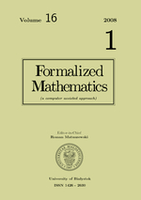
Formalized Mathematics
Innovating Through Open Access to Mathematical InsightsFormalized Mathematics is a pioneering open-access journal published by SCIENDO, dedicated to the field of formalized systems and mathematical foundations. Since its inception in 2006, it has provided a platform for researchers to discuss and disseminate advancements in applied mathematics and computational mathematics, emphasizing formalization in mathematical reasoning. Although recent coverage in Scopus has been discontinued, the journal still serves as a valuable resource for academics looking to deepen their understanding of formalized approaches to mathematical problems. With its ISSN 1898-9934, the journal not only promotes unrestricted access to quality research but also facilitates collaboration among mathematicians and computer scientists. Given its rankings—20th percentile in Applied Mathematics and 18th percentile in Computational Mathematics—Formalized Mathematics is a vital conduit for innovative research, making it a significant asset for students, professionals, and scholars aiming to explore the intersection of mathematics and formal logic.