
ARS Mathematica Contemporanea
metrics 2024
Shaping Tomorrow’s Mathematical Landscape Today
Introduction
ARS Mathematica Contemporanea, published by UP FAMNIT in Slovenia, stands as a pivotal journal within the fields of algebra, number theory, discrete mathematics, geometric topology, and theoretical computer science. Since its inception in 2011, this journal has consistently provided a rich platform for innovative research, garnering a commendable Q2 category ranking in various mathematical domains, including Algebra and Number Theory, and Geometry and Topology, showcasing its growing influence and prestige in the academic community. With an increasing Scopus rank—particularly notable in Algebra and Number Theory at the 71st percentile—ARS Mathematica Contemporanea is dedicated to publishing high-quality, peer-reviewed content that advances the frontiers of mathematical knowledge. The journal’s commitment to open access ensures that valuable research is readily available to scholars, practitioners, and students alike, fostering collaboration and dissemination of ideas across the globe. As it converges towards its dedicated timeline extending to 2024, ARS Mathematica Contemporanea remains a crucial resource for those engaged in mathematical research, presenting an array of theoretical and practical insights that define contemporary mathematical discourse.
Metrics 2024
 0.640.600.6020
Metrics History
Rank 2024
Scopus
IF (Web Of Science)
JCI (Web Of Science)
Quartile History
Similar Journals

Pure and Applied Mathematics Quarterly
Fostering Innovation in Mathematical DisciplinesPure and Applied Mathematics Quarterly is a prestigious journal published by INT PRESS BOSTON, INC, focusing on the diverse and evolving field of mathematics. Since its inception in 2007, this journal has grown significantly, currently holding a Q1 ranking in the Mathematics (Miscellaneous) category for 2023, positioning it among the leading publications in the discipline. With a commitment to publishing high-quality research, Pure and Applied Mathematics Quarterly fosters innovation and dialogue within the mathematical community by providing a platform for theoretical advancements and practical applications. The journal remains accessible to researchers and professionals through its ISSN 1558-8599 and E-ISSN 1558-8602, although it does not currently offer open access. As a vital resource for mathematicians, educators, and students, this journal endeavors to expand the frontiers of mathematical knowledge and contribute to the academic dialogue surrounding this fundamental science.

Acta Mathematica Universitatis Comenianae
Cultivating a vibrant community of mathematical thinkers.Acta Mathematica Universitatis Comenianae is a distinguished journal dedicated to advancing the field of mathematics, particularly in its miscellaneous branches. Published by Comenius University in Slovakia, this journal provides a vital platform for researchers and scholars to disseminate their findings and engage with contemporary mathematical discourse. Despite being categorized in the fourth quartile for 2023 in general mathematics within Scopus, the journal plays an essential role in fostering academic dialogue and contributing to regional developments in mathematical research. The journal's scope includes a wide array of topics, ensuring contributions from various domains of mathematics are encouraged. With its commitment to publishing quality research, Acta Mathematica Universitatis Comenianae is an invaluable resource for professionals, students, and academics seeking to expand their knowledge and engage with a community of its peers.
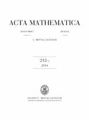
ACTA MATHEMATICA
Advancing Mathematical Excellence Since 1882ACTA MATHEMATICA, published by INT PRESS BOSTON, INC, stands as a prestigious journal in the field of mathematics, holding a distinguished Q1 ranking in the miscellaneous mathematics category for 2023. With a storied history dating back to its inception in 1882, this journal serves as a vital platform for researchers, professionals, and students to disseminate and exchange groundbreaking mathematical theories and applications. Although it is not an open-access journal, it remains influential within the academic community, contributing significantly to the advancement of mathematical knowledge and research integrity. Located in the Netherlands, ACTA MATHEMATICA continues to thrive, bridging historical mathematical discourse with contemporary innovation. Researchers and scholars are encouraged to engage with this venerable publication to stay abreast of emerging trends and discoveries in the mathematical sciences.
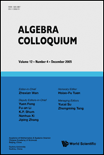
ALGEBRA COLLOQUIUM
Empowering Mathematical Minds Through Rigorous ResearchALGEBRA COLLOQUIUM is a prominent journal dedicated to advancing the field of mathematics, specifically focusing on Algebra and Number Theory as well as Applied Mathematics. Published by World Scientific Publishing Co Pte Ltd, this journal is based in Singapore and has been a cornerstone in mathematical research since its inception in 1996, with an anticipated convergence through 2024. With an ISSN of 1005-3867 and E-ISSN of 0219-1733, it features rigorous peer-reviewed papers that cover a diverse range of topics within its scope. Reflecting its quality, Algebra Colloquium is ranked in the Q3 quartile in both Algebra and Number Theory as well as Applied Mathematics, indicating its significance amidst a competitive publication landscape. Researchers, professionals, and students looking to stay at the forefront of mathematical innovation will find a wealth of knowledge and research insights within these pages, making it an essential resource for anyone committed to deepening their understanding of algebraic concepts and techniques.

Discrete Analysis
Elevating Mathematical Discourse with Every PublicationDiscrete Analysis, published by ALLIANCE DIAMOND OPEN ACCESS JOURNALS, is a pioneering open access journal that has been contributing to the fields of Algebra, Number Theory, Discrete Mathematics, Combinatorics, Geometry, and Topology since its inception in 2016. Based in the United Kingdom, this journal is highly regarded, holding a prestigious Q1 ranking across key mathematical disciplines as of 2023, which underscores its influence and reputation within the academic community. With rigorous peer-review standards and an accessible platform, Discrete Analysis is dedicated to disseminating high-quality research that fosters advancements in mathematical theory and application. By embracing the open access model, the journal ensures that scholarly work is readily available to researchers, professionals, and students alike, promoting greater collaboration and innovation in mathematical research. For up-to-date insights and contributions in the field, Discrete Analysis is an essential resource.

Australasian Journal of Combinatorics
Empowering Scholars in Discrete MathematicsThe Australasian Journal of Combinatorics, published by the CENTRE DISCRETE MATHEMATICS & COMPUTING, serves as a vital platform for researchers and professionals engaged in the dynamic field of discrete mathematics and combinatorics. With an ISSN of 2202-3518 and an E-ISSN of the same, this journal has been committed to open access since 2014, ensuring that groundbreaking research is readily available to a global audience. Based in Australia, specifically at the Department of Mathematics, University of Queensland, this journal spans the years from 1996 to 2024, showcasing the evolution of combinatorial research over nearly three decades. Recognized in the 2023 category quartiles as Q3 in Discrete Mathematics and Combinatorics, it ranks 68th out of 92 in Scopus, reflecting its growing influence despite its current percentile of 26th. The Australasian Journal of Combinatorics is dedicated to fostering innovative research and theoretical development, making it a valuable resource for academics and students alike.
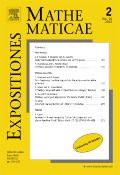
EXPOSITIONES MATHEMATICAE
Fostering Original Research in Diverse Mathematical FieldsEXPOSITIONES MATHEMATICAE, published by Elsevier GmbH, stands as a significant journal in the realm of mathematics, catering primarily to researchers, professionals, and students. With an ISSN of 0723-0869 and an E-ISSN of 1878-0792, this journal has made its mark in the academic community, boasting a Q2 classification in the miscellaneous mathematics category for 2023, illustrating its prominence within its field. The journal addresses a diverse scope of mathematical topics, encouraging the publication of original research and innovative theories while maintaining rigorous academic standards. As it converges from 2004 to 2024, EXPOSITIONES MATHEMATICAE continues to be an essential resource for advancing mathematical knowledge and fostering scholarly communication, despite being a non-open-access publication. Its location in Munich, Germany further anchors it within a rich intellectual tradition, providing accessibility for the mathematical community worldwide.
Aequationes Mathematicae
Elevating Mathematical Discourse Since 1968.Aequationes Mathematicae is a distinguished academic journal published by SPRINGER BASEL AG, focusing on the dynamic fields of Applied Mathematics, Discrete Mathematics, and Combinatorics. Since its inception in 1968, the journal has served as a vital platform for disseminating high-quality research, with Converged Years expected to extend to 2024. With an impressive Q2 ranking in multiple mathematical disciplines as of 2023, Aequationes Mathematicae is positioned within the top half of its field, reflecting its reputation for excellence. Spanning the globe from its base in Basel, Switzerland, this journal is ideal for researchers, professionals, and students seeking to advance their knowledge and contribute to ongoing discussions within mathematics. While it does not currently offer Open Access options, readers can still access an extensive archive of impactful studies that bolster its standing within the academic community.

Analele Stiintifice ale Universitatii Ovidius Constanta-Seria Matematica
Elevating the Discipline of Mathematics with Scholarly ExcellenceAnalele Stiintifice ale Universitatii Ovidius Constanta-Seria Matematica is a prominent open-access journal established by OVIDIUS UNIV PRESS in Romania, dedicated to advancing the fields of mathematics, specifically in Analysis and Applied Mathematics. Since its inception, the journal has emphasized the dissemination of high-quality research, making it accessible to a global audience. With an ISSN of 1224-1784 and E-ISSN 1844-0835, it has positioned itself within the academic community, achieving a respectable Q3 ranking in both analysis and applied mathematics in 2023, reflecting its commitment to rigorous scholarship. The journal spans a considerable publication window from 2009 to 2024, catering to the ongoing developments in mathematical sciences and their applications. Researchers, professionals, and students alike will find valuable insights and contributions that enrich their understanding and foster collaboration within the mathematical community. The journal's headquarters is based at the Faculty of Mathematics & Computer Science, Bulevardul Mamaia 124, Constanta, Romania.

Algebra And Discrete Mathematics
Unlocking New Perspectives in Algebraic and Discrete ResearchAlgebra And Discrete Mathematics, published by LUHANSK TARAS SHEVCHENKO NATIONAL UNIVERSITY, is a pivotal academic journal dedicated to exploring the realms of algebra and discrete mathematics. Since its inception in 2012, this journal has contributed significantly to the mathematical community, catering to researchers, professionals, and students interested in advancing their understanding of both classical and contemporary mathematical theories. With categories placed in Q4 in Algebra and Number Theory and Q3 in Discrete Mathematics and Combinatorics, and rankings that place it among various domains with percentiles reflecting its niche status, the journal offers a platform for innovative and high-quality research. While the journal is currently not open access, it maintains a robust academic presence, and its continuous publication until 2024 ensures a steady stream of scholarly discourse. Researchers and academics keen on disseminating their findings or keeping abreast of the latest developments in these mathematical fields will find valuable insights and diverse methodologies within its pages.