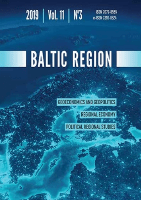
Baltic Region
Scope & Guideline
Connecting Scholars to Shape the Future of the Baltic Region
Introduction
Aims and Scopes
- Regional Development and Governance:
The journal addresses issues related to economic growth, governance structures, and regional policies in the Baltic states and surrounding areas, highlighting local and regional adaptation to global trends. - Geopolitical Dynamics:
A significant focus is placed on the geopolitical interactions within the Baltic Sea region, including the influence of external powers, security concerns, and the effects of regional conflicts on local development. - Migration and Demography:
Research on migration patterns, demographic changes, and their socio-economic implications is prevalent, reflecting the complex demographic landscape of the Baltic region. - Cultural and Ethnic Studies:
The journal explores the cultural and ethnic diversity of the Baltic states, including studies on ethnic minorities, integration policies, and the impact of historical narratives on contemporary society. - Sustainable Development and Environmental Issues:
Sustainability is a core theme, with articles examining environmental challenges, resource management, and sustainable practices in coastal and rural areas. - Technological and Economic Innovation:
The journal emphasizes innovation systems, digitalization, and their roles in shaping economic landscapes and enhancing competitiveness in the Baltic region.
Trending and Emerging
- Geopolitical Security and Regional Stability:
With rising geopolitical tensions, particularly related to Russia and NATO, there is an increasing focus on security studies and the implications for regional stability and cooperation. - Digital Transformation and Innovation:
The integration of digital technologies and their impact on regional economies and governance has become a key area of interest, reflecting the broader global trend towards digitalization. - Health and Social Outcomes Post-COVID-19:
The pandemic has led to heightened interest in health expenditures, public health outcomes, and the socio-economic impacts of health crises, particularly in the context of the Baltic region. - Environmental Sustainability and Climate Change Adaptation:
Research related to climate change, sustainable practices, and environmental policy is on the rise, as regions grapple with the impacts of climate change on their economies and societies. - Migration Trends and Integration Policies:
Studies exploring migration dynamics, integration challenges, and the socio-cultural implications of migration are increasingly relevant, reflecting the changing demographics of the Baltic states.
Declining or Waning
- Historical Narratives and Memory Politics:
Research focusing on historical narratives, particularly regarding Soviet history and memory politics, has seen a decline, possibly due to shifting interests toward more contemporary socio-economic and geopolitical issues. - Cross-Border Cooperation Initiatives:
While cross-border cooperation was once a significant theme, discussions around collaborative projects and initiatives among Baltic states and neighboring countries have diminished in favor of more localized studies. - Traditional Economic Sectors:
Studies centered around traditional economic sectors, such as agriculture and fisheries, have waned, as attention shifts toward innovation-driven and digital economies. - Tourism Development in Rural Areas:
Research on rural tourism development has become less prominent, likely due to an increased focus on urban and coastal tourism dynamics, particularly in the context of the COVID-19 pandemic. - Cultural Heritage Studies:
Although still relevant, the frequency of papers specifically addressing cultural heritage and conservation issues has decreased, with more emphasis placed on broader socio-economic impacts.
Similar Journals

Ter es Tarsadalom
Fostering Dialogue on Social and Economic ChallengesTer es Tarsadalom is a leading open access journal published by the CENTRE ECONOMIC & REGIONAL STUDIES at the HUNGARIAN ACADEMY OF SCIENCES, INSTITUTE OF REGIONAL STUDIES. With the ISSN 2062-9923, this journal serves as a vital platform for scholars and practitioners working in the fields of social sciences, regional studies, and economic development. Since adopting an open access model in 2022, Ter es Tarsadalom has committed to making high-quality research widely accessible, driving innovation and collaboration among researchers, professionals, and students alike. The journal aims to foster discussions on pressing social issues, regional disparities, and economic policies, providing a comprehensive forum for multidisciplinary research. Its rigorous peer-review process ensures that published articles meet the highest academic standards, empowering the community with impactful knowledge that can inspire change in regional planning and policy formulation.

Baltic Journal of Economics
Unleashing insights into contemporary economic challenges.Baltic Journal of Economics, published by Routledge Journals, Taylor & Francis Ltd, is a distinguished platform for research in the fields of economics, political science, and international relations. With an ISSN of 1406-099X and an E-ISSN of 2334-4385, this Open Access journal has been committed to disseminating valuable research since 2014, providing scholars with unrestricted access to impactful studies. As a testament to its quality, the journal resides in the Q2 category within Economics and Political Science as of 2023, ranking highly in Scopus with a notable percentile in its respective fields. By bridging theoretical frameworks with practical implications, the *Baltic Journal of Economics* aims to foster a deeper understanding of contemporary economic and political challenges, making it an essential resource for researchers, professionals, and students dedicated to exploring these dynamic disciplines. With a publication timeline extending from 2008 to 2024, it welcomes diverse studies that contribute to the ongoing discourse in the social sciences, supporting the evolution of knowledge in a globalized context.

WORLD DEVELOPMENT
Navigating the complexities of global development.WORLD DEVELOPMENT is a prestigious peer-reviewed journal published by Pergamon-Elsevier Science Ltd, renowned for advancing the field of global development studies. Established in 1973, this influential journal dives deep into the interconnected realms of economics, sociology, political science, geography, and planning, aiming to provide critical insights and innovative solutions to complex global issues. With an impressive impact factor and a Q1 ranking across multiple disciplines, including Development and Economics and Econometrics, WORLD DEVELOPMENT ranks among the top journals in its field, ensuring high visibility and engagement for contributors. Researchers, professionals, and students engaged in development studies will find WORLD DEVELOPMENT an invaluable resource, as it publishes rigorous empirical research, theoretical discussions, and policy analysis that both informs and challenges prevailing paradigms. The journal remains committed to fostering a comprehensive understanding of development processes worldwide, making it an essential platform for knowledge exchange in this critical domain.
Revue d Economie Regionale et Urbaine
Fostering dialogue in the heart of economic geography.Revue d Economie Regionale et Urbaine is a prestigious journal published by ARMAND COLIN, dedicated to advancing the field of regional and urban economics. Renowned for its rigorous peer-reviewed articles, this journal provides a vital platform for scholars, practitioners, and students to explore contemporary issues, methodologies, and case studies in regional development, urban policy, and economic geography. With its ISSN 0180-7307 and E-ISSN 2107-0865, the journal facilitates widespread dissemination of knowledge, although it currently does not offer open access options. Situated in Paris, France, Revue d Economie Regionale et Urbaine plays a critical role in fostering dialogue and innovation among academics and policymakers alike, contributing significantly to the understanding and enhancement of urban and regional economies.

Revista Digital Mundo Asia Pacifico
Advancing Knowledge Across the Asia-Pacific SpectrumRevista Digital Mundo Asia Pacifico is a pioneering scholarly journal published by UNIV EAFIT, dedicated to exploring the dynamic and multifaceted dimensions of the Asia-Pacific region. With its ISSN 2344-8172, the journal aims to provide a platform for researchers, professionals, and students to disseminate high-quality research and critical insights that address the region's unique socio-economic, cultural, and political landscapes. As an open-access publication, it strives to foster academic collaboration and facilitate knowledge-sharing among scholars globally. The journal welcomes a diverse range of topics, encouraging interdisciplinary studies that contribute to a deeper understanding of Asia-Pacific affairs. While specific metrics such as impact factor and H-index may not yet be established, Revista Digital Mundo Asia Pacifico is poised to become a vital resource for those engaged in this vibrant field of study.
Asian Economic Journal
Empowering Scholars with Insightful Economic ResearchAsian Economic Journal, published by WILEY, represents a crucial platform for scholars and practitioners in the fields of economics, development, and geography. Since its inception in 1987, this journal has evolved to encompass a wide array of research that addresses pressing economic challenges and innovative methodologies relevant to the Asian context and beyond. With an active publication timeline extending to 2024, the journal is indexed under various quartiles classifications, notably achieving a Q3 status in prominent categories such as Development and Economics. Researchers can access its rich repository of articles to deepen their understanding of economic dynamics, regional planning, and development strategies. Although the journal is not open access, its contributions are indispensable for those seeking to enrich the discourse on economic policies and development trends in Asia, making it an essential read for professionals, researchers, and students alike.
Vestnik Mezhdunarodnykh Organizatsii-International Organisations Research Journal
Bridging disciplines to enhance international scholarship.Vestnik Mezhdunarodnykh Organizatsii-International Organisations Research Journal, with ISSN 1996-7845, is a prominent academic platform published by the NATIONAL RESEARCH UNIVERSITY HIGHER SCHOOL OF ECONOMICS in the Russian Federation. Since its transition to Open Access in 2006, it has been dedicated to advancing research in the fields of Political Science, International Relations, Economics, and Sociology. The journal has established itself within reputable quartile rankings as Q2 in Political Science and International Relations, showcasing its significance in contemporary scholarship, while achieving noteworthy positions in Economics and Finance categories. With the aim to encourage interdisciplinary dialogue, the journal invites contributions that deepen our understanding of global governance, economic dynamics, and sociopolitical phenomena. Researchers, professionals, and students alike can benefit from its rigorous peer-reviewed content, contributing to informed discourse in an increasingly complex world.
Journal of Urban and Regional Analysis
Unveiling Patterns in Urban and Regional AnalysisWelcome to the Journal of Urban and Regional Analysis, a leading platform for scholarly research dedicated to the dynamic fields of urban and regional studies. Published by BUCHAREST UNIV PRESS and available through an open access model since 2009, this journal aims to disseminate innovative findings that explore complex interactions within urban environments. With an impact factor reflective of its solid academic standing, the journal proudly holds a Q2 quartile ranking in Urban Studies as of 2023, positioning it among the top-tier publications in the field. Based in Romania, the journal combines interdisciplinary approaches that cater to researchers, professionals, and students eager to contribute to and engage with the ongoing discourse surrounding territorial dynamics. By providing a platform for rigorous analysis and diverse perspectives, the Journal of Urban and Regional Analysis stands as an essential resource for anyone interested in the transformative processes shaping our urban landscapes.
REGIONAL SCIENCE AND URBAN ECONOMICS
Navigating the future of cities through rigorous analysis.Regional Science and Urban Economics, published by Elsevier, is a premier academic journal dedicated to advancing the understanding of spatial dynamics and urbanization. With an ISSN of 0166-0462 and E-ISSN 1879-2308, this journal has established itself as a vital resource for researchers and practitioners in economics and urban studies, boasting a remarkable impact factor and ranking in the Q1 category for both fields. Since its inception in 1975, the journal has provided a platform for high-quality research that examines both theoretical and empirical aspects of regional science and urban economics. With a Scopus rank of 47th in Urban Studies and 157th in Economics, it ensures that the latest findings reach a wide audience. Researchers interested in exploring spatial economics and urbanization trends will find this journal indispensable for staying at the forefront of their fields, facilitating collaboration and innovation in addressing contemporary urban challenges.
Millennial Asia
Exploring the Dynamic Tapestry of Asian SocietiesMillennial Asia is a premier academic journal published by SAGE Publications Inc that serves as a vital platform for interdisciplinary research in the vibrant fields of cultural studies, development, economics, political science, and sociology. With its ISSN 0976-3996 and E-ISSN 2321-7081, the journal provides a comprehensive examination of the socio-economic and political landscapes of Asia, fostering dialogue between regional experts and global scholars. Since its inception in 2014, it has established itself as a significant voice in the academic community, achieving a remarkable quartile ranking of Q1 in Cultural Studies and multiple Q2 rankings in Development, Economics, and Political Science disciplines for 2023. The journal's Scopus rankings further underscore its impact, with notable percentiles in various categories, indicating its commitment to high-quality research. Despite being a non-open access journal, it provides targeted insights and critical analyses that are indispensable for researchers, professionals, and students interested in understanding the complexities of contemporary Asian societies. As it converges towards 2024, Millennial Asia continues to expand its reach and relevance in the rapidly evolving academic landscape.