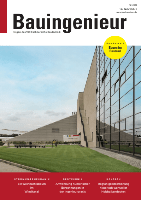
Bauingenieur
Scope & Guideline
Fostering Knowledge for Future Engineering Challenges
Introduction
Aims and Scopes
- Structural Engineering and Design:
This area encompasses research on the design, analysis, and optimization of various structural systems, including bridges, buildings, and other infrastructures, with a focus on safety, performance, and innovative materials. - Sustainable Construction Practices:
Research in this scope addresses methods and technologies that promote sustainability in construction, including the use of eco-friendly materials, energy-efficient designs, and strategies for reducing the carbon footprint of building projects. - Advanced Modelling and Simulation Techniques:
This includes the application of numerical methods, machine learning, and digital twin technologies for modeling complex structural behavior, analyzing construction processes, and enhancing decision-making in project management. - Construction Management and Project Delivery:
This area focuses on the methodologies and practices surrounding project delivery systems, including Integrated Project Delivery (IPD), Building Information Modeling (BIM), and agile construction methods. - Infrastructure Maintenance and Rehabilitation:
Research in this domain looks at techniques for assessing, monitoring, and improving existing structures, with an emphasis on extending service life and ensuring safety. - Innovations in Materials and Construction Techniques:
This includes the exploration of new materials, such as carbon concrete and synthetic composites, and innovative construction techniques that enhance structural performance and efficiency.
Trending and Emerging
- Digitalization and Smart Technologies:
There is a significant increase in research related to digital technologies, including the use of BIM, digital twins, and machine learning, to enhance efficiency and innovation in construction processes. - Sustainability and Climate Adaptation:
Recent publications emphasize the development of climate-neutral buildings and sustainable construction practices, indicating a growing priority on environmental impacts and resilience against climate change. - Innovative Materials and Construction Techniques:
The exploration of new materials, such as carbon-reinforced concrete and other composites, is gaining traction, showcasing advancements in material science that enhance structural performance. - Risk Management and Safety in Construction:
An increasing focus on safety management, including the assessment of risks associated with construction processes and the integration of advanced monitoring technologies, is evident in recent studies. - Collaborative Project Delivery Models:
Emerging themes around collaborative approaches to project delivery, such as Integrated Project Delivery (IPD) and partnerships between stakeholders, are becoming more prominent as the industry seeks efficient and effective ways to manage projects.
Declining or Waning
- Traditional Construction Methods:
There is a noticeable decrease in publications focused on conventional construction methods as the industry increasingly embraces modern techniques and technologies, such as modular construction and digitalization. - Historical Construction Techniques:
Research on historical construction practices and preservation techniques has waned, possibly due to a shift towards more contemporary and innovative engineering solutions that address current challenges. - Basic Research in Structural Theory:
While foundational theories remain important, there has been a decline in papers solely focused on basic research in traditional structural theory, as the journal has shifted towards applied research and case studies that demonstrate practical applications. - Regulatory Compliance in Construction:
Topics centered around compliance with outdated regulations are decreasing, as the industry moves towards more dynamic and flexible regulatory frameworks that adapt to modern construction needs. - Aesthetic Design in Civil Engineering:
The focus on aesthetic aspects of civil engineering has diminished, as there is now a greater emphasis on functionality, sustainability, and performance-driven design.
Similar Journals
Bautechnik
Pioneering research in construction and structural integrity.Bautechnik is a premier academic journal in the fields of Building and Construction and Civil and Structural Engineering, published by ERNST & SOHN in Germany. With a history dating back to 1969 and a significant converged timeline through various years, this journal offers a rich repository of peer-reviewed research dedicated to advancing the principles, methodologies, and innovations within its domains. Bautechnik is currently ranked in the Q3 category for both building and construction, as well as civil and structural engineering, indicating its relevance and contribution to the academic community. Though it does not offer open access, its curated content is accessible to a global audience of researchers, professionals, and students striving for excellence in their fields. The journal aims to foster discussions and disseminate knowledge that impacts the future of construction, architecture, and engineering practices.

International Journal of Building Pathology and Adaptation
Exploring innovative pathways to building preservation.International Journal of Building Pathology and Adaptation is a premier publication dedicated to advancing knowledge in the field of building pathology and adaptation. Established by the esteemed Emerald Group Publishing Ltd, this journal serves as a vital platform for researchers and practitioners focusing on the assessment, preservation, and innovative adaptation of built environments. With an impressive Q2 ranking in both Building and Construction and Civil and Structural Engineering, and a Scopus ranking of #62 out of 223 in the relevant engineering disciplines, the journal showcases high-quality research with significant practical implications. Although currently not featuring an open-access model, its access options cater to a wide audience aiming to explore cutting-edge studies from 2017 to 2024. The journal's commitment to bridging the gap between academic inquiry and real-world application makes it an essential resource for anyone dedicated to advancing the resilience and sustainability of the built environment.
Informes de la Construccion
Advancing knowledge in construction and engineering.Informes de la Construccion, an esteemed journal published by CONSEJO SUPERIOR INVESTIGACIONES CIENTIFICAS-CSIC, serves as a vital platform for disseminating scholarly research in the fields of Architecture, Building and Construction, and Civil Engineering. With an impact factor that reflects its impact within the community, this open access journal has been promoting scientific discourse since 1957, making its comprehensive archive freely available to researchers, professionals, and students alike. The journal maintains a diverse scope, covering significant advancements in construction techniques, sustainable practices, and innovative designs that respond to contemporary challenges in built environments. Currently ranked in the Q2 category for Architecture and positioned within the top quartiles for multiple engineering disciplines, Informes de la Construccion is recognized for its contribution to the engineering scholarship landscape, offering insights that are crucial for overcoming the complexities in modern construction and environmental engineering. Based in Madrid, Spain, the journal encourages contributions that explore both theoretical and practical aspects of construction, fostering an inclusive community dedicated to the advancement of knowledge in this pivotal field.

Civil Engineering Journal-Stavebni Obzor
Advancing Civil Engineering Knowledge for a Global AudienceWelcome to the Civil Engineering Journal-Stavebni Obzor, an esteemed academic publication dedicated to advancing the field of civil engineering. Published by the Czech Technical University in Prague, Faculty of Civil Engineering, this journal has provided a platform for innovative research and critical discourse since its inception. With an ISSN of 1210-4027 and an E-ISSN of 1805-2576, this Open Access journal has been facilitating wide dissemination of knowledge in civil engineering since 2014, ensuring that valuable research reaches a global audience without barriers. The journal is committed to fostering collaboration among researchers, professionals, and students, encouraging the exchange of ideas that drive the discipline forward. Its diverse scope encompasses various aspects of civil engineering, making it an essential resource for anyone looking to stay at the forefront of this dynamic field. Located in Prague, a hub of engineering excellence, this journal not only reflects the latest trends and innovations but also contributes to shaping the future of civil engineering.
Archives of Civil Engineering
Innovating Structural Solutions for TomorrowArchives of Civil Engineering is a premier academic journal published by POLISH ACAD SCIENCES, dedicated to advancing the field of civil and structural engineering. Established in 1996, this open-access journal has been pivotal in disseminating high-quality research and innovation in engineering practices, particularly since adopting open access in 2010. With an ISSN of 1230-2945 and E-ISSN of 2300-3103, it enjoys a notable reputation, currently ranked in Q3 of the Civil and Structural Engineering category for 2023, reflecting its considerable contribution to scholarly content in the discipline. The journal caters to a diverse audience of researchers, professionals, and students, providing them with a platform to share and access essential findings. Its commitment to high academic standards is underscored by its ranking in Scopus, where it stands at Rank #265/379. Located in Warsaw, Poland, the journal aims to promote international collaboration and foster knowledge exchange in civil engineering, making it an indispensable resource for anyone involved in this dynamic field.
Australian Journal of Civil Engineering
Shaping the Landscape of Civil Engineering KnowledgeThe Australian Journal of Civil Engineering, published by Taylor & Francis Ltd, stands as a pivotal platform within the field of civil and structural engineering. With an ISSN of 1448-8353 and an E-ISSN of 2204-2245, this journal consistently delivers high-quality research and innovative practices from both established and emerging scholars in the discipline. Recognized in the Q2 category for Civil and Structural Engineering in 2023, it holds a respectable position, ranking 146 out of 379 within its field according to Scopus, which places it in the 61st percentile. Converging valuable insights from 2011 through 2024, the journal encompasses a broad scope of topics, including sustainable infrastructure, innovative materials, and advanced construction techniques, thereby addressing contemporary challenges faced by engineering professionals. Though it is a traditional publication without open access options, the quality of the research featured ensures that it remains an essential resource for academics, practitioners, and students striving to enhance their knowledge and contribute to the dynamic field of civil engineering.

Advances in Civil and Architectural Engineering
Advancing Knowledge for a Sustainable Built EnvironmentAdvances in Civil and Architectural Engineering is a cutting-edge scholarly journal dedicated to the dissemination of pioneering research in the realm of civil engineering and architecture. Published by the esteemed Josip Juraj Strossmayer University of Osijek, Faculty of Civil Engineering and Architecture, this journal operates under an Open Access model since 2022, allowing for unrestricted access to its rich repository of articles. The journal aims to bridge the gap between academia and industry by providing a platform for innovative studies, technical advancements, and best practices that contribute to the evolution of sustainable construction and architectural design. With its focus on interdisciplinary approaches and contemporary challenges in the field, Advances in Civil and Architectural Engineering serves as an invaluable resource for researchers, professionals, and students seeking to enhance their understanding and impact in this vital area of engineering. The journal's ISSN is 2975-3848, and it is committed to fostering the advancement of knowledge and collaboration within the global engineering community.
AUTOMATION IN CONSTRUCTION
Driving Efficiency and Innovation in the Construction IndustryAUTOMATION IN CONSTRUCTION is a premier academic journal published by Elsevier, dedicated to advancing the fields of Building and Construction, Civil and Structural Engineering, and Control and Systems Engineering. Since its inception in 1992, this journal has served as a vital platform for disseminating innovative research and practical applications in automation technologies within the construction industry. With a distinguished 2023 impact factor reflected in its Q1 ranking across multiple engineering categories—securing rank #3 in Civil and Structural Engineering and rank #3 in Building and Construction—AUTOMATION IN CONSTRUCTION stands out as a leading resource for researchers, professionals, and students keen on staying at the forefront of this rapidly evolving field. The journal offers access to cutting-edge studies that explore automation processes, methodologies, and tools, contributing to the enhancement of productivity and sustainability in construction practices. With contributions from global experts, each issue of AUTOMATION IN CONSTRUCTION provides comprehensive insights that help drive innovation and foster collaboration.
Advances in Civil Engineering
Transforming Ideas into Engineering ExcellenceAdvances in Civil Engineering is a leading peer-reviewed journal published by HINDAWI LTD, dedicated to advancing knowledge and innovation in the field of civil and structural engineering. Holding an esteemed Q2 ranking in the 2023 category for Civil and Structural Engineering, this journal serves as a vital platform for disseminating cutting-edge research and practical applications that address contemporary challenges in infrastructure development, sustainable design, and material science. Launched in 2008 and operating as an Open Access journal since 2009, it promotes the free exchange of ideas by ensuring that all articles are accessible to researchers, professionals, and students globally. The journal is also indexed in Scopus, ranking at #142 out of 379 in its category, situating it within the 62nd percentile of its peers. With a focus on interdisciplinary collaboration and innovative solutions, Advances in Civil Engineering contributes significantly to the ongoing evolution of engineering practices and education, making it an essential resource for anyone involved in or studying the ever-evolving field of civil engineering.
Mauerwerk
Building bridges between research and real-world application.Mauerwerk is a distinguished journal dedicated to the field of masonry and related construction technologies, published by ERNST & SOHN. With its ISSN 1432-3427 and E-ISSN 1437-1022, this journal takes pride in disseminating peer-reviewed research aimed at advancing the knowledge and practice of masonry disciplines. Although it does not operate under an open access model, the journal provides critical insights into innovative practices, material advancements, and engineering techniques pivotal to the construction industry. Hailing from Berlin, Germany, Mauerwerk offers a platform for researchers, professionals, and students to share their findings, collaborate, and keep abreast of the latest developments in the field. The journal not only enhances academic discourse but also serves as an essential resource for practitioners aiming to apply research outcomes to real-world challenges.