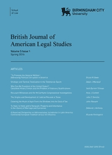
British Journal of American Legal Studies
Scope & Guideline
Empowering Scholars and Practitioners with Insightful Legal Research
Introduction
Aims and Scopes
- Constitutional Law:
Explores the interpretation, application, and evolution of the U.S. Constitution, including discussions on fundamental rights, war powers, and the original meaning of constitutional clauses. - Historical Legal Analysis:
Investigates historical cases and legal practices, particularly during pivotal moments in American history, such as the Civil War and the Reconstruction era, to understand their impact on current legal frameworks. - Judicial Processes and Appointments:
Examines the role and influence of judicial appointments, particularly within the Supreme Court and lower courts, including the dynamics of confirmation hearings and the impact of political considerations. - Race and Law:
Addresses the intersections of race and legal principles, including the implications of race in legal interpretations, historical contexts, and contemporary justice movements. - Immigration Law:
Focuses on the legal frameworks surrounding immigration, including state powers, federal regulations, and the evolving landscape of immigration policy and its constitutional implications. - Environmental Justice:
Discusses the legal dimensions of environmental justice, particularly in relation to social equity, community rights, and the legal mechanisms that address environmental harms.
Trending and Emerging
- Constitutional Interpretation and Rights:
A significant increase in discussions surrounding constitutional interpretation, particularly regarding unenumerated rights and state powers, indicates a growing interest in how contemporary issues challenge traditional constitutional understandings. - Judicial Accountability and Transparency:
Recent papers have increasingly addressed themes of judicial accountability, particularly in relation to Supreme Court confirmations and the implications of judicial secrecy, reflecting public concern over the integrity of the judiciary. - Climate Change and Environmental Law:
Emerging discussions on environmental justice and the legal frameworks addressing climate change highlight an increasing recognition of the intersection between environmental issues and social equity. - Political Dynamics in Law:
The exploration of the political dimensions of law, including the effects of political movements on judicial processes, has gained traction, reflecting broader societal discussions on the relationship between law and politics. - Insurrection and Legal Consequences:
The focus on contemporary issues such as insurrection and its legal ramifications shows a shift towards analyzing current events and their implications for American legal structures, indicating the journal's engagement with pressing national concerns.
Declining or Waning
- International Trade Law:
Earlier publications indicated a stronger focus on international trade agreements and their legal implications, such as U.S.-UK FTA negotiations. Recent titles suggest a reduced emphasis on this area. - Legal Frameworks of Public Policy:
Discussions around public policy frameworks, including the state action doctrine, have become less prevalent, indicating a potential shift towards more immediate legal issues rather than theoretical public policy discussions. - Science Fiction in Legal Education:
The unique exploration of using science fiction narratives in legal education, while innovative, appears to have decreased in frequency, suggesting a move towards more traditional legal pedagogies. - Historical Legal Fiction:
The engagement with fictional narratives in legal contexts, such as references to literary works in legal analysis, has diminished, possibly as the journal focuses more on empirical and real-world legal challenges.
Similar Journals

Studia Prawnicze KUL
Cultivating Knowledge in the Field of LawStudia Prawnicze KUL is an esteemed academic journal published by the John Paul II Catholic University of Lublin, dedicated to the exploration of legal studies and philosophy of law. With the ISSN 1897-7146 and E-ISSN 2719-4264, this journal has adopted an Open Access model since 2019, ensuring that its noteworthy contributions to the field are freely accessible to scholars, practitioners, and students worldwide. The journal aims to disseminate rigorous research, theoretical insights, and practical perspectives in law, fostering scholarly dialogue and collaboration among its diverse readership. As a significant platform for legal scholarship in Poland, Studia Prawnicze KUL provides a vital resource for anyone engaged in the complexities of legal theory and practice, making an important impact in the field of legal studies.

UNIVERSITY OF PITTSBURGH LAW REVIEW
Advancing Legal Thought, One Article at a Time.University of Pittsburgh Law Review is a prestigious academic journal that stands as a cornerstone in the field of legal scholarship. Published by the University of Pittsburgh, University Library System, this journal has been contributing to the discourse of the law since its inception, exemplifying a commitment to advancing scholarly work in various legal domains. Although its open access options are limited, the robust collection of articles and commentaries—spanning from 1973 to the present—provides an invaluable resource for researchers, professionals, and students alike. The journal currently ranks in the Q4 quartile within the field of law for 2023, indicating a specialized focus and offering significant opportunities for legal analysis and research. Positioned in a competitive landscape as Rank #784 out of 1025 in Scopus for Social Sciences - Law, it is an essential platform for emerging voices and innovative ideas that shape legal thought and policy. The University of Pittsburgh Law Review continues to foster critical examination and discussion, making it a vital resource for anyone engaged in the study or practice of law.

Rutgers University Law Review
Advancing legal scholarship for a just tomorrow.Rutgers University Law Review is a premier legal journal published by Rutgers University, dedicated to advancing scholarly discourse in the field of law. Established to serve as a platform for legal practitioners, academics, and students, this journal showcases a rich tapestry of articles, notes, and commentaries that critically engage with contemporary and historical legal challenges. The journal, indexed with an ISSN of 2374-3859, provides open access options, ensuring that its valuable insights are readily available to the global legal community. The Scopus ranking places it at a commendable 61st percentile within the domain of Social Sciences and Law, highlighting its significance and impact in the legal scholarship landscape. By fostering an environment of rigorous academic inquiry, the Rutgers University Law Review continues to play an essential role in shaping future legal frameworks and discussions.

Revista Juridica de Castilla y Leon
Bridging Legal Theory and Practice in SpainRevista Juridica de Castilla y Leon is a prestigious academic journal dedicated to advancing legal scholarship in the field of law and governance. Published by the JUNTA CASTILLA & LEON, CONSEJERIA PRESIDENCIA & ADM TERRITORIAL, this journal plays a vital role in disseminating high-quality research and foster dialogue among legal practitioners, researchers, and students alike. Since transitioning to Open Access in 2003, it has removed barriers to knowledge, allowing a global audience uncontrolled access to innovative legal studies and practices. With its ISSN 1696-6759 and E-ISSN 2254-3805, the journal is committed to publishing articles that address contemporary issues and challenges in the legal landscape, particularly those relevant to the Spanish context. As a reliable source for its readers, Revista Juridica de Castilla y Leon contributes significantly to the field of law, encouraging interdisciplinary research and collaboration to influence policy and improve legal frameworks in Spain and beyond.

ALBERTA LAW REVIEW
Exploring critical legal issues in Canada and beyond.ALBERTA LAW REVIEW, published by the University of Alberta, stands as a key academic journal in the field of law, contributing to the discourse on legal issues and developments in Canada and beyond. With an ISSN of 0002-4821 and an E-ISSN of 1925-8356, this journal has been pivotal since its inception in 1974, providing a platform for legal scholarship that spans a diverse range of topics, from constitutional law to social justice. Although it operates under a traditional subscription model, the journal's illustrious history and rigorously peer-reviewed content affirm its stature in advancing legal research and education. The Alberta Law Review not only serves as a resource for academics and students, but also offers legal practitioners critical insights and analysis pertinent to contemporary legal challenges. With a commitment to enlightening the discourse around law, it is an invaluable asset for anyone engaged in the legal profession or related fields.

Dixi
Advancing Understanding of Complex Social IssuesDixi is an esteemed academic journal published by UNIV COOPERATIVA COLOMBIA, focusing on a wide range of disciplines within the humanities and social sciences. Since its transition to Open Access in 2012, Dixi has committed to democratizing knowledge by providing a platform for researchers and scholars to disseminate their findings without barriers. The journal is dedicated to fostering interdisciplinary dialogue and is particularly well-regarded for its contributions to cultural studies, sociology, and educational research. Located in Bucaramanga, Santander, Colombia, Dixi aims to engage a global audience of researchers, professionals, and students eager to advance their understanding of complex social issues. With its accessible format and commitment to rigorous peer review, Dixi is a vital resource for those seeking to enrich their academic work and influence contemporary discussions in their respective fields.

SYDNEY LAW REVIEW
Fostering Critical Dialogue in Legal StudiesSYDNEY LAW REVIEW is a prestigious academic journal published by the Sydney Law School, dedicated to the field of legal studies and interdisciplinary analysis of law and its impact on society. With its ISSN 0082-0512 and E-ISSN 1444-9528, this journal serves as a vital resource for legal scholars, researchers, and practitioners in Australia and globally. The journal has undergone several phases since its inception in 1990, reflecting the evolving landscape of legal scholarship and policy. Although currently not an open-access publication, it remains a significant contributor to legal discourse, maintaining a Q4 ranking in the Law category as per the 2023 category quartiles. The SYDNEY LAW REVIEW encourages submissions that critically explore contemporary legal issues, thereby fostering a robust platform for academic inquiry and professional advancement.

HARVARD LAW REVIEW
To Inspire, Inform, and Innovate in Law.HARVARD LAW REVIEW, an esteemed publication by the Harvard Law Review Association, stands as a cornerstone of legal scholarship in the United States, boasting an impressive ISSN of 0017-811X and E-ISSN 2161-976X. Renowned for its rigorous editorial standards and comprehensive analyses, this journal occupies the prestigious Q1 category in Law, ranking #149 out of 1025 in Scopus, which places it in the 85th percentile among its peers in the Social Sciences Law category. With a publication history stretching from 1973 to 2024, it consistently features groundbreaking articles, influential essays, and critical commentaries that shape contemporary legal thought. Although not an open-access journal, HARVARD LAW REVIEW remains indispensable for researchers, professionals, and students who seek to engage deeply with the evolving landscape of law. Its rigorous academic focus empowers scholars and practitioners alike, making it a vital resource in the field.

CATHOLIC UNIVERSITY LAW REVIEW
Advancing Legal Scholarship with a Catholic Perspective.CATHOLIC UNIVERSITY LAW REVIEW is a premier legal periodical published by the Catholic University of America Press, located in the heart of Washington, D.C. with a dedicated focus on the intersections of law, education, and religious studies. Since its establishment in 1973, the journal has served as a critical platform for scholarly discourse, presenting innovative legal analysis and thought-provoking research that caters to scholars, practitioners, and students alike. With an ISSN of 0008-8390, this non-open access journal holds a notable place in the academic community, reflected by its category quartiles in 2023, ranking Q4 in Education and Law, and Q3 in Religious Studies. The Catholic University Law Review is distinguished not only by its commitment to advancing legal scholarship but also by its dedication to exploring the implications of law through a distinctly Catholic lens. Its consistent output of high-quality articles contributes to ongoing debates and developments in these fields, making it an essential resource for those interested in the legal implications of contemporary issues.
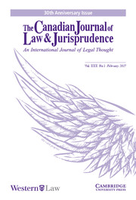
Canadian Journal of Law and Jurisprudence
Bridging Historical Context with Contemporary ChallengesCanadian Journal of Law and Jurisprudence, published by Cambridge University Press, serves as a pivotal platform in the field of legal studies, particularly recognized for its comprehensive exploration of jurisprudence in the context of Canadian law. While the journal operates without an open access model, its ISSN 0841-8209 and E-ISSN 2056-4260 ensure broad academic accessibility. Based in the United Kingdom, it has established a notable impact within its category, maintaining a Q3 ranking in Law according to the latest 2023 metrics. With its convergence of issues from 1996 to 2003, periods in 2007, and recently from 2012 to 2024, the journal embraces a rich historical context while addressing contemporary legal challenges. Ranked #439 out of 1025 in the social sciences category on Scopus, the journal is positioned within the 57th percentile, highlighting its significance and influence in legal scholarship. Aimed at researchers, professionals, and students, the Canadian Journal of Law and Jurisprudence is an essential resource for those seeking to deepen their understanding of the evolving landscape of law and its philosophical underpinnings.