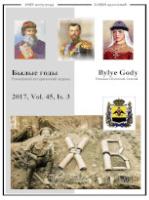
Bylye Gody
Scope & Guideline
Exploring the Depths of History and Politics
Introduction
Aims and Scopes
- Historical Analysis of the Russian Empire:
The journal publishes research that explores various historical events, figures, and periods within the Russian Empire, providing in-depth analyses that contribute to the broader understanding of Russian history. - Interdisciplinary Approaches:
Bylye Gody encourages interdisciplinary methodologies, incorporating perspectives from sociology, anthropology, and political science to enrich historical narratives and provide a multifaceted view of historical developments. - Focus on Ethno-Cultural Dynamics:
The journal places significant emphasis on the interactions between different ethnic groups within the empire, examining how these relationships shaped societal structures, cultural exchanges, and political landscapes. - Documentation and Source Analysis:
Many articles focus on the critical analysis of primary sources, including archival documents, newspapers, and periodicals, to reconstruct historical narratives and understand the socio-political context of various events. - Socio-Political Developments:
The scope includes comprehensive studies on governance, social movements, and legal reforms, particularly how these factors influenced the lives of ordinary citizens and the structure of society.
Trending and Emerging
- Social History and Everyday Life:
A growing number of articles focus on the everyday lives of individuals and communities, exploring social practices, cultural norms, and the impacts of historical events on daily life. - Digital Humanities and Historical Methodologies:
There is an emerging trend towards incorporating digital humanities methods, such as data analysis and digital archiving, to enhance historical research and broaden access to historical resources. - Post-Colonial Perspectives:
Recent publications are increasingly engaging with post-colonial theories to analyze the legacies of imperialism and the complexities of identity among various ethnic groups within the former empire. - Cultural Memory and Historical Narratives:
A significant number of papers are focusing on how collective memory and historical narratives are constructed, contested, and represented in contemporary society, reflecting a broader interest in memory studies. - Transnational History:
There is a noticeable trend towards exploring transnational connections and influences, examining how movements, ideas, and people transcended national boundaries within the context of the Russian Empire.
Declining or Waning
- Military History of the Russian Empire:
Although military history has been a significant theme in past issues, recent publications show a decreasing emphasis on military campaigns and strategies, suggesting a shift towards social and cultural histories. - Colonial Studies:
Research specifically addressing the colonial aspects of the Russian Empire, particularly in Central Asia, has diminished, indicating a potential shift in interest towards more localized or ethno-cultural studies. - Gender Studies in Historical Contexts:
While gender issues were once a more prominent theme, there has been a noticeable decline in articles focusing on women's roles and perspectives in historical narratives, possibly overshadowed by broader socio-political analyses. - Economic History:
The exploration of economic systems and their historical impacts within the empire has seen a reduction, as the journal increasingly prioritizes socio-political and cultural studies over economic analyses. - Environmental History:
Environmental considerations in historical narratives have become less frequent, reflecting a broader trend in historiography where environmental factors are not as prominently featured in discussions of Russian history.
Similar Journals
CENTRAL EUROPEAN HISTORY
Illuminating the Past, Shaping the Future of Central EuropeCENTRAL EUROPEAN HISTORY is a distinguished academic journal published by Cambridge University Press, dedicated to the exploration and analysis of historical developments in Central Europe. With its ISSN 0008-9389 and E-ISSN 1569-1616, this journal has been a cornerstone in historical scholarship since its inception in 1968, catering to a global audience through its rigorous research articles and interdisciplinary approach. Recognized in the Q2 category in History in 2023, it aims to bridge gaps in Central European historiography and foster a deeper understanding of the region's complex past. The journal's commitment to publishing high-quality research makes it an invaluable resource for historians, researchers, and students alike. Although it does not offer Open Access, CENTRAL EUROPEAN HISTORY remains a vital publication in the field, addressing themes and debates that resonate with contemporary academic discourses. With a rich archive spanning over five decades, it continues to influence scholarship and promote informed discussions around Central European historical narratives.

NORTHERN HISTORY
Advancing Historical Understanding in Northern ContextsNorthern History is a distinguished academic journal published by Routledge Journals, Taylor & Francis Ltd, focusing on the exploration of historical narratives, themes, and developments in the northern regions of the United Kingdom and beyond. Established in 1966, this journal has been a pivotal platform for scholars aiming to advance the understanding of historical processes and cultural transformations in a northern context. Though currently categorized in Q4 of the History quartile for 2023, it provides unique insights that have contributed to a diverse range of inquiries and debates within the field, ranking #1143/1760 in Scopus for Arts and Humanities History. While Northern History is not an open-access journal, it remains vital for researchers and students seeking to enrich their knowledge and engage with current scholarly discussions in historical studies. Housed in the United Kingdom, this journal is committed to the dissemination of quality research and serves as an essential resource for understanding the complexities of history in the northern realms.

RUSSIAN HISTORY-HISTOIRE RUSSE
Fostering Insights into Russia’s Historical JourneyRUSSIAN HISTORY-HISTOIRE RUSSE is a distinguished academic journal published by BRILL, focusing on the rich and complex tapestry of Russian historical studies. Established in 1975, this journal serves as a vital platform for scholars, researchers, and students interested in exploring the multifaceted aspects of Russia's past. With its ISSN 0094-288X, it has undergone significant evolution over the years, marking its converged publication years as essential milestones in the academic discourse surrounding Russian history. While currently not an open access journal, it is recognized for its rigorous peer-reviewed articles and contributes to the field's scholarship, as reflected in its 2023 Scopus ranking within the 49th percentile (Rank #876 out of 1760) in Arts and Humanities - History, and its Q4 quartile classification. Located in Leiden, Netherlands, the journal is committed to enhancing understanding of both historical patterns and contemporary implications, making it an essential resource for academic inquiry and research excellence.
PENNSYLVANIA MAGAZINE OF HISTORY AND BIOGRAPHY
Unearthing Pennsylvania's Past, One Story at a TimePennsylvania Magazine of History and Biography, published by University of Pennsylvania Press, is a prominent scholarly journal dedicated to the exploration and examination of historical narratives and biography with a focus on the state of Pennsylvania. Established as a key resource in the field of history, this journal is distinguished by its commitment to interdisciplinary research and its role in fostering scholarly discourse. With an ISSN of 0031-4587 and an E-ISSN of 2169-8546, the journal is indexed in respected databases, although it maintains a Q4 quartile rank in History according to the 2023 category quartiles. It stands as a valuable platform for researchers and historians, offering insights that illuminate the rich tapestry of Pennsylvania's past and its impact on broader historical trends. The journal is accessible through various platforms, ensuring that contemporary scholars can engage with its content even as it continues to evolve, reflecting the changing dynamics of historical study. As it has been in circulation since 1951, with converged formats from several years through 2024, this magazine remains a cornerstone for those seeking comprehensive studies that integrate local history within wider national narratives.
Journal of Modern Russian History and Historiography
Engaging with the Dynamics of Russia's Historical NarrativesJournal of Modern Russian History and Historiography, published by BRILL, serves as a vital platform for scholars engaging with contemporary topics in Russian history and historiographical methodologies. With an ISSN of 1947-9956 and E-ISSN of 2210-2388, this esteemed journal is indexed in fields that reflect the evolving landscape of historical research. Based in Germany and recognized for its academic rigor, the journal stands in the Q4 quartile in both the Arts and Humanities and History categories as of 2023. Despite its challenges in SCOPUS rankings, the Journal of Modern Russian History and Historiography continues to be essential for researchers, professionals, and students alike, fostering critical discourse on modern Russian narratives and historiographical practices. The journal seeks to publish innovative articles that enhance understanding of Russia's historical context and the dynamics of its historiography, making it a valuable resource for those studying or working in this field.

BULGARIAN HISTORICAL REVIEW-REVUE BULGARE D HISTOIRE
Engaging in Discourse: Illuminating Eastern European HistoriesBULGARIAN HISTORICAL REVIEW - REVUE BULGARE D HISTOIRE is a distinguished journal published by the PUBL HOUSE BULGARIAN ACAD SCI, providing a critical platform for the exploration and analysis of historical narratives pertinent to Bulgaria and its broader regional context. With an ISSN of 0204-8906, this journal has been a reservoir of scholarly research since its inaugural issue, recently covering years from 2001 to 2007 and again from 2009 to 2023. Despite its classification in the Q4 category of History, it uniquely contributes to understanding and preserving historical insights, as reflected in its modest but growing impact in the academic community, where it currently ranks #1405 out of 1760 in Scopus Analytics. The journal aims to engage researchers, professionals, and students by presenting a diverse array of articles, encouraging scholarly discourse that sheds light on historical complexities and advancements. While it currently does not adopt an open-access model, it remains a crucial resource for those engaged in historical studies, particularly in Eastern European contexts.
Historical Review-La Revue Historique
Connecting Histories, Inspiring Minds.Historical Review-La Revue Historique, published by the NATL HELLENIC RES FOUNDATION, is a premier open-access journal focusing on the multifaceted field of history. Established in 2004 and operating out of Greece, this journal serves as a platform for the dissemination of scholarly research, critical essays, and innovative perspectives on historical events, figures, and themes. Though it has transitioned through different stages in its indexing, including a hiatus from Scopus coverage between 2009 to 2021, it has successfully maintained its presence in the academic community, evidenced by its current Q4 classification in the history category of Arts and Humanities. With an ISSN of 1790-3572 and an E-ISSN of 1791-7603, the journal continues to foster rich academic dialogue and inquiry, making research accessible to a wider audience. As a valuable resource for researchers, educators, and students, Historical Review-La Revue Historique contributes significantly to the understanding and appreciation of historical narratives and methodologies.

HISTORISCHES JAHRBUCH
Illuminating Historical Narratives.HISTORISCHES JAHRBUCH is a notable German academic journal published by VERLAG KARL ALBER, dedicated to the field of history. With a rich tradition that began in 1941, this journal serves as a platform for scholarly research, exploring various historical themes and methodologies. Although specific impact factors are not readily available, its categorization as Q4 in History indicates its role in the wider academic discourse. HISTORISCHES JAHRBUCH is primarily accessible through subscription, reflecting its commitment to traditional publishing while providing valuable insights for historians, researchers, and students. The journal's coverage, which has converged over selected years including 1980, discontinuing in Scopus, highlights its shifting focus and the evolving landscape of historical study. As a contributing member to the historical scholarship community, HISTORISCHES JAHRBUCH continues to enrich the understanding of historical narratives and foster academic exploration.
CALIFORNIA HISTORY
Preserving the Legacy of the Golden StateCalifornia History, published by the California Historical Society, is a prominent journal dedicated to the exploration and documentation of the rich historical tapestry of California from its early days to the modern era. With an ISSN of 0162-2897 and an E-ISSN of 2327-1485, this journal serves as a critical resource for researchers, historians, and students interested in the socio-cultural, political, and economic developments of the Golden State. Though not classified as Open Access, its extensive archive and curated articles offer valuable insights into California's diverse heritage. Operating from 678 Mission St, San Francisco, CA, California History has transitioned through various phases since its inception in 1978, with a commitment to presenting comprehensive historical narratives and scholarly discourse. The journal is indexed in Scopus, reflecting its academic significance, ranking 1068 among a pool of 1760 in the Arts and Humanities category for History. By bridging the past and the present, California History remains an essential platform for fostering understanding and appreciation of California's unique place in American history.

HISTORIA MEXICANA
Fostering Insights into Mexico's Complex PastHISTORIA MEXICANA is a prestigious academic journal published by the COLEGIO DE MEXICO CENTRO DE ESTUDIOS HISTORICOS that has been an open access resource since its inception in 1967. With an ISSN of 0185-0172 and an E-ISSN of 2448-6531, the journal serves as a vital platform for scholars dedicated to the exploration of historical studies, particularly focusing on Mexico and its broader context within Latin American history. As a testament to its scholarly impact, HISTORIA MEXICANA is ranked in the Q3 category in History according to the 2023 metrics and holds a Scopus rank of #582 out of 1760 in Arts and Humanities. This journal not only fosters rigorous academic discourse but also provides a unique repository of knowledge, bridging gaps in historical research and inspiring future studies in the field. Researchers, professionals, and students alike will find this journal an invaluable resource for deepening their understanding of Mexico's rich and complex past.