Cambridge Journal of Postcolonial Literary Inquiry
Scope & Guideline
Unraveling the complexities of postcolonial narratives.
Introduction
Aims and Scopes
- Interdisciplinary Approaches:
The journal emphasizes interdisciplinary research, integrating perspectives from literature, cultural studies, history, and political theory to enrich the understanding of postcolonial narratives. - Focus on Memory and History:
A significant focus is placed on the themes of memory and history, particularly how they shape postcolonial identities and narratives, exploring concepts like collective memory and historical trauma. - Cultural and Social Critique:
The journal serves as a platform for cultural and social critique, examining the implications of colonial legacies in contemporary society and how literature responds to these challenges. - Global and Transnational Perspectives:
By engaging with global and transnational perspectives, the journal explores how literature transcends national boundaries, fostering dialogues between different cultural contexts. - Emergent Literary Forms:
The journal is interested in emergent literary forms and genres, including digital literatures and new media, reflecting the evolving landscape of postcolonial expression.
Trending and Emerging
- Digital Literatures and Media:
The increasing focus on digital literatures and the role of social media in shaping postcolonial identities highlights the relevance of technology in contemporary cultural expressions. - Memory Studies:
A robust engagement with memory studies is evident, exploring how literature grapples with historical memory, trauma, and the politics of recollection in postcolonial contexts. - Intersectionality and Identity Politics:
There is a growing emphasis on intersectionality, particularly how various identities (gender, race, sexuality) interact within postcolonial frameworks, reflecting contemporary social movements. - Decolonization and Global Literature:
The theme of decolonization is gaining traction, with scholars increasingly examining how literature contributes to or challenges decolonial thought and practices. - Environmental and Postcolonial Studies:
Emerging discussions on environmental issues within postcolonial studies are becoming more prominent, addressing the intersections of colonial histories and ecological crises.
Declining or Waning
- Traditional Canonical Texts:
There appears to be a decline in the focus on traditional canonical texts of postcolonial literature, as contemporary scholarship increasingly prioritizes diverse voices and lesser-known authors. - Colonial Narratives:
The exploration of colonial narratives as standalone subjects has decreased, with more emphasis now placed on postcolonial responses and critiques rather than merely recounting colonial histories. - Static Theoretical Frameworks:
There is a noticeable move away from static theoretical frameworks that do not account for the complexities of contemporary postcolonial situations, as scholars seek more dynamic and adaptable approaches.
Similar Journals
ESPRIT CREATEUR
Exploring the Depths of Literary InnovationESPRIT CREATEUR is a prestigious journal published by the Johns Hopkins University Press, renowned for its contributions to the fields of Literature and Literary Theory. Since its inception in 2002, the journal has become a vital platform for innovative scholarly discourse, achieving an impressive Q2 classification in the 2023 category rankings and a respectable rank of #546 out of 1106 in the Scopus Arts and Humanities - Literature and Literary Theory sector, situating it within the 50th percentile of the discipline. The journal's blend of critical perspectives offers readers insights into contemporary literary analysis and theory, making it essential for researchers, professionals, and students alike. Though it currently adheres to traditional access models, its commitment to fostering high-quality, peer-reviewed scholarship cements its status as a leading voice in literary studies, enhancing its role in academic research and education.

Acta Literaria
Connecting Innovators in the World of LiteratureActa Literaria is a distinguished journal published by the Universidad de Concepción, Facultad de Humanidades y Arte, focusing on the intricate domains of literature and literary theory. With an ISSN of 0717-6848, this Chilean journal has been a vital contributor to the scholarly discourse in its field since its inception in 2007. Although currently categorized in the Q4 quartile for the year 2023 and holding a Scopus rank of #860 out of 1106 in the Arts and Humanities section, Acta Literaria plays a crucial role in fostering dialogue and exploration among researchers, professionals, and students alike. The journal aims to facilitate the exchange of innovative ideas, critical analyses, and diverse perspectives on literature, making it an indispensable resource for anyone engaged in literary studies. While it does not offer open access, the journal's commitment to upholding academic rigor ensures that it remains a respected platform for scholarly publication.
Parallax
Engaging Minds in the Pursuit of Knowledge and CreativityParallax is an esteemed scholarly journal published by Routledge Journals, Taylor & Francis Ltd, focusing on critical studies in Cultural Studies, Literature and Literary Theory, Philosophy, and Visual Arts and Performing Arts. Established in 1995 and operating from the United Kingdom, it has carved out a niche as a vital resource for researchers, professionals, and students alike, contributing notable insights and fostering discourse within these dynamic fields. With its rigorously peer-reviewed articles, Parallax enjoys a solid reputation, evidenced by its Q2 ranking in multiple categories in 2023 and impressive Scopus statistics that position it among the top percentile of its peers. The journal's commitment to interdisciplinary engagement invites scholars to explore the intersections of culture, art, and philosophy, making it an essential reference point for contemporary academic inquiry.

Impossibilia-Revista Internacional de Estudios Literarios
Navigating the Uncharted Territories of LiteratureImpossibilia-Revista Internacional de Estudios Literarios is a premier open access journal dedicated to the vibrant field of literary studies, published by ASSOC CULTURAL IMPOSSIBILIA since 2011. With its ISSN 2174-2464, this international journal encourages the exploration and analysis of diverse literary theories, texts, and contexts, making it an essential resource for researchers, scholars, and students alike. Hailing from Granada, Spain, Impossibilia not only fosters academic discourse in literature but also promotes intercultural dialogue through its commitment to accessibility and inclusivity. While data such as H-index and Scopus rankings are still to be developed, the journal's focus on enriching the literary landscape ensures its growing impact and relevance within the academic community.

Novoe Literaturnoe Obozrenie
Bridging Theory and Practice in Cultural CritiqueNovoe Literaturnoe Obozrenie, an esteemed publication dedicated to the realms of Cultural Studies and Literature and Literary Theory, serves as a vital resource for scholars and professionals alike. Published by NOVOE LITERATURNOE OBOZRENIE-NEW LITERARY OBSERVER in the Russian Federation, this journal provides critical insights and scholarly critiques that reflect the evolving landscape of literary discourse. With an established H-index and a focus on fostering academic inquiry, the journal has secured its place amidst contemporary scholarly discussions, indexed in Scopus with rankings that illustrate its commitment to quality despite a current presence in the lower quartiles. Novoe Literaturnoe Obozrenie is a non-open-access journal, encouraging a traditional yet scholarly approach to literary studies and remains an essential read for researchers, students, and professionals that seek to deepen their understanding of literature’s impact on culture and society. Publishing from 2016 until 2024, it continues to bridge theoretical frameworks with practical discourse, making significant contributions to the fields it encompasses.

Concentric-Literary and Cultural Studies
Advancing Interdisciplinary Dialogues in Literary StudiesConcentric-Literary and Cultural Studies is a distinguished journal dedicated to advancing scholarship in the fields of literature and cultural studies. Published by the NATIONAL TAIWAN NORMAL UNIVERSITY, COLLEGE OF INTERNATIONAL STUDIES & SOCIAL SCIENCES, this journal offers a platform for researchers and academics to explore diverse topics that intersect literature and culture. With its ISSN 1729-6897 and E-ISSN 1729-8792, Concentric has been making significant contributions since its inception in 2012. Although presently listed in the Q4 quartile for both cultural studies and literature, the journal is committed to enhancing interdisciplinary dialogues and fostering innovative research approaches that push the boundaries of traditional scholarship. Residing in Taiwan, Concentric not only caters to local scholars but also reaches an international audience, providing access to critical perspectives and recent advancements in these pivotal fields. Aspiring to an impactful future, this journal continues to promote scholarly excellence and aims to ascend within academic rankings while engaging a robust community of researchers, professionals, and students.

Anclajes
Connecting Cultures Through Scholarly InsightAnclajes is a prominent academic journal dedicated to the fields of Cultural Studies, Linguistics, and Literature, published by the UNIV NACIONAL LA PAMPA, FAC CIENCIAS HUMANAS. With both print (ISSN 0329-3807) and electronic (E-ISSN 1851-4669) formats, the journal has embraced an Open Access model since 2010, greatly enhancing its accessibility and reach to a global audience. Based in Argentina, Anclajes provides a platform for innovative research and critical discourse, contributing significantly to the understanding of cultural phenomena and literary theories. In recent years, the journal has established itself with a Scopus rank placing it in the top 30% of Literature and Literary Theory and the top 57% of Cultural Studies, as indicated by its quartile rankings for 2023. With issues converging from 2012 to 2024, Anclajes continues to foster scholarly communication and serves as an essential resource for researchers, students, and professionals seeking to explore the dynamism of human culture and expression.

Kamchatka-Revista de Analisis Cultural
Exploring the depths of culture and communication.Kamchatka-Revista de Analisis Cultural is a distinguished open-access journal published by the University of Valencia, Department of Prehistory and Archaeology, situated in the vibrant cultural landscape of Valencia, Spain. Since its establishment in 2013, this journal has dedicated itself to advancing knowledge across an array of interdisciplinary fields, including Communication, Cultural Studies, History, Linguistics and Language, and Literature and Literary Theory. With an impressive categorization in the latest 2023 category quartiles, Kamchatka has positioned itself in Q1 for Literature and Literary Theory and consistently ranks within Q2 for several relevant disciplines. This exemplary standing is further validated by its Scopus ranking, reflecting the journal's capacity to engage and disseminate high-quality scholarly discourse. By providing a platform for innovative research and critical analysis, the journal not only enriches academic conversations but also advocates for the dissemination of cultural insights and narratives essential for both researchers and students alike. Engage with Kamchatka-Revista de Analisis Cultural and contribute to the ever-evolving dialogue in the humanities.
South Central Review
Fostering Scholarly Dialogue Across DisciplinesSouth Central Review, a distinguished academic journal published by Johns Hopkins University Press, serves as a vital platform for scholarly discourse in the fields of cultural studies, literature and literary theory, philosophy, and the visual and performing arts. With an ISSN of 0743-6831 and an E-ISSN of 1549-3377, this journal is dedicated to highlighting innovative research and critical analyses that explore the complexities of Southern culture and its broader implications. Although it operates without an open access option, the journal is recognized for its rigorous peer-review process and contributions to contemporary academic dialogue, holding Q3 and Q4 rankings across several disciplines as of 2023. The convergence of ideas and perspectives from diverse academic backgrounds positions the South Central Review as an essential resource for researchers, professionals, and students seeking to deepen their understanding of the cultural narratives shaping our world today.
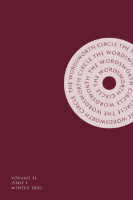
WORDSWORTH CIRCLE
Navigating the Complexities of Cultural NarrativesWORDSWORTH CIRCLE, an esteemed journal published by University of Chicago Press, serves as a pivotal platform for scholars and enthusiasts in the fields of Cultural Studies and Literature and Literary Theory. With a firm foundation established from 2002 and expected to continue through 2024, the journal is recognized for its rigorous scholarship, evident in its prestigious ranking of Q1 in Literature and Literary Theory and Q2 in Cultural Studies for the year 2023. Although it is not an open-access journal, its valuable contributions to the discourse surrounding literary analysis and cultural critique make it a significant resource for researchers, students, and practitioners seeking to deepen their understanding of these dynamic fields. The journal's ISSN is 0043-8006, and it operates out of Chicago, IL, with its influence resonating across academic institutions and literary circles globally. By bridging historical perspectives and contemporary discussions, WORDSWORTH CIRCLE remains an essential publication for those dedicated to exploring the complexities of literature and culture.