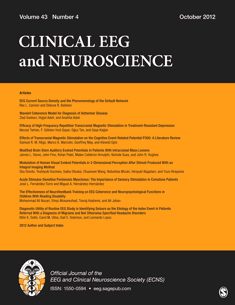
CLINICAL EEG AND NEUROSCIENCE
metrics 2024
Advancing the Frontiers of Neurological Research
Introduction
CLINICAL EEG AND NEUROSCIENCE, published by SAGE Publications Inc, stands as a pivotal journal in the fields of neurology and neuroscience, with a focus on the latest research and advancements in clinical electroencephalography and neurophysiology. Since its inception in 1970, the journal has provided a platform for rigorous scholarly work, offering valuable insights into neurological disorders and EEG technology. With its current categorization in the Q2 and Q3 quartiles across various subfields of medicine and neurology, it ranks prominently in the Scopus database, emphasizing its significance in academic discourse. The journal's commitment to disseminating high-quality research is underscored by its open access options, facilitating broader accessibility to its published findings. For researchers, clinicians, and students alike, CLINICAL EEG AND NEUROSCIENCE remains an essential resource for keeping abreast of the evolving landscape of neurological studies.
Metrics 2024
 0.661.601.9064
Metrics History
Rank 2024
Scopus
IF (Web Of Science)
JCI (Web Of Science)
Quartile History
Similar Journals
NEUROSCIENCE RESEARCH
Connecting Science and Application in NeuroscienceNEUROSCIENCE RESEARCH, published by Elsevier Ireland Ltd, is a leading journal in the field of neuroscience, with a notable reputation for disseminating high-quality research that spans a variety of topics within the discipline. With an ISSN of 0168-0102 and an E-ISSN of 1872-8111, this journal serves as a vital platform for both established researchers and emerging voices in the field. Ranking in the Q2 quartile in both Medicine and Neuroscience categories, it has been recognized as a reliable source of innovative findings since its inception in 1984, with continuous publication through 2024. Although it does not currently offer Open Access options, the journal is indexed in Scopus, holding a significant position at Rank #48/113 in General Neuroscience, reflecting its contribution to advancing the understanding of neural mechanisms across various contexts. With its address anchored in Ireland, NEUROSCIENCE RESEARCH plays an essential role in bridging scientific inquiry and practical applications, making it an indispensable resource for researchers, professionals, and students dedicated to the burgeoning field of neuroscience.

JOURNAL OF NEUROSCIENCE METHODS
Innovating the Future of Neuroscience MethodologiesWelcome to the JOURNAL OF NEUROSCIENCE METHODS, a prestigious platform for disseminating innovative methodologies in the interdisciplinary field of neuroscience. Published by Elsevier, this journal has been pivotal since its inception in 1979, covering a diverse range of experimental techniques and methods aimed at advancing our understanding of neural systems and functions. With a commendable impact factor and classified within the Q2 category in Neuroscience (miscellaneous) as of 2023, the journal continues to attract high-quality research from professionals, scholars, and students alike. While maintaining a robust subscription model, it provides unparalleled access to groundbreaking studies, fostering collaboration and knowledge exchange among the global neuroscience community. Join us as we explore and contribute to the evolution of neuroscience methodologies through rigorous research and comprehensive reviews, setting the stage for future discoveries.

NEUROSCIENCE
Illuminating the pathways of neural understanding.NEUROSCIENCE, published by PERGAMON-ELSEVIER SCIENCE LTD, has established itself as a reputable journal in the field of neuroscience since its inception in 1976, continuing its contributions through 2024. With a Category Quartile ranking of Q2 in Neuroscience (miscellaneous) and a Scopus Rank of #41 out of 113, this journal represents a critical platform for the dissemination of innovative research and insights. Although it currently does not offer open access options, NEUROSCIENCE aims to advance our understanding of the nervous system by publishing high-quality original research, reviews, and methodological articles, thereby engaging a comprehensive audience of researchers, professionals, and students alike. With an impact factor that reflects its significance in the scientific community, this journal remains a go-to source for cutting-edge discoveries and scholarly discussions in the dynamic field of neuroscience.
HUMAN BRAIN MAPPING
Exploring the intricate pathways of the human brain.HUMAN BRAIN MAPPING, published by Wiley, is a premier journal in the field of neuroscience, devoted to comprehensively advancing understanding of brain structure and function through innovative mapping techniques. With an impressive impact factor and ranked in the Q1 category across multiple relevant disciplines—including Anatomy, Neurology, and Radiology—this journal is recognized as a vital resource for researchers and professionals passionate about the complexities of the human brain. Founded in 1993 and continuously publishing groundbreaking research, HUMAN BRAIN MAPPING is essential for those looking to stay at the forefront of developments in anatomical and neurological research. Though it does not currently offer Open Access options, the journal remains committed to disseminating high-quality research that influences clinical practices and academic inquiry. Its esteemed position within Scopus highlights its significance; charting at the top percentiles across various medical and health fields serves as a testament to the critical contributions made by the authors and researchers involved. As it converges toward 2024, HUMAN BRAIN MAPPING continues to be the go-to platform for publishing pivotal insights into the intricacies of brain mapping methodologies and applications.

Frontiers in Neuroinformatics
Driving Scientific Progress Through Open Knowledge ExchangeFrontiers in Neuroinformatics is a prestigious open-access journal published by FRONTIERS MEDIA SA in Switzerland, dedicated to advancing the interdisciplinary field of neuroinformatics. Since its inception in 2007, the journal has played a crucial role in facilitating knowledge exchange among researchers and professionals, exploring the intersection of neuroscience, biomedical engineering, and computer science applications. With an impressive Q2 ranking in both Biomedical Engineering and Computer Science Applications, and a Q3 ranking in Neuroscience, the journal consistently showcases cutting-edge research and innovations that push the boundaries of our understanding of the brain and its computational models. Positioned prominently within the Scopus rankings, with a rank of #15/49 in Neuroscience (miscellaneous) and a 70th percentile standing, Frontiers in Neuroinformatics is essential reading for anyone engaged in this dynamic field. Researchers, students, and practitioners are encouraged to contribute to and leverage this accessible platform to foster collaboration and drive scientific progress.

NEUROIMAGE
Pioneering Insights into Brain Structure and FunctionNEUROIMAGE, published by Academic Press Inc Elsevier Science, is a leading international journal dedicated to advancing the fields of cognitive neuroscience and neurology. With an impressive impact factor that places it in the Q1 category for both disciplines, NEUROIMAGE stands at the forefront of disseminating high-quality research that employs advanced imaging methods to elucidate the workings of the human brain. As a pivotal platform since its inception in 1992, this journal has continued to thrive, embracing Open Access publishing since 2020 to ensure wider dissemination and accessibility of cutting-edge findings. With a Scopus rank of 7th in cognitive neuroscience and 13th in neurology, and situated in the 94th and 93rd percentiles respectively, NEUROIMAGE serves as an invaluable resource for researchers, professionals, and students alike seeking to explore the intricate relationships between brain structure and function. For more information, please visit their office at 525 B ST, STE 1900, SAN DIEGO, CA 92101-4495.
Neurocritical Care
Shaping the future of intensive neurological care.Welcome to Neurocritical Care, a leading journal dedicated to advancing the field of neurocritical care medicine. Published by HUMANA PRESS INC, this esteemed journal boasts a commendable impact, having secured its position in the top quartile (Q1) for both Critical Care and Intensive Care Medicine as well as Clinical Neurology in 2023. Aimed at healthcare professionals, researchers, and students, Neurocritical Care serves as a vital platform for disseminating cutting-edge research, comprehensive reviews, and clinical guidelines that enhance the understanding and management of critically ill neurological patients. With a focus on high-quality, peer-reviewed content, this journal plays a critical role in shaping clinical practice and improving patient outcomes in neurocritical settings. Spanning from 2004 to 2024, its rich archive will continue to support the academic community and foster innovation in this essential area of medicine.
Frontiers in Computational Neuroscience
Advancing the Intersection of Brain Function and Computational Innovation.Frontiers in Computational Neuroscience, published by FRONTIERS MEDIA SA, is a leading journal within the fields of neuroscience and computational biology, dedicated to advancing the understanding of the brain's complex functions through innovative computational methodologies. Since its establishment in 2007, this Open Access journal has provided a platform for researchers around the globe to share their groundbreaking findings, as evidenced by its continual presence in the academic conversation and a strong ranking within Scopus metrics (Rank #12/49 in Neuroscience - Neuroscience (miscellaneous) and Rank #63/97 in Cellular and Molecular Neuroscience). With an esteemed impact factor reflective of its quality and influence, and a commitment to providing freely accessible research, this journal plays a crucial role in fostering collaboration and knowledge dissemination among professionals, researchers, and students alike. Located in the scientific hub of Switzerland, it invites submissions from diverse perspectives, aiming to bridge the gap between computational models and biological insights through rigorous peer-reviewed publications.

CEREBRAL CORTEX
Advancing knowledge in cortical neuroscience.CEREBRAL CORTEX, published by Oxford University Press Inc, is a premier journal dedicated to advancing the field of neuroscience, specifically focusing on the cellular, molecular, and cognitive aspects of cortical structure and function. With an impressive impact factor that situates it in the top quartile (Q1) of its categories for 2023, this journal holds significant relevance for researchers and professionals interested in the latest discoveries and methodologies in both Cognitive Neuroscience (ranked #31 out of 115) and Cellular and Molecular Neuroscience (ranked #48 out of 97). Operating without an open access model, it ensures rigorous peer review and dissemination of high-quality research from across the globe. Since its inception in 1991, CEREBRAL CORTEX has established itself as a critical platform for educators and inventors, pushing the boundaries of knowledge in understanding brain function and its implications for behavior. Researchers and students alike will find this journal an invaluable resource for both foundational and cutting-edge studies in neuroscience.
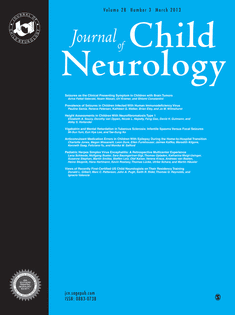
JOURNAL OF CHILD NEUROLOGY
Empowering Research for a Brighter Future in Child NeurologyThe JOURNAL OF CHILD NEUROLOGY is a distinguished publication in the critical fields of neurology and pediatrics, published by SAGE PUBLICATIONS INC. With its ISSN 0883-0738 and E-ISSN 1708-8283, this journal has been a pivotal resource since its inception in 1986, serving the needs of researchers, clinicians, and students dedicated to advancing the understanding and treatment of neurological disorders in children. As evidenced by its impressive Q2 rankings in both Neurology (clinical) and Pediatrics, Perinatology, and Child Health, the journal has established a reputable position within the academic community, ranking in the 75th percentile for pediatrics and the 53rd percentile for clinical neurology. This periodical not only contributes to the body of knowledge in child neurology but also promotes interdisciplinary collaboration, engaging a global audience through innovative research articles and case studies. Although the journal is not open access, it remains committed to disseminating high-quality research aimed at improving pediatric health outcomes, making it an essential read for professionals and researchers dedicated to this crucial area of medicine.