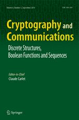
Cryptography and Communications-Discrete-Structures Boolean Functions and Sequences
metrics 2024
Charting new territories in Boolean functions and secure communications.
Introduction
Cryptography and Communications - Discrete Structures, Boolean Functions and Sequences is a distinguished journal published by Springer, focusing on the crucial intersections of cryptography, discrete mathematics, and communication systems. With a significant presence in the academic community since its inception in 2009, the journal has established a robust reputation, holding a Q1 ranking in Applied Mathematics and notable positions in other relevant categories, reflecting its impact in the field. Researchers and professionals will find this journal engaging as it rigorously explores the theoretical underpinnings and practical applications of boolean functions and sequences, essential for advancing secure communication protocols and efficient data processing. Despite not currently offering open access, the journal is highly regarded for its quality peer-reviewed articles, making it a vital resource for scholars aiming to contribute to or stay at the forefront of cryptographic research. Its continual publication through 2024 ensures an ongoing dialogue in this rapidly evolving field, enhancing understanding and innovation among its readership in the United States and beyond.
Metrics 2024
 0.911.201.3024
Metrics History
Rank 2024
Scopus
IF (Web Of Science)
JCI (Web Of Science)
Quartile History
Similar Journals
Journal of Mathematical Cryptology
Unlocking the Future of Cybersecurity through Mathematical InnovationThe Journal of Mathematical Cryptology, published by DE GRUYTER POLAND SP Z O O, is a pioneering open-access journal that has been a valuable resource for researchers and professionals in the field of mathematical cryptography since its inception in 2007. With an ISSN of 1862-2976 and an E-ISSN of 1862-2984, this journal provides a platform for cutting-edge research, aiming to address the complexities and challenges presented by the evolving landscape of cybersecurity. As of 2023, the journal holds a respectable Q3 ranking in Applied Mathematics, Computational Mathematics, and Computer Science Applications, reflecting its relevance and growing impact within these disciplines. Although it currently has an H-index of "-", the qualitative contributions of the journal are recognized through its Scopus rankings, including a placement in the 58th percentile for Applied Mathematics. The journal is committed to fostering collaboration and innovation in mathematical methodologies applied to cryptography, thus attracting a diverse audience of researchers, students, and industry professionals. By embracing an open-access model since 2020, the Journal of Mathematical Cryptology enhances the visibility and accessibility of essential research findings, making it a crucial resource in the academic community.
Groups Complexity Cryptology
Exploring the Intersection of Mathematics and SecurityGroups Complexity Cryptology, published by EPISCIENCES, is an esteemed Open Access journal that has been contributing to the fields of Applied Mathematics, Computational Mathematics, Computational Theory, and Computer Networks and Communications since its inception in 2009. With its headquarters located in France, this journal serves as a crucial platform for disseminating innovative research and solutions in cryptology and related areas. As of 2023, it proudly holds Q4 rankings across several categories in Scopus, indicating its recognized, yet emerging position within the academic community. Additionally, it is indexed under various categories such as Applied Mathematics, where it ranks in the 24th percentile, showcasing its potential for growth and increased visibility among researchers. The journal adheres to an open-access model introduced in 2020, allowing for widespread accessibility and engagement with cutting-edge research. This enhances the journal's mission to foster academic communication and collaboration among researchers, professionals, and students interested in the complex interplay of groups, complexity, and cryptography.

International Journal of Computer Mathematics- Computer Systems Theory
Exploring New Horizons in Computational ResearchInternational Journal of Computer Mathematics - Computer Systems Theory, published by Taylor & Francis Ltd, is a vital resource in the fields of computational mathematics and computer systems theory. With an ISSN of 2379-9927 and E-ISSN 2379-9935, this journal has established a prominent presence in academia since its inception in 2016. It is categorized in the Q3 quartile for both Computational Mathematics and Computational Theory in 2023, reflecting its impact and contribution to the scholarly discourse within these domains. The journal’s Scopus rankings further emphasize its academic relevance, placing it in the 38th and 33rd percentiles in their respective categories. International Journal of Computer Mathematics aims to disseminate innovative research findings, methodologies, and theoretical advancements, making it an essential publication for researchers, professionals, and students looking to deepen their understanding of computational methods and applications. Although it currently does not offer open access, the journal continues to provide insightful contributions to the scientific community, fostering the evolution of computational sciences.
FUNDAMENTA INFORMATICAE
Fostering Excellence in Informatics Research Since 1988.FUNDAMENTA INFORMATICAE is a distinguished academic journal published by IOS PRESS, focusing on the critical intersection of informatics, mathematics, and computer science. Since its inception in 1988, this journal has served as a vital resource for researchers and professionals alike, providing a platform for innovative studies in Algebra and Number Theory, Computational Theory and Mathematics, Information Systems, and Theoretical Computer Science. With an impressive HIndex, and ranking in the Q3 and Q4 categories across various disciplines as of 2023, it underscores its contribution and relevance in advancing the body of knowledge in these fields. The journal's commitment to excellence is reflected not only in its rigorous peer-review process but also in its notable rankings on Scopus, which positions it favorably among its peers. Though not yet available as an open access journal, FUNDAMENTA INFORMATICAE remains a crucial academic venue for authors wishing to disseminate their findings to a global audience, promoting collaboration and further research within the scientific community.
FINITE FIELDS AND THEIR APPLICATIONS
Diving into the Interdisciplinary World of Finite Fields.FINITE FIELDS AND THEIR APPLICATIONS is a premier academic journal published by Academic Press Inc. Elsevier Science that focuses on the interdisciplinary study of finite fields and their diverse applications across various domains of mathematics and engineering. With an ISSN of 1071-5797 and an E-ISSN of 1090-2465, this journal has established itself as a leading platform for researchers, professionals, and students aiming to explore advancements in Algebra and Number Theory, Applied Mathematics, and Engineering. Awarded a Q1 ranking in multiple categories by Scopus in 2023, this journal features rigorous peer-reviewed articles that contribute to both theoretical developments and practical applications, reflecting its relevance within the mathematical sciences community. The journal's convergence over the years from 1995 to 2024 highlights its sustained commitment to quality research, making it an invaluable resource for those seeking to deepen their understanding of finite fields and their significance in contemporary mathematical discourse.

Prikladnaya Diskretnaya Matematika
Connecting Scholars with Cutting-Edge Computational Insights.Prikladnaya Diskretnaya Matematika, published by the PUBLISHING HOUSE SCIENTIFIC & TECHNICAL LITERATURE in the Russian Federation, serves as a vital resource for scholars and practitioners in the realms of applied mathematics, computational theory, and discrete mathematics. With an ISSN of 2071-0410 and an E-ISSN of 2311-2263, this journal has been actively contributing to the academic discourse since its inception in 2016, with expectations to continue until at least 2024. Although currently positioned in the Q4 category across several disciplines—including applied mathematics, computational theory, and signal processing—this journal offers a unique opportunity for researchers to contribute to an evolving field, despite facing competitive rankings in the Scopus database. The open access nature of the journal reflects a commitment to disseminating knowledge broadly, albeit details regarding access options remain unspecified. As a publication dedicated to fostering innovation and collaboration in theoretical and practical applications, Prikladnaya Diskretnaya Matematika plays an important role in advancing mathematical theories and practices, making it pertinent for those engaged in research and application within these critical domains.

ISeCure-ISC International Journal of Information Security
Empowering Research, Securing FuturesISeCure-ISC International Journal of Information Security, published by the Iranian Society of Cryptology, is a vital open-access platform dedicated to advancing the field of information security. Since its inception in 2009, the journal has strived to disseminate high-quality, peer-reviewed research that addresses contemporary challenges in information security, cryptography, and related computational disciplines. With an ISSN of 2008-2045 and an E-ISSN of 2008-3076, it has gained visibility in the academic community, evidenced by its Quartile 4 ranking across multiple categories such as Applied Mathematics, Computational Theory, and Information Systems. This journal aims to foster innovative solutions and theoretical advancements, targeting researchers, professionals, and students who seek to contribute to and learn from the latest developments in the field. By providing a venue for explorative and empirical research, ISeCure-ISC holds an important position in promoting knowledge and collaborative efforts within the global information security landscape.
JOURNAL OF ALGEBRAIC COMBINATORICS
Connecting global experts in the pursuit of mathematical excellence.JOURNAL OF ALGEBRAIC COMBINATORICS, published by SPRINGER, stands as a premier resource in the fields of algebra and combinatorics, playing a pivotal role in advancing research in these disciplines. With an esteemed impact factor reflective of its academic rigor, it holds a prestigious Q1 ranking in both Algebra and Number Theory, as well as in Discrete Mathematics and Combinatorics, according to 2023 assessments. Established in 1992, this journal features contributions from leading experts worldwide, offering insights into the latest developments and methodologies. Although not an open-access journal, it provides a wealth of valuable information and research findings focusing on combinatorial structures, theory, and applications that are essential for advancing academic inquiry. As a vital publication for researchers, professionals, and students alike, JOURNAL OF ALGEBRAIC COMBINATORICS continues to shape the conversation within the mathematical community and beyond, making it indispensable for those engaged in the dynamic landscape of mathematical sciences.
Discrete Mathematics and Applications
Pioneering Research in Discrete and Applied Mathematical Fields.Discrete Mathematics and Applications, published by WALTER DE GRUYTER GMBH, is a vital academic journal catering to the expansive fields of Discrete Mathematics and Applied Mathematics. With an ISSN of 0924-9265 and an E-ISSN of 1569-3929, it serves as a reputable platform for disseminating innovative research and developments within these domains. The journal has been contributing to the academic landscape since its inception in 1991 and continues to actively publish impactful studies through 2024. Despite its current positioning in Q4 of both the Applied Mathematics and Discrete Mathematics and Combinatorics categories, the journal is dedicated to fostering essential discussions that advance understanding and application of discrete mathematical concepts. It provides researchers, professionals, and students with access to a wealth of knowledge, encouraging collaboration and growth within the field. With its strategic German headquarters in Berlin and a focused aim to enhance the visibility and significance of discrete mathematics in real-world applications, Discrete Mathematics and Applications stands out as an important resource for those seeking to contribute to the ongoing evolution of mathematical sciences.

DISCRETE MATHEMATICS
Empowering the academic community with cutting-edge insights.DISCRETE MATHEMATICS, published by Elsevier, is a leading journal dedicated to the field of discrete mathematics and combinatorics, with a distinguished presence in the academic community since its inception in 1971. With an ISSN of 0012-365X and an E-ISSN of 1872-681X, this esteemed journal has firmly established itself within the Q1 category for Discrete Mathematics and Combinatorics, and Q2 for Theoretical Computer Science as per the 2023 metrics, underscoring its pivotal role in advancing research in these vital areas. DISCRETE MATHEMATICS is highly regarded, reflected in its Scopus rankings, where it stands at #44 out of 92 in its primary category, contributing significantly to the global discourse on complex mathematical theories and applications. Published from the Netherlands, the journal serves as a crucial resource for researchers, professionals, and students looking to stay informed about the latest innovations and methodologies in discrete mathematics. Though currently not an open-access journal, DISCRETE MATHEMATICS continues to foster a vibrant scholarly community through rigorous peer-reviewed research, promoting a deeper understanding of the mathematical structures that underpin both theoretical and applied science.