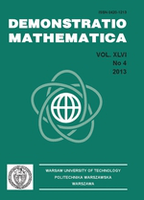
Demonstratio Mathematica
metrics 2024
Empowering Innovation in Mathematical Research
Introduction
Demonstratio Mathematica, published by DE GRUYTER POLAND SP Z O O, is an esteemed open-access journal in the field of mathematics, with an ISSN of 0420-1213 and E-ISSN 2391-4661. Established in 1996 and providing open access since 2009, it has become a vital platform for disseminating innovative research and advancements in various areas of mathematics. With a commendable Scopus ranking of 85/399 in General Mathematics and a 2023 Category Quartile of Q2, it stands at the forefront of the mathematical community, demonstrating a significant impact within the top 78th percentile. The journal aims to foster a deeper understanding and appreciation of mathematical concepts and their applications, catering to both seasoned researchers and emerging scholars. Located in Warsaw, Poland, Demonstratio Mathematica not only enriches the academic discourse but also strengthens collaborative efforts within the international mathematics community, making it an essential resource for those seeking to expand their knowledge and research output.
Metrics 2024
 0.482.001.6033
Metrics History
Rank 2024
Scopus
IF (Web Of Science)
JCI (Web Of Science)
Quartile History
Similar Journals

Kyungpook Mathematical Journal
Nurturing the Next Generation of Mathematical Thought LeadersWelcome to the Kyungpook Mathematical Journal, a prominent publication dedicated to the advancement of mathematical research across various fields, including applied mathematics and miscellaneous mathematical disciplines. Published by the Department of Mathematics at Kyungpook National University in South Korea, this journal aims to disseminate high-quality original articles, fostering a deeper understanding and innovative applications of mathematical theories. With a distinguished Scopus ranking in its category, standing at Q3 in Applied Mathematics and Q3 in Mathematics (miscellaneous), it serves as a crucial platform for both emerging and renowned scholars to share their findings with a global audience. This publication is indexed in reliable databases, ensuring enhanced visibility and impact for its contributors. Even though it currently lacks open-access distribution, the journal remains an essential resource for researchers, professionals, and students looking to stay at the forefront of mathematical exploration from 2007 to 2024 and beyond. Join us in contributing to the vibrant discourse that shapes the future of mathematics.
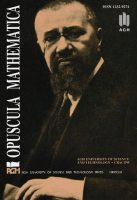
Opuscula Mathematica
Elevating Mathematical Discourse GloballyOpuscula Mathematica is an esteemed open-access journal published by AGH University of Science & Technology Press in Poland, specializing in the field of mathematics. Since its inception, it has provided a collaborative platform for researchers and scholars to share innovative mathematical insights and solutions, expanding its reach globally. With an impressive Q2 ranking in the realm of miscellaneous mathematics for 2023 and a notable Scopus ranking of Rank #139/399, it stands as a significant conduit for researchers seeking to publish high-quality, peer-reviewed articles. The journal has embraced open-access principles since 2004, ensuring that advancements in mathematical research are accessible to all. By publishing original research, reviews, and scholarly notes, Opuscula Mathematica plays a pivotal role in enhancing the visibility of vital mathematical discoveries and fostering academic discourse. Its convergence years from 2012 to 2024 highlight the journal's commitment to ongoing relevance and evolution in a dynamic research landscape.

Korean Journal of Mathematics
Advancing Mathematical Frontiers.The Korean Journal of Mathematics, published by the Kangwon-Kyungki Mathematical Society, is an esteemed platform dedicated to advancing the field of mathematics. With an ISSN of 1976-8605 and E-ISSN of 2288-1433, the journal features a range of scholarly articles that emphasize both theoretical and applied aspects of mathematics, catering to researchers, professionals, and students alike. Although it is not open access, the journal maintains a commitment to academic rigor and integrity, ensuring high-quality contributions to the mathematical community. As it converges from years 2021 to 2024, the Korean Journal of Mathematics is poised to enhance its visibility within the Scopus database, currently ranking #354 out of 399 in the general mathematics category, reflecting its potential for growth and impact in the mathematical sciences. With its strategic focus and institutional backing from Kangwon National University, the journal serves as a vital resource for fostering research and dialogue in the ever-evolving landscape of mathematics.

Sahand Communications in Mathematical Analysis
Fostering dialogue in the realm of mathematical analysis.Sahand Communications in Mathematical Analysis is a distinguished open-access journal published by the University of Maragheh in Iran, dedicated to the field of mathematical analysis and its applied branches. Since its inception in 2014, the journal has provided a valuable platform for researchers to disseminate significant findings in areas ranging from analytical methods to numerical analysis and applied mathematics. Despite its relatively recent establishment, the journal has quickly gained recognition, noted for its Q3 rankings in both Applied Mathematics and Numerical Analysis categories, and its Q4 ranking in Analysis for 2023. With an ambition to foster innovative research and facilitate scholarly dialogue, Sahand Communications in Mathematical Analysis aims to support the global mathematical community by ensuring unrestricted access to high-quality research outputs. Researchers, professionals, and students can look forward to engaging content that pushes the boundaries of mathematical inquiry through its open-access model, thus enhancing the accessibility and reach of critical mathematical discussions.

Tamkang Journal of Mathematics
Exploring Mathematical Frontiers with Insight and InnovationTamkang Journal of Mathematics, published by TAMKANG UNIVERSITY, serves as a vital platform for researchers and professionals in the fields of applied mathematics, general mathematics, and materials science. With an ISSN of 0049-2930 and an E-ISSN of 2073-9826, this journal has established itself within the academic community, particularly noted for its contributions from Taiwan. Although categorized as Q4 in Applied Mathematics and Q3 in multiple related fields according to the 2023 ranking, it maintains a solid reputation for disseminating significant research findings and innovative methodologies. Researchers can explore an array of topics within its pages, making it an excellent resource for enhancing mathematical knowledge and applications. As it converges from 2005 to 2024, the journal invites academics, professionals, and students to engage with its content and contribute to the ongoing dialogue in mathematics and its interdisciplinary applications.

CUBO-A Mathematical Journal
Advancing Knowledge Across Mathematical DisciplinesCUBO-A Mathematical Journal, published by the Department of Mathematics and Statistics at Universidad de La Frontera in Chile, stands as a significant Open Access resource in the field of mathematics since its inception in 2011. With an ISSN of 0716-7776 and an E-ISSN of 0719-0646, this journal invites submissions that explore a wide spectrum of mathematical disciplines, including Algebra, Number Theory, Analysis, Geometry, Topology, and Logic. Although currently positioned in the Q4 category across various mathematical domains and registered at Rank #223/399 in General Mathematics in Scopus, CUBO serves as a valuable platform for emerging researchers and practitioners to disseminate their findings. Operating under a continuous commitment to accessibility, CUBO fosters an inclusive academic environment that supports the exchange of innovative ideas vital to advancing mathematics. The journal's target audience encompasses a diverse community of researchers, professionals, and students eager to participate in the expanding dialogue within mathematical sciences.

Vietnam Journal of Mathematics
Unveiling New Horizons in Mathematical InquiryVietnam Journal of Mathematics, published by SPRINGER SINGAPORE PTE LTD, serves as a prominent platform for disseminating high-quality research in the field of mathematics. With an ISSN of 2305-221X and E-ISSN 2305-2228, this esteemed journal has established itself as a noteworthy contributor to the academic landscape since its inception in 2013, continuing its coverage until 2024. Enjoying a Q2 ranking in Mathematics (miscellaneous) for 2023, and holding a commendable Scopus rank of #126 out of 399 in General Mathematics, the journal stands at the intersection of innovation and scholarly excellence. Although still developing its open-access model, it provides a valuable resource for researchers, professionals, and students alike, who are keen to explore the vast universe of mathematical inquiry and application. As the journal progresses, it strives not only to publish original research but also to foster dialogue and collaboration within the global mathematics community.

Journal of Analysis
Exploring the Depths of AnalysisThe Journal of Analysis, published by SPRINGERNATURE, serves as a crucial platform for disseminating advanced research in the fields of mathematics, particularly focusing on Algebra, Number Theory, Analysis, Applied Mathematics, Geometry, Topology, and Numerical Analysis. Since its inception in 2016, this journal has aimed to foster knowledge-sharing and innovation among researchers, professionals, and students. Boasting a diverse scope and a commitment to high-quality research, the journal is indexed in various categories with rankings that reflect its growing influence, particularly in Algebra and Number Theory (Q4), Analysis (Q3), and Applied Mathematics (Q3), among others. With an ISSN of 0971-3611 and E-ISSN of 2367-2501, it offers insightful articles that contribute to the ongoing discourse in mathematics. The journal is located in Germany, ensuring a European perspective while also welcoming global contributions. Researchers seeking to enhance their understanding and impact in their respective fields will find this journal an invaluable resource.

ACTA SCIENTIARUM MATHEMATICARUM
Catalyzing Progress in Mathematical Analysis and ApplicationsACTA SCIENTIARUM MATHEMATICARUM, published by SPRINGER BIRKHAUSER in Switzerland, is a distinguished journal focusing on the fields of mathematical analysis and applied mathematics. With an ISSN of 0001-6969 and an E-ISSN of 2064-8316, this journal serves as a critical platform for disseminating high-quality research that bridges theoretical and practical aspects of mathematics. Although currently categorized in the Q3 quartile for both Analysis and Applied Mathematics as of 2023, the journal strives to enhance its impact on the mathematical community by offering a perfect blend of rigorous research and innovative applications. Researchers, professionals, and students can benefit from the journal’s commitment to advancing knowledge in mathematics, despite the absence of open-access options. The mailing address for correspondences is 233 SPRING STREET, 6TH FLOOR, NEW YORK, NY 10013. As mathematics continues to evolve, ACTA SCIENTIARUM MATHEMATICARUM positions itself as a valuable resource for those looking to contribute to and stay informed about the latest developments in this vibrant field.

Pure and Applied Mathematics Quarterly
Fostering Innovation in Mathematical DisciplinesPure and Applied Mathematics Quarterly is a prestigious journal published by INT PRESS BOSTON, INC, focusing on the diverse and evolving field of mathematics. Since its inception in 2007, this journal has grown significantly, currently holding a Q1 ranking in the Mathematics (Miscellaneous) category for 2023, positioning it among the leading publications in the discipline. With a commitment to publishing high-quality research, Pure and Applied Mathematics Quarterly fosters innovation and dialogue within the mathematical community by providing a platform for theoretical advancements and practical applications. The journal remains accessible to researchers and professionals through its ISSN 1558-8599 and E-ISSN 1558-8602, although it does not currently offer open access. As a vital resource for mathematicians, educators, and students, this journal endeavors to expand the frontiers of mathematical knowledge and contribute to the academic dialogue surrounding this fundamental science.