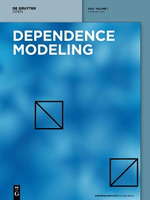
Dependence Modeling
Scope & Guideline
Connecting Ideas, Enhancing Understanding
Introduction
Aims and Scopes
- Copula Theory and Applications:
The journal emphasizes the development and application of copulas, which are functions that describe the dependence between random variables, allowing for the modeling of complex multivariate distributions. - Statistical Inference for Dependence Structures:
It includes methodologies for estimating and testing copula models, focusing on the statistical inference and properties of copulas in various contexts, such as survival analysis and financial modeling. - Modeling Techniques for Multivariate Data:
The journal explores various modeling techniques for multivariate data, including the use of copulas for non-Gaussian dependence structures and the integration of copulas with other statistical approaches. - Theoretical Developments in Dependence Structures:
It contributes to the theoretical aspects of dependence modeling, including the exploration of new types of copulas, asymptotic properties, and mathematical foundations of dependence measures. - Interdisciplinary Applications:
The journal publishes research that applies dependence modeling in diverse fields such as finance, economics, environmental studies, and health sciences, showcasing its versatility and relevance.
Trending and Emerging
- High-Dimensional Dependence Modeling:
There is a growing emphasis on high-dimensional copula models, driven by the increasing complexity of data in fields like finance and genomics, necessitating advanced techniques for managing large datasets. - Nonparametric and Semiparametric Approaches:
An emerging trend is the use of nonparametric and semiparametric methods for dependence modeling, which allows for greater flexibility and robustness in the face of model uncertainty. - Integration of Machine Learning Techniques:
The intersection of dependence modeling and machine learning is becoming more prominent, with researchers exploring how machine learning methods can enhance the estimation and prediction of dependence structures. - Applications to Extreme Value Theory:
There is an increasing focus on the application of copula models to extreme value theory, particularly in risk assessment and environmental studies, highlighting the relevance of dependence in extreme events. - Network and Graphical Models:
The exploration of dependence structures through network and graphical models is gaining traction, reflecting a broader interest in understanding complex relationships in multivariate datasets.
Declining or Waning
- Traditional Parametric Models:
There is a noticeable decrease in the publication of papers focusing solely on traditional parametric models for dependence structures, as researchers increasingly prefer flexible and non-parametric approaches. - Basic Copula Properties:
Research centered on foundational properties of copulas is becoming less common, with a shift toward more complex interactions and applications rather than basic theoretical explorations. - Single-Variable Analysis:
There is a diminishing interest in studies that solely analyze single-variable distributions without considering their multivariate dependencies, reflecting a broader shift towards more comprehensive multivariate analyses. - Static Dependence Structures:
The exploration of static dependence structures is declining, as dynamic and time-varying models are gaining traction due to their applicability in real-world scenarios.
Similar Journals

JIRSS-Journal of the Iranian Statistical Society
Advancing Statistical Knowledge for a Brighter Tomorrow.JIRSS - Journal of the Iranian Statistical Society is a prominent academic journal dedicated to the field of statistics and probability, published by the esteemed Iranian Statistical Society. With its ISSN number 1726-4057 and E-ISSN 2538-189X, this journal serves as a vital platform for disseminating cutting-edge research and advancements in statistical methodology and its applications. Established in 2011, JIRSS has consistently contributed to the academic community, achieving a 2023 Scopus rank of #180 out of 278 in its category, placing it within the 35th percentile in the dynamic domain of Mathematics: Statistics and Probability. As an Open Access publication, it enhances accessibility for researchers, professionals, and students, facilitating a wider engagement with innovative statistical techniques and theories. The journal aims to foster collaboration and knowledge exchange among statisticians, ultimately enriching the field and its impact on various scientific disciplines.
Electronic Journal of Statistics
Unlocking the Future of Statistical ResearchElectronic Journal of Statistics, published by INST MATHEMATICAL STATISTICS-IMS, is a premier open-access platform dedicated to the field of statistics and probability, with a remarkable track record since its inception in 2007. With an ISSN of 1935-7524, this journal has quickly established itself as a leading resource within the top Q1 category in both Statistics and Probability, as well as Statistics, Probability and Uncertainty, highlighting its significance and impact in the academic community. The journal’s commitment to disseminating high-quality research allows researchers, professionals, and students to access valuable findings and methodologies that contribute to the advancement of statistical sciences. With its convergence set to continue until 2024, the Electronic Journal of Statistics remains a vital source for scholars looking to enrich their knowledge and engage with cutting-edge statistical theories and applications.
STATISTICAL SCIENCE
Connecting Scholars with Cutting-Edge Statistical Discoveries.STATISTICAL SCIENCE, published by the Institute of Mathematical Statistics (IMS), stands as a premier journal in the fields of Statistics and Probability, commencing its journey in 1986 and continuing through 2024. With an impressive track record reflected in its Q1 quartile rankings in Mathematics, Statistics and Probability, and Statistics, Probability and Uncertainty for 2023, it holds a distinguished position in the academic community. The journal is recognized for its rigorous peer-review process and for publishing high-quality research that significantly contributes to advancing statistical methodology and its applications across various domains. Researchers and professionals are encouraged to engage with its contents to stay abreast of the latest developments and methodologies in statistical science. Although it does not offer open access, the valuable insights provided within its pages are essential for any scholar dedicated to the pursue of statistical excellence. As you navigate the complexities of data analysis and interpretation, STATISTICAL SCIENCE is your go-to resource for groundbreaking research, innovative techniques, and comprehensive reviews.
STATISTICS & PROBABILITY LETTERS
Elevating the discourse in statistics and probability.STATISTICS & PROBABILITY LETTERS is a distinguished journal published by ELSEVIER, dedicated to advancing the field of statistics and probability. With an ISSN of 0167-7152 and an E-ISSN of 1879-2103, this journal is an essential platform for research, featuring cutting-edge studies and significant findings in the realms of statistical theory and applied probability. The journal operates under a notable Q3 ranking in both the categories of Statistics and Probability, and Statistics, Probability and Uncertainty for 2023, underscoring its relevance in these fields. Researchers, professionals, and students alike benefit from its rigorous peer-review process and its commitment to published integrity, fostering innovative insights from 1982 through its anticipated convergence in 2025. While it does not offer open access, the journal’s widely recognized impact within the academic community makes it a valuable resource for anyone seeking to deepen their understanding of statistical methodologies and probabilistic models.
Brazilian Journal of Probability and Statistics
Innovating Insights in Probability and StatisticsThe Brazilian Journal of Probability and Statistics, published by the Brazilian Statistical Association, stands as a pivotal platform for researchers and practitioners in the realms of probability and statistics. With an ISSN of 0103-0752, this esteemed journal has contributed significantly to the advancement of statistical theory and its applications since its inception. The journal is currently indexed in Scopus, holding a rank of #175 in the Statistics and Probability category and a third quartile (Q3) designation as of 2023, indicating its steady impact within the field. Covering a broad scope of topics, from theoretical advancements to practical applications, it invites submissions that enhance understanding and fosters discussion among academics and professionals alike. The journal is based in São Paulo, Brazil, and operates without open access, ensuring a quality review process that adheres to the highest scholarly standards. Researchers, professionals, and students interested in the latest findings and innovative methodologies in statistics are encouraged to engage with the Brazilian Journal of Probability and Statistics, a vital resource at the intersection of theory and practice.
STATISTICS IN MEDICINE
Fostering collaboration among statisticians, clinicians, and researchers.Statistics in Medicine, published by Wiley, is a prestigious journal dedicated to the advancement of statistical methods and their application in biomedical research. Established in 1982, this journal has become a cornerstone in the fields of Epidemiology and Statistics and Probability, demonstrating its importance by consistently achieving a Q1 ranking in the 2023 category quartiles. With an impressive ISSN of 0277-6715 and an E-ISSN of 1097-0258, it serves as a vital platform for disseminating high-quality research that enhances evidence-based medicine. Although the journal does not currently offer open access, it remains highly regarded, holding a Scopus rank of #66 in Mathematics and #80 in Medicine, indicating its significant impact on the academic community. By publishing cutting-edge research, Statistics in Medicine aims to bridge the gap between statistical theory and practical application in health domains, fostering a rigorous dialogue among researchers, clinicians, and statisticians alike.
SCANDINAVIAN JOURNAL OF STATISTICS
Pioneering insights in the realm of statistical sciences.SCANDINAVIAN JOURNAL OF STATISTICS is a premier publication in the field of statistics, published by Wiley. With an impressive impact factor that reflects its influence, this journal is recognized for its rigorous peer-reviewed research articles that contribute to the advancement of statistical methods and their applications. As a leading resource, the journal spans a wide range of topics within Statistics and Probability, maintaining a strong scholarly presence with a Q1 rank in Statistics and Probability and a Q2 rank in Statistics, Probability and Uncertainty as per the 2023 category quartiles. The journal has been diligently publishing high-quality research since 1996, and now encompasses studies up to 2024, reinforcing its commitment to providing valuable insights for researchers, professionals, and students alike. While the journal does not offer open access, it remains an essential repository of knowledge in statistical sciences, fostering collaboration and innovation within the global academic community.

Siberian Electronic Mathematical Reports-Sibirskie Elektronnye Matematicheskie Izvestiya
Bridging Disciplines through Mathematical InsightsSiberian Electronic Mathematical Reports (Sibirskie Elektronnye Matematicheskie Izvestiya) is a prominent academic journal dedicated to the dissemination of cutting-edge research in the field of mathematics. Published by the esteemed Sobolev Institute of Mathematics in the Russian Federation, this journal provides a vital platform for scholars from around the globe to share their innovative findings and methodologies. With an ISSN of 1813-3304 and an impressive recognition within the academic community, the journal currently holds a Q2 classification in Mathematics (miscellaneous) and ranks #256 out of 399 in general mathematics according to Scopus, indicating its relevance and contribution to the field. While operating on an open-access model, Siberian Electronic Mathematical Reports ensures that high-quality research is readily accessible, promoting collaboration and knowledge sharing among researchers, professionals, and students. Covering a broad spectrum of mathematical topics, it aims to foster interdisciplinary connections and advance the understanding of mathematical principles in various applications. As it converges years from 2011 to 2024, this journal remains an essential resource for those looking to stay updated on significant advancements and contemporary discussions within the mathematical sciences.
Sankhya-Series A-Mathematical Statistics and Probability
Exploring Innovative Research in Statistical Theory and ApplicationsSankhya-Series A-Mathematical Statistics and Probability is a prestigious academic journal published by SPRINGER, situated in the United States. With a focus on the rapidly evolving fields of mathematical statistics and probability, this journal serves as a critical platform for researchers, professionals, and students seeking to disseminate their findings and engage with latest advancements. Although it is not an open access publication, its rigorous peer-review process ensures high-quality content that contributes to the scholarly community. As of 2023, the journal is classified within the Q3 quartile in both Statistics and Probability, and Statistics, Probability and Uncertainty categories, reflecting its relevance and growing influence in the field. Sankhya-Series A showcases a convergence of interdisciplinary approaches, facilitating dialogue among statisticians and mathematicians, making it an essential resource for those committed to the exploration of theoretical and applied statistics. The journal accepts contributions advancing innovative research and methodologies, promoting a deeper understanding of probabilistic models and statistical techniques.
PROBABILITY IN THE ENGINEERING AND INFORMATIONAL SCIENCES
Elevating engineering practices with the power of probabilistic methods.PROBABILITY IN THE ENGINEERING AND INFORMATIONAL SCIENCES is a premier journal published by Cambridge University Press, dedicated to advancing the fields of statistics, probability, and their applications within engineering and informational sciences. With an ISSN of 0269-9648 and an E-ISSN of 1469-8951, this journal has established itself as a significant resource since its inception in 1987, continuing to publish impactful research through 2024. Ranking in the Q2 category for Industrial and Manufacturing Engineering and holding Q3 status in multiple relevant categories, it boasts a respectable impact in academia, reflected in its Scopus rankings across various disciplines. Although not an open-access journal, it remains essential for researchers interested in the integration of probabilistic methods in contemporary engineering challenges. By providing a platform for innovative studies and practical applications, PROBABILITY IN THE ENGINEERING AND INFORMATIONAL SCIENCES plays a crucial role in shaping future research and methodologies in these overlapping domains, fostering collaboration and knowledge exchange among researchers, professionals, and students alike.