Devices and Methods of Measurements
Scope & Guideline
Innovative insights into measurement methodologies.
Introduction
Aims and Scopes
- Measurement Technologies:
The journal emphasizes the advancement of measurement technologies, including optical, thermal, and electrical methods, to enhance precision and reliability in experimental setups. - Material Characterization:
A significant focus is on techniques for characterizing materials, such as surface roughness assessments, hardness measurements, and microstructural analysis, which are crucial for quality control and material science. - Sensor Development:
The journal showcases research into the design and application of sensors, particularly gas and environmental sensors, which are vital for monitoring and controlling various processes. - Methodological Innovation:
There is a consistent emphasis on developing new methodologies for measurement, including advanced calibration techniques and data analysis methods, to improve measurement accuracy and reliability. - Application in Emerging Technologies:
The journal also explores applications of measurement devices in emerging fields such as renewable energy, nanotechnology, and biomedical engineering, highlighting their relevance in modern science.
Trending and Emerging
- Nanotechnology and Micro-scale Measurements:
There is a growing trend in exploring measurement techniques for nanostructures and micro-scale materials, driven by advancements in nanotechnology and its applications in various fields. - Environmental Monitoring and Safety:
The focus on environmental sensors and monitoring devices is increasing, particularly in relation to air quality and pollution detection, highlighting the journal's commitment to addressing global environmental challenges. - Integration of Machine Learning and AI in Measurement:
Emerging research is focusing on the application of machine learning and artificial intelligence to enhance measurement accuracy and data analysis, representing a significant shift towards intelligent measurement systems. - Advanced Optical Measurement Techniques:
There is a notable increase in the exploration of advanced optical measurement methods, such as spectrometry and laser-based techniques, indicating a trend towards high-resolution and non-invasive measurement approaches. - Smart Sensor Technologies:
The development of smart sensors that incorporate IoT and connectivity features is becoming a prominent theme, reflecting the industry's shift towards more integrated and automated measurement solutions.
Declining or Waning
- Traditional Mechanical Measurement Techniques:
There has been a noticeable decrease in papers focusing on conventional mechanical measurement techniques, such as basic dimensional measurements, as newer technologies gain prominence. - Basic Electrical Measurement Methods:
Research on fundamental electrical measurement methods seems to be waning, possibly due to the shift towards more advanced electronic and digital measurement systems. - Static Measurement Systems:
Static measurement systems have seen a decline in focus, with a noticeable increase in dynamic and real-time measurement methodologies becoming more prevalent in recent publications.
Similar Journals
International Journal of Microwave and Wireless Technologies
Connecting Ideas in the World of Wireless Technologies.International Journal of Microwave and Wireless Technologies is a leading academic journal published by Cambridge University Press, dedicated to the advancement of knowledge in the fields of microwave and wireless technologies. Since its inception in 2009, this journal has established itself as a crucial platform for researchers, professionals, and students involved in Electrical and Electronic Engineering, currently positioned in the Q3 quartile as per the 2023 category rankings. With an ISSN of 1759-0787 and an E-ISSN of 1759-0795, it facilitates the dissemination of high-quality research articles that address emerging trends and challenges in microwave and wireless communications. The journal is committed to fostering innovation and collaboration within the global scientific community, aiming to publish significant contributions that appeal to both academic and industrial perspectives. Its Scopus ranking of 382 out of 797 highlights its relevance and impact in the engineering domain. While currently not an open-access journal, it provides various access options for its readership, ensuring that cutting-edge research remains accessible to all.
Measurement Science Review
Enhancing Understanding through Rigorous Measurement PracticesMeasurement Science Review is a distinguished open-access journal published by SCIENDO, dedicated to advancing the field of measurement science across various disciplines, including Biomedical Engineering, Control and Systems Engineering, and Instrumentation. Since its inception in 2008, it has actively contributed to the dissemination of innovative research and practices relevant to these fields, currently holding a notable Q3 ranking in its category as per the 2023 metrics. With an emphasis on robust scientific inquiry and practical applications, Measurement Science Review is positioned as an essential resource for researchers, professionals, and students seeking to enhance their understanding and expertise in measurement technologies. The journal provides an accessible platform for interdisciplinary dialogue and collaboration, making it a vital component of the academic landscape in Slovakia and beyond. Its publication track extends to 2024, ensuring timely access to cutting-edge research findings for a global audience.

JOURNAL OF RESEARCH OF THE NATIONAL INSTITUTE OF STANDARDS AND TECHNOLOGY
Driving Progress in Measurement and Technology.Welcome to the Journal of Research of the National Institute of Standards and Technology, published by the National Institute of Standards and Technology (NIST). This esteemed journal, identifiable by its ISSN 1044-677X and E-ISSN 2165-7254, serves as a critical platform for disseminating valuable research in the field of engineering, particularly with its focus on standards and technology applications. Operating as an Open Access journal since 2012, it ensures that all published works are freely accessible, fostering greater collaboration and advancement within the scientific community. Despite its coverage discontinuation in Scopus, the journal maintains a respectable Q3 quartile ranking in Engineering (Miscellaneous), with a Scopus rank of 118 out of 302, placing it within the 61st percentile. Based in Gaithersburg, Maryland, this publication not only supports the research ecosystem but also contributes significantly to advancing knowledge and practices in measuring and standards, making it an indispensable resource for researchers, professionals, and students engaged in related fields.
FLOW MEASUREMENT AND INSTRUMENTATION
Connecting Theory and Practice in InstrumentationFLOW MEASUREMENT AND INSTRUMENTATION, published by Elsevier Science Ltd, serves as a vital resource for researchers and professionals in the fields of Instrumentation, Electrical and Electronic Engineering, Computer Science Applications, and Modeling and Simulation. With an impressive trajectory since its inception in 1989 and extending to 2024, this journal has gained a notable reputation, ranking in the upper quartiles of various categories within the 2023 Scopus metrics, reflecting its significant contribution to advancing knowledge in flow measurement technologies and methodologies. Although it does not offer Open Access options, the journal is well-regarded for its rigorous peer-review process, ensuring high-quality, impactful research dissemination. The journal's emphasis on empirical studies and innovative instrument design establishes it as an essential platform for disseminating cutting-edge findings that facilitate practical applications and inform future research directions. Positioned within the United Kingdom, it attracts a global readership dedicated to the continuous enhancement of measurement sciences and engineering innovations.
St Petersburg Polytechnic University Journal-Physics and Mathematics
Unlocking Innovations in Science and TheorySt Petersburg Polytechnic University Journal-Physics and Mathematics is a distinguished academic journal published by the Polytechnical University Publishing House, dedicated to advancing the fields of physics and mathematics. Established as an Open Access publication since 2013, this journal aims to facilitate the unrestricted dissemination of high-quality research, allowing global access to innovative findings and discussions. With its ISSN 2405-7223, the journal serves as a pivotal platform for researchers, professionals, and students keen on exploring the latest advancements and theoretical insights within these disciplines. The journal emphasizes rigorous peer-reviewed articles, promoting critical discourse and collaboration within the scientific community. By prioritizing open access, it enhances academic engagement and supports the ongoing development of knowledge crucial for addressing contemporary scientific challenges.
Metrology and Measurement Systems
Advancing Precision in Measurement and Control.Metrology and Measurement Systems is a distinguished open-access journal dedicated to the advancement of knowledge in the field of metrology, instrumentation, and the engineering disciplines that encompass control systems. Published by the esteemed Polska Akademia Nauk (Polish Academy of Sciences), this journal serves as a vital resource for researchers, professionals, and students striving to address the complexities of measurement systems and the intricacies of control engineering. With an ISSN of 0860-8229 and an E-ISSN of 2300-1941, Metrology and Measurement Systems has been an open-access publication since 2010, broadening the reach of cutting-edge research to a global audience. The journal is categorized in the Q4 quartile for both Control and Systems Engineering and Instrumentation as of 2023, indicative of its growing platform for high-quality scholarly discourse. Its Scopus rankings reveal its relevance in the community, with its contributions becoming increasingly significant despite the current rankings of 209/321 and 106/141 in their respective categories. As it converges into the future, culminating in a timeline from 2008 to 2024, the journal remains committed to enhancing the essential dialogue surrounding measurement systems and fostering innovations in the field.
TRANSACTIONS OF THE INSTITUTE OF MEASUREMENT AND CONTROL
Driving Progress in Measurement and Control TechnologiesTRANSACTIONS OF THE INSTITUTE OF MEASUREMENT AND CONTROL, published by SAGE Publications Ltd, is a prestigious journal that has been at the forefront of research in measurement and control since its inception in 1979. With its ISSN 0142-3312 and E-ISSN 1477-0369, this UK-based journal is indexed in reputable databases, showcasing its impact in the field, highlighted by a notable Q2 ranking in Instrumentation for 2023. The journal serves as a vital platform for scholars and practitioners alike, publishing high-quality, peer-reviewed articles that span a range of topics related to measurement technology and control systems. With an increasing focus on interdisciplinary approaches, TRANSACTIONS OF THE INSTITUTE OF MEASUREMENT AND CONTROL strives to advance the understanding and application of innovative measurement and control methodologies, making it an essential resource for academics, industry professionals, and students aiming to enhance their knowledge and expertise in this dynamic field. Although it operates under a traditional subscription model, the journal's commitment to disseminating cutting-edge research remains unwavering, inviting contributions that push the boundaries of instrumentation and control science.
MEASUREMENT TECHNIQUES
Unveiling Innovative Solutions in Engineering MeasurementMEASUREMENT TECHNIQUES, published by SPRINGER, is an esteemed journal within the realm of applied mathematics and instrumentation. With a history of publication dating back to 1958, this journal serves as a platform for innovative research and development in the measurement sciences. Though currently not an open-access journal, it provides a critical resource for researchers and professionals seeking to advance their knowledge in the fields of engineering and instrumentation techniques. The journal holds a vital position in its category, being ranked in the Q4 quartile for 2023 across multiple related fields, including engineering and applied mathematics. With an ISSN of 0543-1972 and e-ISSN of 1573-8906, MEASUREMENT TECHNIQUES strives to disseminate contemporary findings and foster collaboration among scholars, ensuring significant contributions to the evolving landscape of measurement technologies.
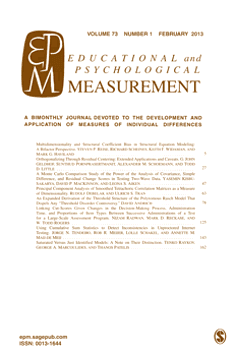
EDUCATIONAL AND PSYCHOLOGICAL MEASUREMENT
Empowering Educational Insights Through MeasurementEDUCATIONAL AND PSYCHOLOGICAL MEASUREMENT, published by SAGE Publications Inc, is a premier journal serving as a vital resource for researchers and practitioners in the fields of educational and psychological assessment. With a rich history dating back to 1941, this esteemed journal encompasses a wide-ranging scope, exploring the intricacies of measurement techniques and their implications within applied mathematics, psychology, and education. Notably categorized in Q1 quartiles across various fields, including Applied Mathematics and Educational Psychology, the journal ranks impressively in Scopus, reflecting its high impact and relevance—ranked #82/635 in Applied Mathematics and #232/1543 in Education. The journal’s commitment to advancing knowledge in educational measurement equips scholars with essential insights and methodologies, making it an essential tool for advancing scholarly inquiry and practice. With no open access limitations, EDUCATIONAL AND PSYCHOLOGICAL MEASUREMENT is dedicated to disseminating quality research that influences educational practices and psychological evaluation, thus reinforcing its esteemed position within academia.
INSTRUMENTATION SCIENCE & TECHNOLOGY
Advancing the Frontiers of Instrumentation KnowledgeInstrumentation Science & Technology, published by Taylor & Francis Inc, is a leading journal in the fields of Chemical Engineering, Environmental Science, and Instrumentation. With an ISSN of 1073-9149 and an E-ISSN of 1525-6030, this established publication spans a rich history from 1968 to 1972, 1974 to 1977, 1979 to 1982, 1984 to 1990, and continuing through to 2024. Positioned in the Q3 category of its subject areas, it ranks competitively within the Scopus framework, notably achieving rank #103/233 in Environmental Science and #138/273 in Chemical Engineering. Aimed at researchers, professionals, and students, this journal serves as a crucial platform for advancing knowledge in instrumentation technologies and their applications across various disciplines. Although not an open-access journal, it provides valuable insights and peer-reviewed articles that are essential for staying at the forefront of instrumentation science.