
Diplomatica
Scope & Guideline
Connecting Historical Contexts with Contemporary Diplomacy
Introduction
Aims and Scopes
- Historical Analysis of Diplomacy:
The journal emphasizes a historical perspective on diplomacy, exploring events, figures, and practices that have shaped international relations throughout history. - Cultural Diplomacy:
Cultural elements and their influence on diplomatic relations are a core focus, examining how arts, literature, and cultural exchanges impact international dialogue. - Gender and Diplomacy:
The journal highlights the role of gender in diplomatic practices, addressing the contributions and challenges faced by women in diplomacy historically and in contemporary settings. - Regional and Thematic Studies:
It covers diverse regional studies, particularly focusing on Scandinavian, European, and Global South perspectives, providing insights into specific diplomatic contexts and themes. - Interdisciplinary Approaches:
The journal embraces interdisciplinary methodologies, incorporating insights from political science, history, sociology, and cultural studies to enrich the analysis of diplomatic phenomena.
Trending and Emerging
- Critical and Reflexive Diplomacy:
There is an increasing emphasis on critical perspectives of diplomacy, exploring its implications and the ethical dimensions of diplomatic actions, reflecting a broader trend in social sciences. - Environmental Diplomacy:
Emerging themes around environmental issues and diplomacy are gaining traction, emphasizing the role of diplomacy in addressing global environmental challenges and climate change. - Digital and Technological Influences:
The impact of digital technology on diplomatic practices is a growing focus, exploring how digital communication and social media are reshaping traditional diplomatic interactions. - Intersectionality in Diplomacy:
An emerging interest in intersectionality is noted, particularly how various identities and social factors influence diplomatic practices and representations. - Transnational Networks and Global South Perspectives:
There is a notable trend towards exploring transnational networks and perspectives from the Global South, highlighting diverse voices and experiences in diplomatic discourse.
Declining or Waning
- Traditional State-Centric Diplomacy:
There has been a noticeable decrease in papers focused solely on traditional state-to-state diplomatic relations, as the journal shifts towards more nuanced understandings of diplomacy that include non-state actors. - Cold War Era Diplomacy:
While once a prevalent theme, studies specifically centered on Cold War diplomacy are appearing less frequently, possibly overshadowed by contemporary global challenges and newer diplomatic paradigms. - Military Diplomacy:
Research on military diplomacy, which was once a significant area of interest, is now less prominent, suggesting a shift towards softer forms of diplomacy and international cooperation. - Formal Protocols and Procedures:
The exploration of rigid diplomatic protocols and formalities has waned, with a growing emphasis on the dynamics of informal diplomacy and personal relationships in international affairs. - Historical Diplomatic Treaties:
While historical treaties were a common focus, there is a declining trend in their standalone analysis, as the journal prioritizes broader themes and interdisciplinary approaches.
Similar Journals

New Perspectives
Exploring innovative ideas for a dynamic global landscape.New Perspectives is a pivotal academic journal published by SAGE Publications Inc, dedicated to advancing the fields of Political Science and International Relations. With a focus on innovative research and critical analysis, it has established a notable presence since its inception in 2015, currently holding a Q3 ranking in its category for 2023. Based in the Czech Republic, New Perspectives has a robust Scopus rank of #292 out of 706, placing it in the 58th percentile among social science journals. This underscores its significance in fostering scholarly dialogue and presenting fresh ideas in a rapidly evolving global landscape. While not open access, the journal attracts a diverse readership, including researchers, professionals, and students who are keen on exploring emerging trends and insights in political theory and international discourse. The journal’s commitment to high-quality scholarship makes it an essential resource for those aiming to contribute to and engage with contemporary political challenges.
CHINA QUARTERLY
Unveiling the Interconnections of Geography, Politics, and Development in ChinaCHINA QUARTERLY, an esteemed journal published by Cambridge University Press, serves as a leading platform for scholarly discourse in the fields of Development, Geography, Planning and Development, and Political Science and International Relations. With a strong reputation evidenced by its Q1 ranking in multiple categories and indexed since 1960, it attracts a diverse array of research focusing on the socio-economic and political dynamics within China and its impact on global affairs. The journal's rigorous peer-review process ensures the publication of high-quality articles that contribute meaningfully to contemporary debates and theoretical advancements. Although not open access, CHINA QUARTERLY offers extensive research opportunities for scholars, professionals, and students keen on exploring and understanding the intricate layers of China’s development and its global relations. Its dedicated address in Cambridge, United Kingdom underscores its commitment to fostering international dialogue and academic collaboration.
DIPLOMATIC HISTORY
Connecting Historical Narratives with Modern DiplomacyDIPLOMATIC HISTORY, published by OXFORD UNIV PRESS, is a leading academic journal in the field of diplomatic studies, boasting an impressive Q2 ranking in History and a notable 84th percentile among the top arts and humanities journals as per Scopus rankings. Since its inception in 1977, this esteemed journal has consistently provided a scholarly platform for rigorous research and innovative discussions surrounding the dynamics of international relations, statecraft, and political diplomacy. With contributions from esteemed historians and emerging scholars alike, DIPLOMATIC HISTORY endeavors to examine historical contexts that shape contemporary diplomatic practices, fostering a deep understanding of past and present geopolitical landscapes. While this journal does not currently offer Open Access, it remains a vital resource for researchers and professionals striving to enhance their expertise in the complex interplay of history and diplomacy.
Journal of Contemporary East Asia Studies
Unveiling the Complexities of Contemporary East Asia.The Journal of Contemporary East Asia Studies, published by Taylor & Francis Ltd, stands as a premier platform dedicated to the interdisciplinary exploration of contemporary East Asia, effectively bridging cultural studies, sociology, political science, and development. Established as an Open Access journal since 2017, it has rapidly distinguished itself in the academic landscape, achieving a commendable Q1 ranking in Cultural Studies and Q2 rankings in both Sociology and Political Science, as well as Development for 2023. This journal not only boasts impressive Scopus ranks, placing it in the top decile of Cultural Studies, but also emphasizes engaging and impactful research that reflects the complex dynamics of East Asia today. With an unwavering commitment to accessibility and scholarly excellence, the journal invites researchers, professionals, and students to contribute to and benefit from high-quality research that shapes understanding in one of the world’s most dynamic regions.

Russian Journal of Vietnamese Studies-Vyetnamskiye issledovaniya
Illuminating Vietnam: A Gateway to Southeast Asian StudiesRussian Journal of Vietnamese Studies-Vyetnamskiye issledovaniya is a specialized academic journal dedicated to the exploration and dissemination of knowledge pertaining to Vietnamese culture, history, and society. Published by CENTER VIETNAM & ASEAN STUDIES, this journal serves as a critical platform for researchers, professionals, and students interested in the multifaceted connections between Russia and Vietnam, as well as broader Southeast Asian studies. With a commitment to open access and the highest standards of scholarship, the journal addresses pressing contemporary issues and historical insights, fostering a deeper understanding of Vietnam's role in the global context. Housed at the INST FAR EASTERN STUDIES of the RUSSIAN ACADEMY OF SCIENCES in Moscow, the journal aspires to enrich the academic dialogue surrounding Vietnamese studies and promote collaborative research efforts within the region. Researchers can look forward to insightful articles that contribute to the fields of cultural studies, international relations, and social sciences.
MIDDLE EAST POLICY
Navigating the Political Landscape of the Middle EastMIDDLE EAST POLICY stands as a notable journal in the fields of Political Science and International Relations, published by Wiley in the United Kingdom. With a rich publication history dating back to 1992, this journal provides a critical platform for scholarly exploration and dialogue surrounding Middle Eastern political dynamics and policies. It ranks in the Q3 category in the 2023 evaluations for both Political Science and International Relations and Sociology, indicating its influential role in these academic fields. While it does not offer open access, it is recognized for its rigorous peer-reviewed articles that contribute valuable insights and analyses on pressing regional challenges and institutional frameworks. Researchers, professionals, and students engaged in Middle Eastern studies will find MIDDLE EAST POLICY essential for understanding the complex socio-political landscapes of the region and for fostering informed discussions that advance both scholarship and practice.
JOURNAL OF STRATEGIC STUDIES
Connecting Scholars to the Pulse of Strategic StudiesJOURNAL OF STRATEGIC STUDIES is a premier academic journal dedicated to the fields of political science and international relations, published by Routledge Journals, Taylor & Francis Ltd. Established in 1978, this journal has built a strong reputation for disseminating high-quality research and theoretical contributions that drive innovation and scholarship in strategic studies. With a commendable impact factor that places it in the Q1 quartile for Political Science and International Relations, and Q2 quartile for Sociology and Political Science, the journal ranks among the top publications with notable Scopus rankings that reflect its influence and reach. The journal’s comprehensive scope encompasses a wide array of topics, from security studies to diplomacy, making it an invaluable resource for researchers, professionals, and students alike. Although it operates on a subscription-based access model, the journal's commitment to advancing knowledge in strategic studies ensures that it remains a vital platform for scholarly dialogue and exploration. Join the community of scholars contributing to cutting-edge research through this leading journal.
PACIFIC REVIEW
Fostering critical discussions in geography, planning, and sociology.PACIFIC REVIEW is a prestigious journal published by Routledge Journals, Taylor & Francis Ltd, dedicated to advancing the fields of geography, planning, and sociology. With an impressive impact factor and recognized as a Q1 journal in both Geography and Sociology categories, PACIFIC REVIEW ranks among the top journals in its domain, sitting at the 84th percentile for Sociology and Political Science and the 76th percentile for Geography, Planning and Development according to Scopus rankings. The journal aims to foster critical discussions and disseminate innovative research that addresses pressing social, geographical, and political issues facing the Pacific region. Published since 1988, it benefits from a rich history of scholarship and aims to bridge knowledge gaps through robust academic contributions. Researchers, professionals, and students interested in interdisciplinary studies will find valuable insights and cutting-edge research within its pages. While currently not an open-access publication, PACIFIC REVIEW provides essential literature to support academic and policy developments in these vital fields.
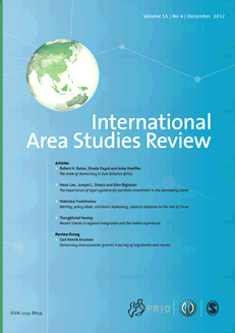
International Area Studies Review
Bridging Theory and Empirical Research in Political ScienceInternational Area Studies Review is a pivotal journal in the fields of Political Science, International Relations, and Sociology, published by SAGE Publications Ltd. With an ISSN of 2233-8659 and an E-ISSN of 2049-1123, this journal serves as a distinguished platform for scholarly discourse, exploring the complexities of international affairs and area studies since its inception in 1997. Housing contributions that bridge theoretical perspectives and empirical research, it plays a critical role in advancing knowledge and understanding within its domain. Currently ranked in the Q3 category for both Political Science and Sociology, the journal demonstrates consistent scholarly engagement, reflected in its Scopus rankings, with a notable position in the 55th percentile for Political Science and International Relations. While not open access, the International Area Studies Review remains a vital resource for researchers, professionals, and students eager to contribute to and engage with emerging areas of inquiry in a rapidly evolving global landscape.

CTAD-Cumhuriyet Tarihi Arastirmalari Dergisi
Connecting Past and Present through Rigorous ResearchCTAD-Cumhuriyet Tarihi Arastirmalari Dergisi, published by Hacettepe University in Turkey, is a prominent academic journal contributing to the discourse in the field of History. With an ISSN of 1305-1458 and an E-ISSN of 2147-1592, the journal has established itself as a vital resource for researchers, professionals, and students alike. As of 2023, the journal is ranked in the Q2 category in History and holds a Scopus rank of #1448 out of 1760 in the Arts and Humanities, demonstrating its significant contribution to historical scholarship. The journal, which covers a range of topics until 2024, provides an open-access platform for disseminating innovative research findings, encouraging an inclusive approach to academic publishing. Its commitment to advancing historical research makes it an essential tool for anyone interested in the evolution of republican history and its implications in contemporary discourse.