
Dynamics of Partial Differential Equations
Scope & Guideline
Exploring the Frontiers of Differential Dynamics
Introduction
Aims and Scopes
- Mathematical Analysis of PDEs:
Research dedicated to the rigorous mathematical analysis of various types of partial differential equations, including existence, uniqueness, and regularity of solutions. - Nonlinear Dynamics and Stability:
Exploration of nonlinear phenomena in PDEs, focusing on stability analysis, bifurcation theory, and long-term behavior of solutions. - Fluid Dynamics and Compressible Flows:
Investigation of fluid dynamics through PDEs, particularly in the context of Navier-Stokes equations, compressible flows, and related models. - Geometric and Functional Analysis:
Application of geometric methods and functional analysis techniques to study the properties of solutions to PDEs. - Numerical Methods and Computational Techniques:
Development and analysis of numerical methods for solving PDEs, including finite element methods and spectral methods. - Applications in Physical Sciences:
Interdisciplinary research that applies mathematical theories of PDEs to real-world problems in physics, biology, and engineering.
Trending and Emerging
- Fractional PDEs:
An increasing number of studies are investigating fractional derivatives and their implications in various models, highlighting their relevance in capturing memory effects in dynamical systems. - Nonlocal and Nonlinear Dynamics:
There is a rising trend in research addressing nonlocal interactions and nonlinear dynamics, particularly in the context of fluid flows and ecological models. - Complex Fluid Dynamics:
The exploration of complex fluids, including micropolar and non-Newtonian fluids, is gaining traction, reflecting a broader interest in advanced materials and their behaviors. - Multiscale and Asymptotic Analysis:
Research focusing on multiscale phenomena and asymptotic behaviors is trending, as it provides insights into the interactions between different scales in physical systems. - Applications to Biological Systems:
An emerging interest in applying PDE models to biological systems, such as population dynamics and disease spread, indicates a trend towards interdisciplinary research.
Declining or Waning
- Stochastic PDEs:
Research focusing on stochastic partial differential equations has seen less frequency, possibly due to a shift towards more deterministic models or other emerging fields. - Classical Solutions of PDEs:
The focus on classical solutions has diminished in favor of weak, distributional, or generalized solutions, reflecting a broader trend towards more flexible approaches in PDE analysis. - Simple Linear Models:
The study of basic linear PDE models appears to be declining as researchers increasingly explore more complex, nonlinear systems that offer richer dynamics. - Static or Steady States:
There is a noticeable reduction in papers emphasizing static solutions or steady-state problems, as newer research gravitates towards transient and time-dependent phenomena.
Similar Journals
COMMUNICATIONS IN PARTIAL DIFFERENTIAL EQUATIONS
Exploring Innovative Applications of Mathematical Analysis.COMMUNICATIONS IN PARTIAL DIFFERENTIAL EQUATIONS is a prestigious journal published by Taylor & Francis Inc that stands at the forefront of the mathematical sciences, specifically focusing on the study and application of partial differential equations. Established in 1971, this esteemed journal has fostered rigorous academic discourse and innovative research, notably holding a strong position in the first quartile (Q1) in both Analysis and Applied Mathematics as of 2023. With an impressive Scopus ranking of 29 out of 193 in Mathematics – Analysis, and 176 out of 635 in Mathematics – Applied Mathematics, the journal serves as a critical platform for researchers, professionals, and students seeking to disseminate influential findings and developments in the field. Although it does not currently offer Open Access, its editorial standards and impactful contributions make it a vital resource for advancing knowledge in mathematical analysis and its applications. By engaging with this journal, scholars can stay updated on the latest research trends and contribute to ongoing discussions that shape the future of applied mathematics.

Electronic Journal of Qualitative Theory of Differential Equations
Exploring the Depths of Differential EquationsThe Electronic Journal of Qualitative Theory of Differential Equations, published by the esteemed UNIV SZEGED's BOLYAI INSTITUTE in Hungary, is a prominent platform in the realm of applied mathematics, recognized for its rich contributions to the field since its inception in 1998. With an ISSN of 1417-3875 and open access format, the journal ensures that cutting-edge research is accessible to a global audience, fostering collaboration and knowledge exchange among researchers, professionals, and students alike. It holds a commendable Q2 ranking in Applied Mathematics, reflecting its commitment to high-quality scholarship, and maintains a respectable Scopus rank, positioned at #432 out of 635. Covering a wide spectrum of qualitative theories related to differential equations, the journal guides its readers through the complexities of mathematical theories and applications, making it an essential resource for anyone looking to deepen their understanding in this vital area of study. The journal's focus on innovative and interdisciplinary approaches ensures that it remains at the forefront of mathematical research, ultimately contributing to advancements in the field.
ASYMPTOTIC ANALYSIS
Pioneering Research in Asymptotic Analysis and BeyondASYMPTOTIC ANALYSIS, published by IOS PRESS, is a leading international journal dedicated to the field of mathematics, specifically focusing on asymptotic methods and their applications across various mathematical disciplines. Established in 1988, this journal has established a strong reputation, achieving a Q1 category in 2023 within the miscellaneous mathematics category, indicating its significant impact and recognition in the academic community with a Scopus rank of 120 out of 399. With a commitment to advancing theoretical knowledge and fostering mathematical innovation, ASYMPTOTIC ANALYSIS serves as an essential resource for researchers, professionals, and students alike, facilitating the dissemination of groundbreaking findings and methodologies. Although the journal does not currently offer open access, it continuously strives to maintain high editorial standards and broaden the accessibility of its content. With its focus on critical aspects of mathematics, ASYMPTOTIC ANALYSIS will surely remain at the forefront of scholarly exchange, influencing future research directions and educational practices in the mathematical sciences.
ANNALES DE L INSTITUT HENRI POINCARE-ANALYSE NON LINEAIRE
Exploring the frontiers of nonlinear research.ANNALES DE L INSTITUT HENRI POINCARE-ANALYSE NON LINEAIRE, published by the renowned EUROPEAN MATHEMATICAL SOCIETY (EMS), is a leading, Open Access journal since 2022 that serves as a vital platform for the dissemination of cutting-edge research in nonlinear analysis. With an impressive impact factor, this journal ranks in the top quartile (Q1) in the fields of Analysis, Applied Mathematics, and Mathematical Physics, reflecting its esteemed position within these disciplines. Featuring robust contributions from a global network of mathematicians, it is dedicated to advancing theoretical and practical insights important for both academia and industry. The journal covers a diverse array of topics and encourages interdisciplinary approaches, making it an essential resource for researchers, professionals, and students alike. Housed in Germany and operating out of Technische Universität Berlin, ANNALES DE L INSTITUT HENRI POINCARE strives to bridge knowledge across mathematical domains while maintaining rigorous peer-review standards. Explore innovative findings that push the boundaries of knowledge in mathematics and related fields by accessing the journal today.
NONLINEAR ANALYSIS-REAL WORLD APPLICATIONS
Driving Discoveries in Nonlinear PhenomenaNONLINEAR ANALYSIS-REAL WORLD APPLICATIONS, published by PERGAMON-ELSEVIER SCIENCE LTD, is a premier academic journal dedicated to advancing the field of nonlinear analysis through rigorous research and practical applications. With an impressive impact factor and categorized in the Q1 quartile across multiple disciplines including applied mathematics, computational mathematics, and engineering, this journal stands as a vital resource for researchers, professionals, and students. Its extensive scope encompasses significant contributions from the domains of economics, medicine, and various engineering fields, making it a leading platform for interdisciplinary exchange. The journal's commitment to showcasing innovative methodologies and solutions from 2000 to 2025 not only enhances its academic prestige but also fosters real-world impact, thus catering to a diverse scholarly audience eager to explore the complexities and potentials of nonlinear phenomena. Access options vary, ensuring a wide dissemination of knowledge to drive future discoveries in this dynamic area of study.
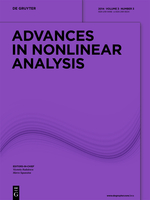
Advances in Nonlinear Analysis
Pioneering Insights in Nonlinear MathematicsAdvances in Nonlinear Analysis is a highly regarded academic journal dedicated to the exploration and dissemination of research in the field of nonlinear analysis. Published by DE GRUYTER POLAND SP Z O O, this journal has established itself as a pivotal resource for scholars and practitioners, achieving an impressive Q1 ranking in the Mathematics - Analysis category, and placing in the top 97th percentile within its discipline as per the latest Scopus rankings. With an Open Access model since 2018, Advances in Nonlinear Analysis ensures that cutting-edge research is readily accessible to a global audience, promoting the advancement of knowledge without barriers. Covering a broad spectrum of topics within nonlinear analysis, this journal invites contributions that involve either theoretical or applied aspects, making it an essential platform for exchanging innovative ideas and results in this dynamic field. Researchers, professionals, and students alike will find this journal invaluable for staying abreast of the latest developments and methodologies in nonlinear analysis.
Journal of Dynamics and Differential Equations
Advancing the Frontiers of Dynamic SystemsJournal of Dynamics and Differential Equations, published by SPRINGER, is a premier academic journal dedicated to advancing the understanding of dynamic systems and their mathematical foundations. Operating since its inception in 1989, the journal has become a vital resource for researchers and practitioners in the field, boasting a commendable Q1 ranking in the Analysis category as of 2023 and ranking #39 out of 193 journals in Mathematics Analysis on Scopus, placing it in the 80th percentile. While it maintains a traditional subscription model, its substantial contributions to the mathematics community—measured by a robust impact and adherence to high academic standards—make it essential reading for those engaged in differential equations and dynamical systems. The journal covers a broad scope of theoretical and applied research, positioning itself as a cornerstone for innovative studies and discussions, and ensuring its relevance to both contemporary and future mathematical inquiries.

COMMUNICATIONS ON PURE AND APPLIED ANALYSIS
Pioneering Research in Analysis and Its ApplicationsCOMMUNICATIONS ON PURE AND APPLIED ANALYSIS, published by the American Institute of Mathematical Sciences (AIMS), is a pivotal journal that serves the fields of pure and applied mathematics. With an ISSN of 1534-0392 and an E-ISSN of 1553-5258, this journal showcases rigorous research findings that span a myriad of topics within mathematical analysis and its applications. Given its impressive Q2 ranking in both Analysis and Applied Mathematics categories, it is recognized for its significant contributions, ranking 92nd out of 193 in Analysis and 369th out of 635 in Applied Mathematics according to Scopus. The journal, running continuously from 2004 to 2024, invites submissions that push the boundaries of mathematical thought and practice. While it operates under a traditional access model, the journal's comprehensive scope and burgeoning impact factor underscore its importance for researchers, professionals, and students who seek to engage deeply with current mathematical advancements.

NONLINEARITY
Pioneering Research in Applied Mathematics and PhysicsNONLINEARITY is a premier academic journal published by IOP Publishing Ltd, dedicated to advancing the field of complex systems through the lens of nonlinear science. Since its inception in 1988, the journal has established itself as a vital resource for researchers and professionals alike, offering a robust platform for disseminating high-quality research in areas such as applied mathematics, mathematical physics, and statistical and nonlinear physics. With an impressive Q1 ranking across multiple pertinent categories, including Applied Mathematics and Mathematical Physics, NONLINEARITY ranks among the top journals globally, making it essential reading for those seeking to deepen their understanding of nonlinear phenomena. Although it does not operate under an open-access model, its rich repository of rigorous articles significantly contributes to academia, fostering innovative thought and facilitating cutting-edge research. Located in the heart of the United Kingdom at TEMPLE CIRCUS, TEMPLE WAY, BRISTOL BS1 6BE, NONLINEARITY continues to be at the forefront of the scientific community, championing new discoveries and interdisciplinary dialogue within its dynamic scope.
ANNALI DI MATEMATICA PURA ED APPLICATA
Elevating Mathematical Discourse Since 1858ANNALI DI MATEMATICA PURA ED APPLICATA is a prestigious journal published by Springer Heidelberg, focusing on the field of Applied Mathematics. With a rich history dating back to its initial publication stages from 1858, this journal continues to serve as a vital platform for researchers and professionals seeking to disseminate high-quality, peer-reviewed research. The journal's strong reputation is reflected in its Q1 ranking in Applied Mathematics and its Scopus rank of #335 out of 635, placing it in the 47th percentile, showcasing its impact in the field. Although it is not an open-access journal, it provides exclusive insights and advancements in mathematical applications, allowing academics to explore innovative methodologies and theoretical developments. The combination of its long-standing tradition and contemporary relevance makes ANNALI DI MATEMATICA PURA ED APPLICATA an essential resource for scholars and students looking to deepen their understanding of mathematics and its practical applications.