EAST EUROPEAN POLITICS AND SOCIETIES
Scope & Guideline
Illuminating the challenges and changes in Eastern European politics.
Introduction
Aims and Scopes
- Democratic Transition and Backsliding:
The journal critically examines the processes of democratization in Eastern Europe, focusing on various factors that contribute to democratic backsliding, civic mobilization, and the role of civil society in promoting or hindering democratic norms. - Civic Engagement and Social Movements:
A significant focus on civic activism, including the motivations behind protests, the role of social movements, and the impact of grassroots initiatives on political change in Central and Eastern Europe. - National and Ethnic Identities:
Research on the construction and negotiation of national and ethnic identities, particularly in the context of post-communist societies, is a core area, reflecting the region's complex historical legacies and current political challenges. - Policy Analysis and Governance:
The journal includes studies on governance structures, policy-making processes, and the effectiveness of governmental institutions, particularly in relation to local and regional governance in post-communist contexts. - Historical Perspectives and Memory Politics:
The exploration of historical narratives, memory politics, and their implications on contemporary social and political issues is a notable aspect, addressing how history shapes current identities and political discourse.
Trending and Emerging
- Democratic Backsliding and Authoritarianism:
There is a significant increase in research addressing the issue of democratic backsliding and the rise of authoritarianism in Eastern Europe, reflecting scholars' concerns about the erosion of democratic norms and practices in several countries. - LGBTQIAP Rights and Social Movements:
An emerging focus on the intersection of LGBTQIAP rights and civic mobilization highlights the growing importance of gender and sexuality in political discourse and activism, particularly in response to rising conservativism. - Impact of War and Migration:
Studies examining the effects of war, particularly the ongoing conflict in Ukraine, on migration patterns and social dynamics are trending, indicating a heightened interest in the humanitarian and socio-political implications of conflict. - Civic Mobilization and Political Participation:
The journal is increasingly publishing articles on civic mobilization strategies and the role of citizens in political participation, reflecting a growing interest in grassroots activism and its impact on policy outcomes. - Populism and Political Polarization:
Research on populism, political polarization, and its effects on party systems and governance in Eastern Europe is gaining traction, as scholars seek to understand the implications of these phenomena on democracy and civil society.
Declining or Waning
- Economic Transition and Market Reforms:
Research on the economic transformations and market reforms in post-communist countries has seen a decline, possibly due to a shift towards more politically focused studies amid rising concerns over democratic governance and civil society. - Environmental Politics:
Although environmental issues were once prominent, there is a noticeable decrease in articles focusing on environmental politics and sustainability, indicating a possible shift in research priorities towards more immediate social and political challenges. - Comparative Studies with Western Europe:
The comparative analysis between Eastern and Western European politics has diminished, as the focus has increasingly turned inward to address the unique challenges faced by Eastern European nations, reducing the emphasis on cross-regional comparisons.
Similar Journals

POLITY
Unraveling Complexities in Social StructuresPOLITY, published by University of Chicago Press, is a premier academic journal that navigates the intricate landscapes of sociology and political science. With an ISSN of 0032-3497 and an E-ISSN of 1744-1684, this esteemed periodical has been a vital platform for scholarly discourse and innovative research since its convergence in 1995, continuing to inform and shape the field until 2024. Ranking in the 2nd quartile (Q2) and positioned at #637 out of 1466 in the Scopus rankings for Social Sciences in sociology and political science, POLITY stands out for its commitment to quality and its impact on contemporary debates. Researchers and students alike will find an array of articles that delve into the complexities of social structures and political ideologies, offering critical insights essential for advancing both theoretical understanding and practical applications. While access options may vary, the journal remains a pivotal resource in fostering dialogue among scholars interested in the dynamic interplay between politics and society.
SLAVIC REVIEW
Illuminating the Tapestry of Slavic Heritage.SLAVIC REVIEW, published by Cambridge University Press, is a prominent academic journal that delves into the rich tapestry of Slavic studies, focusing on the cultural, historical, and social dimensions of Slavic regions. With an ISSN of 0037-6779 and an E-ISSN of 2325-7784, this journal holds a significant position within the academic community, ranking in the Q2 category of Arts and Humanities (miscellaneous) and achieving a Q1 rating in Cultural Studies as of 2023. Notably, the journal has consistent relevance in the field, as evidenced by its Scopus rankings—Rank #260 in Cultural Studies and Rank #204 in Miscellaneous Arts and Humanities. Since its converged years starting from 1966 up to the present, SLAVIC REVIEW has been an essential resource for researchers, professionals, and students aiming to deepen their understanding of Slavic cultures. While it operates on a traditional subscription model and does not provide open access, the journal remains a vital platform for pioneering research and critical discourse in Slavic studies.
SLAVONIC AND EAST EUROPEAN REVIEW
Illuminating the Complex Narratives of the Slavic WorldSLAVONIC AND EAST EUROPEAN REVIEW, published by the Modern Humanities Research Association, stands as a pivotal academic journal since its inception in 1971, focusing on the rich cultural, historical, and linguistic landscapes of Eastern Europe and the Slavic-speaking world. With its ISSN 0037-6795 and E-ISSN 2222-4327, this esteemed journal provides a platform for scholars to share innovative research and critical analyses that shape the understanding of these complex regions. Although not open access, it maintains a reputation for rigorous scholarship, reflected in its categorization across multiple fields including Cultural Studies, History, and Literature in prestigious quartiles. The journal's Scopus rankings further illustrate its importance in the academic community, fostering a dialogue among researchers, professionals, and students who seek to deepen their insights into Eastern European studies. As a contributor or reader, you will find the SLAVONIC AND EAST EUROPEAN REVIEW an essential resource in navigating the intricate narratives that define this significant area of scholarship.
East European Politics
Fostering Discourse on Contemporary Political IssuesEast European Politics, published by ROUTLEDGE JOURNALS, TAYLOR & FRANCIS LTD, is a premier academic journal that plays a pivotal role in advancing the understanding of the socio-political dynamics within East Europe. Established in 2012 and spanning through 2024, this journal is renowned for its rigorous scholarship, achieving a distinguished Q1 ranking in key categories including Development, Geography, Planning and Development, and Political Science and International Relations for 2023. With an impressive Scopus rank placing it in the top 5% within the fields of Political Science and International Relations, East European Politics serves as an essential resource for researchers, professionals, and students seeking to engage with contemporary political issues and development challenges in the region. The journal does not offer open access at this time, but maintains a rich archive of high-quality articles that contribute significantly to scholarly discourse and policy analysis. This vital platform not only disseminates current research but also fosters a deeper understanding of the historical and cultural contexts that shape the political landscapes of East Europe.

European Journal of Transformation Studies
Unveiling the Forces Behind Cultural ShiftsThe European Journal of Transformation Studies is a distinguished peer-reviewed publication focusing on the multifaceted field of transformative processes across Europe and beyond. Published by EUROPE OUR HOUSE in Tbilisi, Georgia, this journal serves as a vital platform for researchers, academics, and professionals to share insights into socio-economic, cultural, and technological transformations in contemporary societies. Although the journal operates under an open-access model, ensuring wider dissemination of knowledge, it aims to cultivate a rich discourse around transformation studies by presenting innovative research, theoretical advancements, and case studies that reflect the evolving landscape of Europe. With its commitment to advancing understanding in this critical field, the European Journal of Transformation Studies is poised to become an essential resource for scholars and practitioners alike, encouraging interdisciplinary collaboration and fostering new perspectives on transformation.
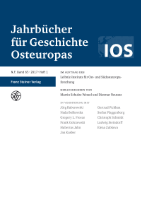
JAHRBUCHER FUR GESCHICHTE OSTEUROPAS
Connecting the Dots of Eastern Europe's Historical LandscapeJAHRBUCHER FUR GESCHICHTE OSTEUROPAS, published by FRANZ STEINER VERLAG GMBH, is a prominent academic journal dedicated to the exploration of Eastern European history. With its inception dating back to 1978, this journal has consistently provided a platform for scholarly discourse, contributing significantly to the understanding of the region's complex historical narratives. While the journal is not open access, it holds a solid reputation within the academic community, positioned in the Q4 quartile in history as per the 2023 category rankings, and stands at Rank #1636 within the Scopus Arts and Humanities History ranking. The convergence of its publication years throughout the decades emphasizes a long-standing commitment to historical research, thereby making it an essential resource for researchers, professionals, and students interested in Eastern European studies. Explore the intricate dynamics of historical events and cultural developments that shape Eastern Europe through this invaluable periodical.

Comparative Southeast European Studies
Innovating Research for a Deeper Understanding of Southeast EuropeComparative Southeast European Studies, published by WALTER DE GRUYTER GMBH, is an esteemed open-access journal that has been contributing to scholarly discourse since its inception in 2021. With its ISSN 2701-8199 and E-ISSN 2701-8202, the journal is dedicated to the multidisciplinary examination of Southeast European societies, cultures, and economies. The journal strives to foster a nuanced understanding of historical and contemporary issues through an array of perspectives, appealing to researchers, professionals, and students alike. While it currently resides in Q4 for several categories including Anthropology, Economics, and Political Science, it maintains a robust platform for innovative research and dialogue within the region. Situated in Germany, this journal serves not only as a repository of knowledge but also as a catalyst for future scholarly endeavors, with the aim to elevate the discourse surrounding Southeast Europe during the converging years of 2021 to 2024. Its commitment to open access ensures that critical research is readily available, inspiring collaboration and engagement across academic and professional communities.

Eastern Journal of European Studies
Fostering critical scholarship in Economics, History, and beyond.Eastern Journal of European Studies is a distinguished open-access platform published by UNIV ALEXANDRU IOAN CUZA, CENTRUL STUDII EUROPENE, dedicated to advancing research and scholarship in the fields of Economics, History, Political Science, and Sociology. Since its inception in 2010, this journal has been committed to fostering a rich dialogue among scholars and practitioners, emphasizing interdisciplinary approaches to European studies. With a notable Q1 ranking in History and Q3 rankings in other social sciences categories as of 2023, the journal holds a strong position in both European and global research landscapes. As part of the Scopus indexing, it stands out with impressive percentiles, including the 90th percentile in History. By providing an open-access platform, the journal ensures that critical research is widely accessible, bridging gaps between academia and the public. It serves as an essential resource for researchers, policymakers, and students interested in exploring Europe’s complex dynamics, making significant contributions to contemporary debates and policy implications.

COMPARATIVE POLITICS
Illuminating the dynamics of power and governance.COMPARATIVE POLITICS, published by SHERIDAN PRESS, is a prestigious journal that has been a cornerstone of the fields of sociology and political science since its inception in 1978. It is renowned for its rigorous peer-reviewed articles that explore and analyze the complex dynamics of political systems and comparative methodologies. With an impressive impact factor that places it in the Q1 category of Sociology and Political Science as of 2023, it ranks among the top 15% in its field, showcasing its influence and scholarly relevance. The journal's inclusion in prestigious academic database rankings, specifically its Scopus rank of 224 out of 1466, further underscores its prominence, reflecting its significant contribution to ongoing discourse in comparative politics. While open access options are not available, this journal remains widely accessible through academic institutions and libraries, catering to researchers, professionals, and students who seek to deepen their understanding of political frameworks and comparative analysis. COMPARATIVE POLITICS continues to be an indispensable resource for advancing knowledge and fostering intellectual engagement in its discipline.

MODERN ASIAN STUDIES
Exploring the Rich Tapestry of Asian NarrativesModern Asian Studies, published by Cambridge University Press, is a highly esteemed journal that encompasses scholarly research focused on the vibrant and complex narratives of Asian societies, cultures, and histories. With an ISSN of 0026-749X and an E-ISSN of 1469-8099, this journal has been at the forefront of Asian studies since its inception in 1967 and continues to evolve, striving towards excellence with a convergence period extending to 2024. It holds a prestigious Q1 ranking in History and Q2 rankings in both Geography, Planning, and Development as well as Sociology and Political Science as of 2023. With Scopus rankings placing it in the top 92nd percentile in History and maintaining significant standing in other social sciences categories, Modern Asian Studies provides invaluable insights for researchers, professionals, and students alike. Although not an open-access journal, it remains committed to disseminating impactful research that addresses critical issues within Asian studies, enhancing the academic discourse and contributing to a deeper understanding of the region's past and present.