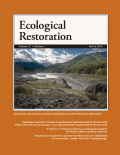
Ecological Restoration
metrics 2024
Championing innovative practices in restoration.
Introduction
Ecological Restoration is a renowned journal published by University of Wisconsin Press, focusing on the critical and evolving field of ecological restoration. With its inception dating back to 1999 and converging through the years to 2024, the journal has carved out a significant niche, reflected in its recognition within the Q3 category of Nature and Landscape Conservation for 2023. Although the journal is not readily available as open access, it offers an essential platform for researchers, professionals, and students to publish their findings and collaborate across diverse topics relevant to environmental science and restoration practices. Ranked #123 out of 211 in its Scopus category and positioned in the 41st percentile, Ecological Restoration is dedicated to advancing the dialogue surrounding restoration techniques, ecological health, and sustainability efforts in response to ongoing global environmental challenges. This makes it a vital resource for anyone committed to enhancing the integrity of our natural ecosystems.
Metrics 2024
 0.272.301.6034
Metrics History
Rank 2024
Scopus
IF (Web Of Science)
JCI (Web Of Science)
Quartile History
Similar Journals
RUSSIAN JOURNAL OF ECOLOGY
Fostering Interdisciplinary Dialogue in Ecological ScienceRUSSIAN JOURNAL OF ECOLOGY, published by PLEIADES PUBLISHING INC, stands as a critical resource within the field of ecology, offering an array of research insights that span various ecological topics. With an ISSN of 1067-4136 and an E-ISSN of 1608-3334, this journal has been consistently disseminating knowledge since its inception in 1996, now converging towards 2024. Despite its current Q4 ranking in the Ecology, Evolution, Behavior and Systematics category, the journal has carved out a niche in the publication landscape, particularly for scholars focused on the rich and diverse ecological phenomena of Russia and surrounding territories. The journal aims to foster interdisciplinary collaboration and innovation by providing a platform for the dissemination of high-quality research. While it currently lacks open access options, readers can expect in-depth studies and analytical discourses that contribute meaningfully to the global understanding of ecological systems. With an impressive Scopus rank, this journal remains an important outlet for researchers, professionals, and students committed to advancing ecological science.
RESTORATION ECOLOGY
Fostering Global Dialogue on Biodiversity ConservationRESTORATION ECOLOGY is a leading international journal dedicated to the science and practice of ecological restoration, published by WILEY. With an ISSN of 1061-2971 and a robust E-ISSN of 1526-100X, this journal has successfully positioned itself within the top quartiles (Q1) in significant categories such as Ecology, Evolution, Behavior and Systematics, and Nature and Landscape Conservation, showcasing its high-impact contributions to these vital fields. RESTORATION ECOLOGY has been actively disseminating critical research since 1993 and continues to thrive as it converges toward 2024. Ranked impressively within Scopus, it stands at #98 out of 721 in Agricultural and Biological Sciences and #30 out of 211 in Environmental Science, emphasizing its substantial influence and reach. While the journal operates under traditional access guidelines, it serves as an invaluable resource for researchers, professionals, and students alike, aiming to advance knowledge and practical solutions for biodiversity conservation and ecosystem rehabilitation globally. For those interested in the intersection of ecological theory and practical restoration applications, RESTORATION ECOLOGY is a key outlet for fostering dialogue and collaboration.
WETLANDS ECOLOGY AND MANAGEMENT
Fostering interdisciplinary dialogue in wetland science.Wetlands Ecology and Management, published by Springer, is an esteemed journal that has been advancing the field of wetland studies since its inception in 1982. Operating under the ISSN 0923-4861 and E-ISSN 1572-9834, this journal is headquartered in the Netherlands and serves as a critical resource for researchers, professionals, and students alike. It fosters interdisciplinary dialogue among aquatic science, ecology, and resource management disciplines, ranking in the Q2 category for Aquatic Science and Ecology, Evolution, Behavior and Systematics as of 2023. With a notable Scopus ranking, it is positioned favorably within the 65th percentile in Ecology and a commendable 58th percentile in Aquatic Sciences. The journal emphasizes the importance of effective management strategies and policies in the conservation of wetlands, making it indispensable for those aiming to drive impactful research. Although it is not an open-access journal, its high-quality publications remain accessible through library consortia and institutional subscriptions, ensuring that pertinent insights into the ecological dynamics and sustainable management practices are available to the global research community.
ECOLOGICAL MANAGEMENT & RESTORATION
Championing biodiversity and ecosystem resilience.Ecological Management & Restoration is a premier international journal published by Wiley, dedicated to advancing the fields of ecology, environmental management, conservation, and restoration practices. With an impact factor that positions it in the Q2 category across various ecological and management domains, this journal serves as a critical platform for researchers and professionals seeking to address contemporary issues related to ecosystem health, biodiversity, and sustainable management. Covering a wide range of topics from ecological restoration techniques to policy impacts on nature conservation, the journal caters to a diverse audience and contributes to the scientific community's understanding of environmental challenges. Importantly, the journal provides significant visibility, ranking in the top percentiles within key ecological research arenas such as Nature and Landscape Conservation, reinforcing its value for researchers aiming to influence both scientific thought and practical applications in ecology and management. The journal's commitment to disseminating high-quality research makes it an essential resource for students, researchers, and practitioners dedicated to fostering a sustainable future.
FOREST ECOLOGY AND MANAGEMENT
Innovating Strategies for Forest StewardshipFOREST ECOLOGY AND MANAGEMENT is a premier peer-reviewed journal dedicated to the integral study of forest ecosystems and their management, published by Elsevier in the Netherlands. With an impactful presence in the field, this journal boasts a prestigious Q1 ranking in multiple categories, including Forestry, Management, Monitoring, Policy and Law, and Nature and Landscape Conservation as of 2023. It addresses key issues relevant to sustainable forest practices, conservation strategies, and environmental monitoring, making it a vital resource for researchers, practitioners, and policymakers alike. The journal is indexed with an impressive Scopus rank, placing it among the top tier of titles in Agricultural and Biological Sciences and Environmental Science. While it does not offer Open Access options, its rigorous review process and high visibility make it essential for those seeking to stay abreast of the latest findings and trends in forest ecology and management. Published continuously since 1976, FOREST ECOLOGY AND MANAGEMENT aims to foster interdisciplinary collaboration and advance knowledge critical to the stewardship of forest resources in an ever-changing global landscape.

GAYANA BOTANICA
Innovating the future of plant research and practices.GAYANA BOTANICA is a prominent academic journal that specializes in the fields of Ecology, Horticulture, and Plant Science, published by EDICIONES UNIV, CONCEPCION in Chile. Established in 1981, this journal has become a vital resource for researchers and professionals seeking to advance their knowledge and contribute to the understanding of botanical sciences, offering a diverse range of articles that explore the ecology of plants, horticultural practices, and innovative plant science methodologies. Although it currently holds a Q4 quartile ranking in its categories, the journal’s commitment to disseminating valuable scientific findings continues to strengthen its relevance in the field. With its focus on promoting original research and fostering dialogue among scholars, GAYANA BOTANICA plays an essential role in supporting the global scientific community. We invite researchers, academics, and students to engage with its content and explore advancements that are shaping the future of plant sciences.

Mires and Peat
Championing Biodiversity Through Peatland ScienceMires and Peat is a premier open-access journal focusing on the intricate and vital ecosystems of mires and peatlands, published by the International Peatland Society and the International Mire Conservation Group. Established in Germany, this journal has been serving the scientific community since 2006 and offers a unique platform for researchers, conservationists, and students to explore topics pertinent to aquatic sciences, ecology, and soil science. With impressive rankings across several Scopus categories, including a Q2 designation in Ecology and Nature and Landscape Conservation, Mires and Peat is recognized for its vital contributions to environmental science. The journal aims to disseminate innovative research and foster discussions that enhance understanding and conservation of peatland ecosystems, which are crucial for global biodiversity and climate regulation. Accessible to a broad audience through its open-access model, Mires and Peat stands out as an essential resource for those dedicated to advancing knowledge in this critical field.
AFRICAN JOURNAL OF AQUATIC SCIENCE
Advancing aquatic knowledge for a sustainable future.AFRICAN JOURNAL OF AQUATIC SCIENCE, published by TAYLOR & FRANCIS LTD, is a premier scholarly journal dedicated to the field of aquatic science, ecology, and environmental management, playing a crucial role in advancing research and knowledge in these vital areas. With an impressive Q2 ranking in both Aquatic Science and Ecology, Evolution, Behavior and Systematics, the journal seeks to publish high-quality research encompassing a wide range of topics related to freshwater and marine ecosystems, including biodiversity, conservation strategies, and the impacts of climate change. Featuring a rich history of publication from 2000 to 2024, the journal not only embraces rigorous peer review but also aims to foster collaboration and dialogue among researchers, practitioners, and students interested in aquatic environments. Readers will find that the journal’s commitment to impactful scientific communication is reflected in its notable rankings within the Scopus database, making it an essential resource for those engaged in aquatic research and management.
CALDASIA
Fostering Connections in the World of Biological ResearchCALDASIA is a distinguished open-access journal dedicated to the field of Agricultural and Biological Sciences, published by INST CIENCIAS NATURALES, MUSEO HISTORIA NATURAL since its inception in 1981. Based in Colombia, this journal plays a pivotal role in disseminating scientific knowledge and fostering research collaboration across the globe. With a focus on diverse subjects within the biological sciences, CALDASIA aims to bridge gaps in research and support scholars, professionals, and students in advancing their work. With a 2023 Scopus Ranking of #132 out of 221 in its category, representing a 40th percentile ranking, it holds a solid position in the academic community, particularly recognized for its contributions to miscellaneous areas within agricultural and biological sciences. The journal remains committed to enhancing accessibility, as evidenced by its open-access policy since 2001, thereby ensuring that research findings reach a wider audience without barriers. For those returning to this vibrant field, CALDASIA serves as an essential resource for contemporary findings and discussions that shape environmental and biological scholarship.
Ecosphere
Advancing ecological understanding for a sustainable future.Ecosphere is a leading open-access journal published by WILEY, dedicated to advancing research in the fields of ecology, evolution, behavior, and systematics. Established in 2010 and headquartered in the United States, this innovative journal provides a platform for the exchange of cutting-edge scientific knowledge and discovery, fulfilling its mission to enhance our understanding of ecological systems and their interactions. With a prestigious impact factor reflecting its commitment to high-quality research, Ecosphere is ranked Q1 in both Ecology and Ecology, Evolution, Behavior, and Systematics for 2023, further solidifying its prominence in the scientific community. The journal's scope includes a wide array of topics related to environmental science, making it an essential resource for researchers, professionals, and students aiming to stay at the forefront of ecological research. It offers comprehensive open access options, ensuring that groundbreaking findings are readily available to a global audience, thus fostering collaboration and innovation in the field.