
Ekonomia i Srodowisko-Economics and Environment
Scope & Guideline
Uniting Economics and Environment for Sustainable Development
Introduction
Aims and Scopes
- Sustainable Development and Environmental Management:
The journal prioritizes research that explores sustainable practices across various sectors, including agriculture, energy, and urban planning, highlighting innovative strategies for environmental conservation and resource management. - Economic Analysis of Environmental Policies:
It provides a platform for studies assessing the economic implications of environmental regulations and policies, including analyses of cost-benefit scenarios and the effectiveness of different policy instruments. - Public Perception and Behavioral Studies:
The journal focuses on understanding societal attitudes and behaviors towards environmental issues, including studies on consumer behavior, public awareness, and the impacts of education and communication strategies. - Technological Innovations and Eco-Innovation:
Research that examines the role of technology in promoting sustainability, including innovations in waste management, renewable energy, and eco-efficient practices, is a core area of interest. - Regional and Local Economic Development:
The journal explores the interplay between local economic development and environmental sustainability, emphasizing case studies and strategies that foster regional resilience and ecological health.
Trending and Emerging
- Climate Change and Resilience Strategies:
There is a growing emphasis on research addressing climate change impacts and the development of resilience strategies in various sectors, including agriculture, urban planning, and energy, highlighting the urgent need for adaptive measures. - Energy Transition and Renewable Sources:
Research focusing on the transition to renewable energy sources and the economic implications of this shift is trending, as countries strive to meet sustainability goals and reduce carbon emissions. - Circular Economy Practices:
The concept of the circular economy is gaining traction, with an increasing number of studies exploring innovative waste management solutions and sustainable consumption patterns that promote resource efficiency. - Socio-Economic Impacts of Environmental Policies:
There is an emerging interest in understanding the socio-economic impacts of environmental policies, particularly how they affect different demographics and contribute to social equity. - Integration of Technology in Environmental Management:
Research exploring the role of technology in enhancing environmental management practices, such as smart city initiatives and the use of big data for sustainability, is on the rise.
Declining or Waning
- Traditional Agricultural Practices:
Research focusing solely on conventional agricultural methods is waning as the discourse shifts towards sustainable and organic farming practices, reflecting a growing concern for environmental impact and sustainability. - General Economic Growth Without Environmental Consideration:
Papers that concentrate solely on economic growth metrics without integrating environmental considerations are becoming less common, as there is an increasing recognition of the need for sustainable economic models. - Static Environmental Impact Assessments:
The trend of conducting one-time environmental impact assessments without ongoing monitoring and adaptive management is declining, as there is a shift towards more dynamic and continuous assessment methodologies. - Single-Dimensional Approaches to Urban Planning:
Research that addresses urban planning from a purely economic or infrastructural perspective without considering environmental sustainability is seeing reduced emphasis, as integrated approaches gain traction. - Outdated Waste Management Strategies:
Studies focusing on traditional waste management practices that do not incorporate circular economy principles or innovative recycling methods are becoming less prevalent.
Similar Journals
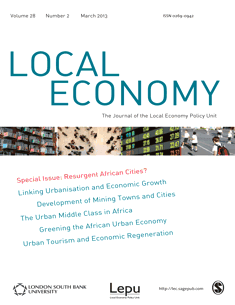
Local Economy
Transforming Local Economies with Scholarly ExcellenceLocal Economy is a prestigious academic journal published by SAGE Publications Ltd, specializing in the dynamic field of local economic development. With an ISSN of 0269-0942 and an E-ISSN of 1470-9325, this journal has established itself as a leading source of interdisciplinary research from 1986 to 2024. Based in the United Kingdom, the journal boasts a remarkable Q1 ranking in the category of Economics, Econometrics, and Finance, reflecting its significant impact and influence in the field. Researchers and practitioners alike value Local Economy for its rigorous peer-reviewed studies that address key issues related to local economic policies, practices, and community resilience. With a Scopus rank of 72 out of 288, positioning it in the top 75th percentile, this journal is essential reading for those seeking to deepen their understanding of economic development at the local level. The absence of open access reinforces its commitment to quality scholarship, making the journal a reputable platform for disseminating important research findings and engaging discussions.

Geografia-Malaysian Journal of Society & Space
Pioneering Insights into Regional Studies and Spatial PracticesGeografia-Malaysian Journal of Society & Space, published by the esteemed Universiti Kebangsaan Malaysia through its Faculty of Social Sciences & Humanities, stands as a vital platform for scholarly discourse in the fields of geography, social sciences, and spatial studies. With its ISSN 2180-2491 and E-ISSN 2682-7727, this journal emphasizes the importance of regional studies, fostering a deep understanding of societal dynamics within the Malaysian context and beyond. Although currently lacking impact factor and HIndex data, the journal is poised to contribute significantly to academic discussions, urging researchers, professionals, and students to explore spatial complexities influencing social structures. Geografia aims to publish high-quality, peer-reviewed works, focusing on innovative theoretical and empirical research that addresses contemporary issues in society and space. By promoting open access to its content, it ensures that knowledge is freely available, furthering academic engagement and collaboration in the global scholarly community.

Journal of Mehmet Akif Ersoy University Economics and Administrative Sciences Faculty
Pioneering Research for a Sustainable FutureJournal of Mehmet Akif Ersoy University Economics and Administrative Sciences Faculty (ISSN: 2149-1658, E-ISSN: 2149-1658) is a premier, peer-reviewed academic journal published by Mehmet Akif Ersoy University, dedicated to advancing the fields of economics and administrative sciences. Established in 2014 as an Open Access journal, it aims to facilitate the rapid dissemination of research findings, making them freely available to a global audience. This journal is committed to fostering interdisciplinary communication and collaboration among researchers, professionals, and students, encouraging innovative studies that address contemporary economic and administrative challenges. Despite the absence of a specific H-Index and quartile rankings, the journal is poised to establish a significant academic footprint, providing a platform for quality research that is instrumental in shaping policy and practice within the sector. By promoting high-quality research, it contributes to the advancement of knowledge and fosters academic growth in both national and international contexts.

Economics Ecology Socium
Connecting research and policy for a greener tomorrow.Economics Ecology Socium is an impactful open-access journal focused on the intersection of economic systems, ecological sustainability, and societal dynamics. Published by Dr. Viktor Koval, this journal aims to foster interdisciplinary research that addresses contemporary challenges in environmental economics and social policies. Since its inception in 2017, Economics Ecology Socium has become a vital platform for scholars, practitioners, and students to disseminate novel insights and data-driven findings. With a commitment to advancing eco-socioeconomic knowledge, the journal encourages contributions that promote sustainability and improve decision-making processes across various sectors. Its open-access model allows for broad dissemination of research, making crucial knowledge available to a global audience. With an ISSN of 2616-7107 and an E-ISSN of 2786-8958, Economics Ecology Socium is positioned to contribute meaningfully to the global dialogue on economic and ecological issues, ensuring that research reaches those who need it most.
African Journal of Economic and Management Studies
Elevating Discourse on Africa’s Economic LandscapeThe African Journal of Economic and Management Studies, published by EMERALD GROUP PUBLISHING LTD, is a premier academic platform dedicated to advancing knowledge in the fields of economics, management, and business studies, focusing on trends and issues pertinent to the African context. With an ISSN of 2040-0705 and an E-ISSN of 2040-0713, this journal has established itself as a critical resource, achieving a commendable Q2 ranking in both the Business, Management and Accounting and Economics, Econometrics and Finance categories for 2023. By offering a blend of theoretical insight and empirical research, the journal facilitates the discourse surrounding effective economic policies and management practices, essential for students, researchers, and professionals alike. As it continues to expand its impact from its base in the United Kingdom and runs from 2010 to 2024, the African Journal of Economic and Management Studies remains committed to contributing to the academic community through rigorous peer-reviewed articles and innovative studies that address the unique challenges and opportunities within the African economy.
Journal of Environmental Economics and Policy
Advancing Policies for a Greener TomorrowThe Journal of Environmental Economics and Policy, published by Routledge Journals, Taylor & Francis Ltd, serves as a premier platform for researchers, policymakers, and scholars focused on the interlinkages between environmental issues and economic principles. With an ISSN of 2160-6544 and an E-ISSN of 2160-6552, this esteemed journal has achieved a commendable positioning in the academic community, securing a Q2 rating in key fields such as Economics and Econometrics, Environmental Science, and Management, Monitoring, Policy, and Law as of 2023. The journal has consistently been ranked in the upper tiers of its categories, reflecting its impact and relevance in contemporary environmental discussions. Operating from the United Kingdom, this journal is dedicated to publishing high-quality research articles, reviews, and case studies that contribute to the understanding of economic strategies in environmental governance and policy-making. With an address at 2-4 Park Square, Milton Park, Abingdon OX14 4RN, Oxon, England, it invites contributions that address pressing ecological challenges through an economic lens, fostering an interdisciplinary dialogue crucial for sustainable development. Although not an open access journal, it remains influential in shaping policies and practices that align economic growth with environmental sustainability.

AUSTRALIAN JOURNAL OF AGRICULTURAL AND RESOURCE ECONOMICS
Empowering insights for sustainable resource management.Introducing the AUSTRALIAN JOURNAL OF AGRICULTURAL AND RESOURCE ECONOMICS, a premier publication dedicated to advancing the fields of agricultural and resource economics. Published by Wiley in the United Kingdom, this journal boasts an impressive Impact Factor, reflecting its significance and influence within its disciplines. Classified as Q1 in Agricultural and Biological Sciences and Q2 in Economics and Econometrics for 2023, it ranks among the top journals in these fields, with notable Scopus rankings of 16/193 and 121/716 respectively. With convergence from 1996 to 2024, the journal aims to disseminate innovative research, critical analysis, and empirical studies that address pressing economic issues in agriculture and resource management. Through its commitment to high-quality research and multiple open access options, the AUSTRALIAN JOURNAL OF AGRICULTURAL AND RESOURCE ECONOMICS serves as an essential resource for researchers, professionals, and students alike, fostering knowledge and dialogue in this vital area of study.

New Medit
Empowering academics and practitioners through open access research.New Medit is a distinguished open-access journal published by Bologna University Press, focusing on the diverse realms of agricultural, biological, and social sciences. Established in 1990, New Medit aims to foster interdisciplinary research and dialogue, facilitating knowledge exchange among academics, policymakers, and practitioners. With a notable impact factor and recognized quartile rankings, including Q2 in Agricultural and Biological Sciences and Q3 in various other categories such as Agronomy, Development, and Economics, the journal maintains a steady trajectory of scholarly excellence. Its commitment to accessibility ensures that valuable research is available to a wide audience, thereby contributing significantly to advancements in these critical fields. With its publication history converging from 2008 to 2024, New Medit continues to be a crucial platform for innovative research and comprehensive reviews that address pressing global challenges.

Bio-based and Applied Economics
Exploring the Intersection of Economics and Environmental StewardshipBio-based and Applied Economics, an esteemed journal published by FIRENZE UNIV PRESS, is an open-access platform dedicated to the dissemination of innovative research and critical reviews in the interdisciplinary areas of agronomy, animal science, and food science, with a strong emphasis on the economic and environmental implications of bio-based applications. Since its inception in 2012, the journal has positioned itself as a valuable resource for academics and professionals alike, boasting a commendable Q2 ranking across various fields, including Economics, Environmental Science, and Applied Biological Sciences. With its notable impact factor and commitment to accessible research, it aims to foster knowledge exchange and stimulate advances in bio-economy practices. This journal not only contributes significantly to scholarly discourse but also serves as a crucial tool for policymakers and industry leaders seeking evidence-based solutions to contemporary challenges in sustainability and resource management.
JOURNAL OF ECOTOURISM
Cultivating a deeper understanding of ecotourism dynamics.The JOURNAL OF ECOTOURISM, published by Taylor & Francis Ltd, serves as a vital platform for scholarly discourse in the fields of geography, tourism, and sustainable development. With an ISSN of 1472-4049 and an E-ISSN of 1747-7638, this journal has been a cornerstone of academic research since 2002, and continues to contribute to the growing body of knowledge on ecotourism practices. The journal is ranked in the second quartile (Q2) for both Geography, Planning and Development and Tourism, Leisure and Hospitality Management, underscoring its relevance and impact in these critical areas, with Scopus rankings placing it in the 87th percentile among its peers. Although it operates under a subscription model, the significance of its published work is reflected in the robust engagement from researchers and professionals alike, ensuring that the insights shared within its pages significantly influence policy and practice in sustainable tourism. Based in the United Kingdom, the JOURNAL OF ECOTOURISM continues to evolve, inviting contributions that explore innovative methodologies, case studies, and theoretical frameworks essential for advancing ecotourism scholarship through its ongoing convergence from 2002 to 2024.