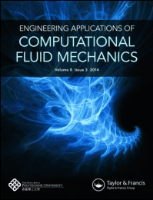
Engineering Applications of Computational Fluid Mechanics
metrics 2024
Advancing Fluid Dynamics Through Innovative Research
Introduction
Engineering Applications of Computational Fluid Mechanics is an esteemed journal published by Taylor & Francis Ltd that serves as a vital resource for researchers, professionals, and students in the field of fluid mechanics and its computational applications. With an ISSN of 1994-2060 and an E-ISSN of 1997-003X, this journal has established its reputation through its rigorous peer-review process and commitment to Open Access since 2015, facilitating widespread dissemination of cutting-edge research. Based in the United Kingdom, the journal is indexed in leading databases and has achieved a significant impact in its categories, ranking in the top quartile (Q1) for both Computer Science (miscellaneous) and Modeling and Simulation as of 2023. Notably, its Scopus rankings place it in the top 4% of Mathematics/modeling and simulation, highlighting its importance in advancing knowledge and innovation within the discipline. The journal invites contributions that explore both theoretical and practical aspects of computational fluid dynamics, fostering collaboration and intellectual growth within the community.
Metrics 2024
 1.155.905.5055
Metrics History
Rank 2024
Scopus
IF (Web Of Science)
JCI (Web Of Science)
Quartile History
Similar Journals
EUROPEAN JOURNAL OF MECHANICS B-FLUIDS
Advancing Knowledge in Fluid MechanicsThe EUROPEAN JOURNAL OF MECHANICS B-FLUIDS, published by Elsevier, is a prominent journal in the field of fluid mechanics, addressing the theoretical and experimental aspects of fluid behavior. Since its inception in 1990, this journal has consistently fostered a robust academic dialogue, maintaining a significant impact evidenced by its Q2 ranking in both Mathematical Physics and Physics and Astronomy categories as of 2023, placing it among the top publications in these disciplines. Researchers and professionals focusing on fluid dynamics will find a wealth of knowledge in its articles, which span broad topics pertinent to real-world applications as well as fundamental theories. While the journal is not open access, it offers critical insights that shape ongoing studies in fluid mechanics, making it an invaluable resource for anyone looking to deepen their understanding of the field. Located in the innovative environment of Amsterdam, Netherlands, the journal serves as a nexus for cutting-edge research and collaboration globally.
THEORETICAL AND COMPUTATIONAL FLUID DYNAMICS
Advancing the Frontiers of Fluid Dynamics.THEORETICAL AND COMPUTATIONAL FLUID DYNAMICS, published by SPRINGER, stands at the forefront of scientific discourse in the fields of fluid mechanics and computational methods. With an impressive impact factor reflecting its significance and reach, this journal has consistently maintained a Q1 ranking across multiple categories, including Computational Mechanics and Condensed Matter Physics as of 2023. Covering a rich scope of theoretical research and computational analysis, it aims to advance the understanding of fluid flow and transfer processes, making it an essential resource for researchers, professionals, and students alike. The journal, with its historical archive extending from 1989 to 2024, not only contributes to foundational theories but also integrates applied research and emerging computational techniques, thus facilitating innovation within the discipline. As a result, THEORETICAL AND COMPUTATIONAL FLUID DYNAMICS serves as a crucial platform for disseminating impactful findings that shape future advancements in fluid dynamics research.

Mechanika
Catalyzing Innovation in the Academic LandscapeMechanika is a prominent open-access journal published by Kaunas University of Technology in Lithuania, with an ISSN of 1392-1207 and E-ISSN 2029-6983. Since its transition to open access in 2007, the journal has successfully facilitated the dissemination of vital research findings within the field of condensed matter physics, carving a niche for itself in a competitive academic landscape. Despite currently being categorized in the Q4 quartile for its impact in this area, Mechanika aims to foster advancements by providing a platform for innovative studies, reviews, and applications. As researchers, professionals, and students engage with its content, they will find an array of studies that push the boundaries of understanding in mechanics and related disciplines. Situated in the vibrant academic milieu of Kaunas, Mechanika is committed to quality, accessibility, and fostering scientific dialogue among the global academic community.
Journal of Hydrodynamics
Fostering Scholarly Dialogue in Condensed Matter PhysicsWelcome to the Journal of Hydrodynamics, a premier academic journal dedicated to pioneering research in the fields of Condensed Matter Physics, Mechanical Engineering, Mechanics of Materials, and Modeling and Simulation. Published by Springer, this esteemed journal has been a vital resource since its inception in 1990 and boasts a notable Q1 ranking across its relevant categories, underscoring its importance in advancing knowledge and innovation. With a robust Scopus ranking reflecting its impact—such as being in the 82nd percentile in Mathematics: Modeling and Simulation and the 75th percentile in various engineering disciplines—the journal serves as a critical platform for researchers, professionals, and students. While not currently an open-access publication, the Journal of Hydrodynamics remains committed to fostering scholarly dialogue and disseminating high-quality research that shapes the future of its field. Our mission is to provide a comprehensive forum for the discussion of theoretical and applied hydrodynamics, potentially influencing both academic inquiry and practical applications worldwide.

Computational Thermal Sciences
Exploring the Nexus of Energy and MathematicsComputational Thermal Sciences, an esteemed journal published by BEGELL HOUSE INC, presents cutting-edge research at the intersection of computational mathematics, energy engineering, and fluid dynamics. With an ISSN of 1940-2503 and an E-ISSN of 1940-2554, this journal aims to disseminate high-quality research articles, reviews, and methodologies that improve our understanding of thermal processes and their applications. Renowned for its solid impact in the field, it holds a Q3 ranking in multiple categories including Computational Mathematics and Energy Engineering for 2023. As the field evolves, the journal continues to play a pivotal role in bridging theoretical research with practical innovations, thereby catering to a diverse audience of researchers, professionals, and students. Although it operates on a subscription model, the journal ensures accessibility to significant contributions in thermal sciences from 2009 to 2024, fostering an environment of knowledge sharing and collaboration.
FLUID DYNAMICS RESEARCH
Pioneering Discoveries in Fluid Flow and Transfer ProcessesFLUID DYNAMICS RESEARCH, published by IOP Publishing Ltd, is a pivotal journal dedicated to advancing the understanding of fluid dynamics through interdisciplinary research that spans several domains including mechanical engineering and physics. With an ISSN of 0169-5983 and E-ISSN 1873-7005, this journal provides a vital platform for researchers aiming to disseminate new findings and theoretical advancements in fluid flow and transfer processes. As of 2023, FLUID DYNAMICS RESEARCH holds a commendable position within the academic community, ranked Q3 in fluid flow and transfer processes, mechanical engineering, and miscellaneous physics and astronomy categories. The journal showcases a diverse array of articles that not only inspire collaboration among professionals and students but also ensure that theoretical and experimental studies are accessible for further development in the field. Operating from the United Kingdom, the journal offers a unique opportunity for scholars worldwide to contribute to the vibrant community dedicated to understanding the complexities of fluid dynamics, even as it anticipates converging its years of research from 1986 to 2024.

Journal of Fluid Science and Technology
Advancing the Frontiers of Fluid DynamicsThe Journal of Fluid Science and Technology, published by the Japan Society of Mechanical Engineers, serves as a pivotal platform for the dissemination of cutting-edge research in the fields of fluid mechanics and mechanical engineering. With an ISSN of 1880-5558, this Open Access journal has been dedicated to advancing the understanding of fluid flow and transfer processes since its establishment. As of 2023, it holds a significant position with a Q3 quartile ranking in both Fluid Flow and Transfer Processes and Mechanical Engineering categories. Researchers and practitioners are encouraged to explore the journal’s extensive collection of articles, contributing to the body of knowledge that impacts various practical applications in engineering and technology. The journal, which has established a reputation for quality amidst a competitive landscape, further fosters international collaboration and education by providing unrestricted access to its content. For professionals and students alike, the Journal of Fluid Science and Technology represents an invaluable resource for the latest findings and innovations in fluid dynamics and mechanical systems.
Journal of Mathematical Fluid Mechanics
Illuminating the Path of Fluid Dynamics with Mathematical RigorThe Journal of Mathematical Fluid Mechanics, published by SPRINGER BASEL AG, is a prestigious academic journal dedicated to the study of fluid dynamics through the lens of mathematics. With its ISSN 1422-6928 and E-ISSN 1422-6952, this journal has firmly established itself in the academic community since its inception in 2004, converging knowledge across various mathematical disciplines until 2024. Recognized in the top Q1 quartile rankings for Applied Mathematics, Computational Mathematics, Condensed Matter Physics, and Mathematical Physics as of 2023, it reflects a strong commitment to high-quality research and innovation. The journal features a variety of research articles, reviews, and theoretical frameworks, serving as an essential resource for researchers, professionals, and students eager to explore the mathematical principles underlying fluid mechanics. While it does not offer open access, the impact of its contributions resonates within interdisciplinary fields, advancing both theoretical insights and practical applications.
INTERNATIONAL JOURNAL OF COMPUTATIONAL FLUID DYNAMICS
Connecting Researchers and Practitioners in CFD ExcellenceInternational Journal of Computational Fluid Dynamics, published by Taylor & Francis Ltd, is a prominent academic journal dedicated to advancing the field of computational fluid dynamics (CFD). Since its establishment in 1993, the journal has provided a platform for disseminating high-quality research, covering a wide spectrum of topics across various engineering disciplines, including Aerospace Engineering, Computational Mechanics, and Mechanical Engineering. With an impact factor placing it within Q2 categories across several relevant fields, the journal holds a significant position in the academic community, evidenced by its diverse Scopus rankings. Researchers and practitioners engage with state-of-the-art methodologies and innovative applications presented within its pages, contributing to both theoretical development and practical solutions in fluid dynamics. Though it currently operates under a subscription model, the journal remains a vital resource for those seeking to deepen their understanding of computational techniques and their application in industries spanning engineering and physics. This makes it an essential read for professionals, researchers, and students alike, striving for excellence in this dynamic and evolving area of study.
Journal of Applied Mechanics and Technical Physics
Elevating Knowledge in Mechanical Engineering and PhysicsJournal of Applied Mechanics and Technical Physics is a distinguished publication that serves as a vital resource for researchers and professionals in the realms of mechanical engineering, mechanics of materials, and condensed matter physics. Published by MAIK NAUKA/INTERPERIODICA/SPRINGER, this journal has been committed to disseminating high-quality research since its inception in 1965. With a noted presence in the academic community, it holds a respectable Q3 ranking in multiple categories as of 2023, indicating its relevance and contribution to the field. Although it does not currently offer open access, the journal provides valuable insights and advancements through its rigorous peer-review process. Covering a broad spectrum of topics in applied mechanics and technical physics, it aims to foster innovation and dialogue among scientists, engineers, and scholars alike. Located in the United States, the journal continues to make significant strides in bridging the gap between theoretical research and practical applications, making it an essential read for anyone engaged in these dynamic fields.