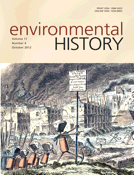
ENVIRONMENTAL HISTORY
Scope & Guideline
Innovating Research to Understand Our Ecological Legacy
Introduction
Aims and Scopes
- Interdisciplinary Approaches to Environmental History:
The journal encourages contributions that integrate various disciplines such as history, ecology, sociology, and anthropology, allowing for a multifaceted understanding of environmental issues. - Focus on Human-Nature Interactions:
A core aim is to investigate how human activities have historically interacted with natural environments, influencing ecological outcomes and shaping societal development. - Global and Local Perspectives:
The journal values both global environmental histories and localized studies, showcasing how broader ecological processes affect local contexts and vice versa. - Thematic Diversity:
Topics cover a wide range of themes including climate change, resource extraction, conservation movements, and the politics of environmental governance, making it a comprehensive platform for environmental scholarship. - Engagement with Contemporary Issues:
By examining historical contexts, the journal aims to inform current environmental debates and policies, highlighting the relevance of historical insights in modern ecological and social challenges.
Trending and Emerging
- Climate Change and Historical Contexts:
An increasing number of papers are examining historical perspectives on climate change, connecting past events to current environmental crises and exploring societal responses to climatic shifts. - Environmental Justice and Equity:
There is a growing focus on the intersections of environmental issues with social justice, examining how marginalized communities are affected by ecological policies and practices. - Technological Impacts on Environment:
Emerging themes include the historical role of technology in environmental transformation, particularly regarding energy transitions and industrial impacts on ecosystems. - Indigenous Knowledge and Practices:
Research that incorporates indigenous perspectives and knowledge systems in environmental history is on the rise, emphasizing the importance of these narratives in understanding sustainable practices. - Globalization and Environmental Change:
Papers increasingly address the implications of globalization on environmental histories, exploring how global economic systems influence local ecological conditions and historical transformations.
Declining or Waning
- Traditional Conservation Narratives:
There seems to be a waning focus on conventional narratives surrounding conservation that emphasize preservation over the complexities of land use, indigenous practices, and community engagement. - Colonial Environmentalism:
Studies centered exclusively on colonial perspectives of environmentalism are less frequent, indicating a potential shift towards examining post-colonial narratives and indigenous engagements with the environment. - Single-Nation Studies:
There is a noticeable decrease in papers focusing solely on environmental history within a single national context, as the journal increasingly encourages comparative and transnational approaches. - Static Ecological Perspectives:
Research that presents static views of ecosystems without considering dynamic changes over time is becoming less common, as the field moves towards understanding environmental change as a complex, ongoing process.
Similar Journals
Meridiano 47-Journal of Global Studies
Advancing Global Understanding Through Interdisciplinary ResearchMeridiano 47-Journal of Global Studies is a premier publication dedicated to the interdisciplinary exploration of global studies, a field that encompasses the complexities of international relations, socio-economic dynamics, and cultural interactions across borders. Published by the Instituto Brasileiro de Relações Internacionais, this journal has been an open-access platform since 2000, ensuring wide accessibility and dissemination of knowledge to researchers, professionals, and students alike. With its commitment to fostering critical discussions and innovative research in the realm of global dynamics, Meridiano 47 serves as a vital resource for those seeking to understand the intricacies of our increasingly interconnected world. By publishing high-quality articles that engage with contemporary issues and theoretical frameworks, the journal plays a significant role in shaping academic discourse and informing policy debates. Located in Brasília, Brazil, the journal contributes to a rich tradition of scholarship in global studies and invites submissions that advance collective understanding of global phenomena.
Anthropocene Review
Navigating the Complexities of Human-Environment InteractionsAnthropocene Review is a prominent academic journal published by SAGE Publications Inc. that focuses on the interdisciplinary study of the Anthropocene—a term used to describe the significant global changes resulting from human activity. Launched in 2014 and forming part of its converged years until 2024, this journal has quickly established itself as an essential resource for researchers and professionals in the fields of Ecology, Geology, and Global and Planetary Change, as evidenced by its notable Q2 and Q3 rankings in these categories. With a solid Scopus ranking placing it within the top tiers of Earth and Planetary Sciences and Environmental Science disciplines, the Anthropocene Review aims to shed light on the complex interactions between human actions and the environment, fostering a deeper understanding of sustainability and ecological impacts. While currently not an open-access journal, it provides crucial research findings and theoretical advancements that appeal to students and academics alike, shaping the discourse on our planet's future.

Global Environment
Navigating Global Change Through Interdisciplinary ResearchGlobal Environment, published by White Horse Press, is a notable academic journal dedicated to addressing critical issues in the realm of environmental studies, emphasizing the intersections of global and planetary change, history, and environmental policy. With an ISSN of 1973-3739 and an E-ISSN of 2053-7352, this journal has been a key contributor to the academic discourse since its inception in 2014, with a focus on promoting interdisciplinary research. The journal holds a Q4 ranking in Global and Planetary Change and Management, Monitoring, Policy and Law, alongside a commendable Q3 classification in History, reflecting its diverse scope and the relevance of its contributions. Researchers, professionals, and students will find valuable insights and the latest findings in Global Environment, making it an essential resource for anyone looking to understand and engage with contemporary environmental challenges.
Canadian Journal of History-Annales Canadiennes d Histoire
Exploring Canada’s Rich Tapestry of HistoryCanadian Journal of History - Annales Canadiennes d'Histoire is a prestigious scholarly publication that serves as a vital forum for research in the field of history, particularly as it pertains to Canadian narratives and experiences. Published by University of Toronto Press Inc, this journal has been at the forefront of Canadian historiography since its inception in 1979, continuing to disseminate knowledge through its rigorously peer-reviewed articles up to 2024. Although it operates under a traditional access model, its Q3 category ranking in History and presence in global academic databases reflect its ongoing commitment to quality scholarship, catering to historians, academics, and students alike. With an inclusive scope that encourages interdisciplinary collaboration, the journal provides a platform for diverse perspectives on Canadian history, thereby enhancing our understanding of the past and its significance in shaping contemporary society. For those engaged in the study of history, particularly in a Canadian context, the Canadian Journal of History is an indispensable resource.
Global Environmental Politics
Bridging Disciplines to Tackle Environmental Challenges.Global Environmental Politics, published by MIT Press, serves as a pivotal platform for interdisciplinary research that intersects the fields of environmental science, political science, and sustainability. Established with the aim to address the most pressing global environmental challenges, this journal has achieved prestigious recognition, placing in the Q1 category across multiple disciplines such as Global and Planetary Change and Political Science and International Relations as of 2023. With an impressive Scopus rank of #23 out of 706 in Political Science and International Relations, it appeals to a diverse audience by publishing high-quality, peer-reviewed articles that contribute to knowledge and policy frameworks essential for promoting sustainability and effective governance. Researchers, professionals, and students engaged in environmental studies will find this journal invaluable for exploring innovative ideas, policy analyses, and case studies designed to foster informed decision-making in an era of rapidly changing ecological and political landscapes. Access to the journal's articles is available through standard subscription options, ensuring that critical research remains accessible to the academic community.

Trumpeter-Journal of Ecosophy
Innovating Perspectives on Environmental EthicsTrumpeter-Journal of Ecosophy, published by Athabasca University Press, is a distinguished journal dedicated to the interdisciplinary study of ecological and philosophical concepts. With its ISSN of 0832-6193, this journal fosters scholarly discourse on issues such as environmental ethics, sustainability, and the interconnections between human societies and the natural world. Although it does not operate under an open-access model, the journal aims to benefit researchers, professionals, and students alike, providing insights and critical perspectives that are vital in a rapidly evolving ecological landscape. Trumpeter embraces a unique role in the field of ecosophy, challenging contributors to explore fresh ideas and innovative solutions to pressing ecological dilemmas, and thus establishing itself as an essential resource for advancing knowledge in this important area of study.
Ethics and the Environment
Transforming Environmental Discourse Through Ethical Inquiry.Ethics and the Environment is a distinguished journal dedicated to the dialogue between ecological considerations and moral philosophy, published by Indiana University Press. With an emphasis on fostering interdisciplinary discourse, this journal addresses the ethical implications of environmental issues, making it an essential resource for researchers, professionals, and students in both the fields of Environmental Science and Philosophy. As of 2023, it holds a notable impact factor with its Q4 ranking in Environmental Science (miscellaneous) and a favorable Q2 ranking in Philosophy, reflecting its relevance and contribution to ongoing scholarly discussions. Although not an open-access publication, it provides valuable insights that hold practical significance for policy-making, conservation efforts, and sustainability practices. With coverage spanning from 2013 to 2024, the journal continues to engage with current global environmental challenges through a philosophical lens, positioning itself as a crucial platform for ethical explorations in environmental discourse.

ENVIRONMENT AND HISTORY
Charting the Course of Environmental HistoriesENVIRONMENT AND HISTORY is a distinguished academic journal published by WHITE HORSE PRESS, focusing on the interdisciplinary study of environmental history and the intricate relationships between human societies and their environments. With an ISSN of 0967-3407 and an E-ISSN of 1752-7023, this journal serves as a vital platform for researchers, professionals, and students engaged in Arts and Humanities, Environmental Science, and Geography. Released in the United Kingdom, ENVIRONMENT AND HISTORY has been contributing to scholarly discourse since 1995 and continues to thrive with its current scope extending to 2024. The journal boasts impressive Scopus rankings, notably a 89th percentile in the field of History within the Arts and Humanities category. Although it operates without open access, the insights and findings published within its pages are invaluable to understanding historical contexts that influence current environmental challenges. Researchers and students alike can benefit from the journal's commitment to high-quality academic standards, reflected in its Q2 and Q4 categorizations across multiple subjects.
Nature + Culture
Connecting Cultural Narratives with Environmental RealitiesNature + Culture, published by BERGHAHN JOURNALS, focuses on the interdisciplinary exploration of cultural and environmental relationships, bridging the gap between the social sciences and ecological studies. With its ISSN 1558-6073 and E-ISSN 1558-5468, this journal has established itself as a key platform for scholars aiming to advance discussions in an era of rapid environmental change and cultural transformation. Operating from the United States, specifically at 20 Jay St, Suite 512, Brooklyn, NY 11201, it holds a respectable position within the academic community, evidenced by its Q3 ranking in Social Sciences (miscellaneous) for 2023 and its Scopus rank of #132 out of 275 in General Social Sciences. While currently not an Open Access journal, Nature + Culture provides vital insights that address the pressing issues of our time, making it an essential resource for researchers, professionals, and students committed to understanding the intersection of nature and human culture from 2008 through its converging years into 2024.

International Journal of Ecological Economics & Statistics
Fostering Knowledge for a Greener Economic Landscape.The International Journal of Ecological Economics & Statistics is a critical platform for research in the intersecting fields of ecological economics and statistical analysis. Published by the CENTRE ENVIRONMENT SOCIAL & ECONOMIC RESEARCH (PUBL-CESER), this journal aims to promote scholarly discussion and knowledge dissemination regarding sustainable economic practices and quantitative research methodologies. Despite the discontinuation of its coverage in Scopus, the journal continues to play a significant role in enhancing the understanding of the economic aspects of environmental issues within a global context. Researchers and professionals engaged in the fields of economics, decision sciences, and environmental studies are particularly invited to contribute and stay updated with the latest findings and theories. With its commitment to fostering academic discourse, the journal aspires to bridge the gap between environmental sustainability and economic growth, equipping readers with essential insights for future applications.