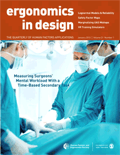
Ergonomics in Design
metrics 2024
Shaping the future of design through ergonomic research.
Introduction
Ergonomics in Design is a premier journal published by SAGE PUBLICATIONS INC that focuses on the intersection of engineering and human factors, offering essential insights into the practical applications of ergonomics. With an ISSN of 1064-8046 and E-ISSN of 2169-5083, this journal aims to disseminate high-quality research and innovative design solutions that enhance user experience across various domains. Having consistently ranked in the Q2 tier for Engineering and Q3 for Human Factors and Ergonomics, as per the recent Scopus Ranks, it serves as a valuable platform for scholars and practitioners dedicated to the advancement of ergonomic principles in design. The journal encompasses a wide array of topics from product design to workplace ergonomics, facilitating a multidisciplinary dialogue that supports the improvement of safety, comfort, and performance. This commitment to bridging theory and practice has established Ergonomics in Design as a vital resource for those keen to influence the design landscape from 1993 through to 2024 and beyond.
Metrics 2024
 0.320.701.1026
Metrics History
Rank 2024
Scopus
IF (Web Of Science)
JCI (Web Of Science)
Quartile History
Similar Journals
ERGONOMICS
Pioneering insights into ergonomics and human factors.ERGONOMICS is a premier journal that serves the dynamic fields of Human Factors and Ergonomics, as well as Physical Therapy, Sports Therapy, and Rehabilitation. Published by Taylor & Francis Ltd in the United Kingdom, this journal not only boasts a commendable impact factor but also holds a Q2 quartile ranking across its categories, underscoring its influence and academic rigor. With a convergence of significant research dating back to 1957, ERGONOMICS provides a multifaceted platform for the dissemination and discussion of innovative findings that enhance the interaction between people and their environments. Although the journal does not offer Open Access options, it remains a vital resource for researchers, professionals, and students seeking to deepen their understanding of ergonomic principles and applications. Positioned at the intersection of health and human behavior, ERGONOMICS is dedicated to advancing knowledge and promoting best practices in an era where the demand for safe and efficient work environments continues to grow.
Zentralblatt fur Arbeitsmedizin Arbeitsschutz und Ergonomie
Enhancing Safety Practices with Groundbreaking ResearchZentralblatt für Arbeitsmedizin, Arbeitsschutz und Ergonomie, published by Springer Heidelberg, is a pivotal academic journal dedicated to the fields of public health, occupational safety, and ergonomics. With an ISSN of 0944-2502 and an E-ISSN of 2198-0713, this journal has been serving the academic community since its inception in 1953, covering a breadth of topics related to workplace health and safety practices. Although currently classified in the Q4 quartile in Public Health, Environmental, and Occupational Health, the journal continues to publish valuable research that impacts both practitioners and policymakers in these essential fields. The journal’s scope encompasses a wide range of studies, evaluations, and methodologies aimed at improving occupational health standards and ergonomic practices. With access options that facilitate global dissemination of knowledge, it aims to foster collaboration and innovation among professionals, researchers, and students committed to enhancing workplace well-being and safety.

Journal of Usability Studies
Fostering deep understanding of user-system interactions.The Journal of Usability Studies, published by the USERS EXPERIENCE PROFESSIONAL ASSOCIATION, is a pivotal platform for researchers and professionals dedicated to advancing the field of usability and user experience design. With an ISSN of 1931-3357, this journal offers a collection of peer-reviewed articles that explore innovative methodologies, emerging technologies, and applied research in usability studies. Though it operates under a traditional access model, the journal remains dedicated to fostering a detailed understanding of how users interact with systems and products. The Journal of Usability Studies is instrumental for those aiming to enhance user satisfaction through research-backed insights, making it a vital resource for academics, practitioners, and students seeking to contribute to the evolving discourse in human-computer interaction and usability engineering.

She Ji-The Journal of Design Economics and Innovation
Fostering Interdisciplinary Dialogue in Design and EconomicsShe Ji - The Journal of Design Economics and Innovation is a pioneering Open Access journal published by Elsevier since 2015, based in the Netherlands. With its unique focus on the intersection of design, economics, and innovation, this journal serves as a vital platform for researchers, professionals, and students who are keen on understanding the complexities of designing value-creating innovations. Consistently recognized for its high impact, She Ji holds a prestigious Q1 quartile ranking in both Economics and Education, while maintaining a strong presence in Management of Technology and Innovation and the Visual Arts sector. This reflects its commitment to fostering interdisciplinary dialogue and advancing knowledge in the rapidly evolving fields of design and economic theory. Researchers seeking to disseminate their work can benefit from the journal's robust open access model, ensuring wide visibility and accessibility to their findings. With a commitment to excellence, She Ji continues to shape thought leadership in its field and is an essential resource for anyone involved in the integration of design thinking with economic innovation.

International Journal of Affective Engineering
Innovating user experiences through affective insights.Welcome to the International Journal of Affective Engineering, an esteemed publication dedicated to advancing the interdisciplinary fields of affective engineering and human-centered design. Published by the Japan Society of Kansei Engineering, this journal aims to foster innovative research that bridges emotional perception with engineering practices, ultimately enhancing user experiences across various applications. As a peer-reviewed platform, the journal plays a pivotal role in disseminating groundbreaking studies and methodologies, positioning itself as a valuable resource within the academic landscape. The journal is designed for a diverse audience, including researchers, industry professionals, and students committed to exploring the emotional dimensions of technology. Although it currently operates under a subscription model, the journal remains open to new research contributions that emphasize the significance of affective design in technology development. With its focus on quality research, the International Journal of Affective Engineering is poised to make a substantial impact in the evolving field of affective sciences.
Design Journal
Fostering Innovation in Design DiscoursesDesign Journal, published by Routledge Journals, Taylor & Francis Ltd, serves as a pivotal platform for interdisciplinary research within the expansive fields of Arts and Humanities as well as Computer Graphics and Computer-Aided Design. With an ISSN of 1460-6925 and an E-ISSN of 1756-3062, this journal is dedicated to disseminating innovative ideas and methodologies that shape contemporary design practices. Ranked in the Q2 category in Arts and Humanities and Q3 in Computer Graphics per the 2023 category quartiles, it stands as a reference point for scholars and practitioners alike, fostering a vibrant community for sharing knowledge and fostering creativity. Researchers will find the journal's scope particularly valuable as it covers a diverse range of topics, providing insights critical for advancing knowledge and practice. With the journal continuing to evolve—converging research avenues from 2005 to 2024—it thrives as a beacon of scholarly excellence in the United Kingdom and beyond, appealing to professionals, researchers, and students eager to engage with cutting-edge design discourse.

Design Studies
Pioneering Research for a Dynamic Design FutureDesign Studies, published by Elsevier Science Ltd, is an esteemed international journal, recognized for its pivotal contributions to the fields of design, architecture, and engineering. With an impressive history spanning from 1979 to 2024, this journal holds top positions in various categories, including Q1 rankings in Architecture, Arts and Humanities, and Engineering, indicating its high impact and relevance within academic circles. It boasts a notable Scopus ranking of #3 in Engineering & Architecture and #10 in General Social Sciences, demonstrating its multidisciplinary influence and the value it brings to both theoretical and practical aspects of design. Although not an open-access publication, the journal provides comprehensive access options to facilitate the dissemination of groundbreaking research. Catering to researchers, professionals, and students alike, Design Studies aims to foster innovation by publishing high-quality articles that explore contemporary design challenges and solutions, making it an essential resource for those invested in advancing knowledge in this dynamic field.
Cognition Technology & Work
Unveiling the Dynamics of Human-Machine InteractionCognition Technology & Work, published by SPRINGER LONDON LTD, is a premier journal dedicated to exploring the multifaceted interactions between cognitive processes and technological applications in various work environments. With an ISSN of 1435-5558 and an E-ISSN of 1435-5566, this journal has established itself as a critical resource for scholars and practitioners in the fields of Computer Science, Human-Computer Interaction, and Philosophy. Evaluated in the 2023 Journal Citation Reports, it holds impressive category quartiles, ranking Q2 in Computer Science Applications and Human-Computer Interaction, and Q1 in Philosophy, highlighting its significant impact in academic discourse. Furthermore, its Scopus rankings showcase its robust standing, particularly within the Arts and Humanities and Computer Science sectors. Adopting a rigorous peer-review process, the journal aims to foster scholarly communication and advancement in the understanding of cognitive influences on technology in the workplace. It serves as an essential platform for researchers, professionals, and students alike, providing insight into innovative methodologies and theoretical frameworks that shape the future of cognitive technology in work settings.
INTERNATIONAL JOURNAL OF HUMAN-COMPUTER INTERACTION
Exploring the Synergy Between Humans and TechnologyINTERNATIONAL JOURNAL OF HUMAN-COMPUTER INTERACTION, published by Taylor & Francis Inc, stands at the forefront of research within the interdisciplinary fields of human-computer interaction, human factors, and ergonomics. Since its establishment, the journal has consistently contributed to advancing the understanding of the interactions between people and computers, making it a vital resource for researchers, professionals, and students alike. With an impressive impact factor reflecting its high citation rate, this journal is recognized as a Q1 publication in both Computer Science Applications and Human Factors and Ergonomics categories for 2023, showcasing its stature within the academic community. Additionally, it boasts a commendable ranking within the top percentiles in key areas on Scopus, ensuring that the research published here reaches broad scholarly audiences. Available in traditional subscription format, the journal covers seminal studies from 1989 to 2024, reflecting ongoing innovation in technology and its applications in everyday life, and thus serves as an essential platform for pioneering research that shapes the future of user experience.
ACM Transactions on Computer-Human Interaction
Bridging the Gap Between Users and TechnologyACM Transactions on Computer-Human Interaction (ISSN: 1073-0516; E-ISSN: 1557-7325) is a prestigious journal published by the Association for Computing Machinery, focusing on the dynamic and rapidly evolving field of Human-Computer Interaction (HCI). With an impressive 2023 impact factor reflecting its high-quality research output, it proudly holds a Q1 ranking in the HCI category on Scopus, positioning it among the top journals in the field. Established in 1994, the journal has been a vital resource for researchers and professionals alike, featuring innovative studies that explore the design, evaluation, and implementation of user interfaces and interactive systems. Its broad scope encompasses various aspects of HCI, including cognitive processes, user experience design, and the social implications of technology. As an essential read for anyone involved in HCI research and practice, the journal is a gateway to advancements that shape the future of human-technology interactions. The journal is accessible to readers globally, and it plays a pivotal role in disseminating knowledge that drives excellence in software design and user interface research.