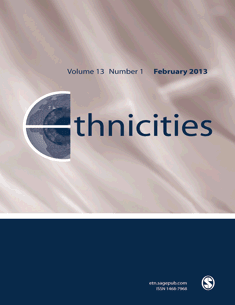
Ethnicities
Scope & Guideline
Unraveling the Complexities of Race and Identity
Introduction
Aims and Scopes
- Ethnic Identity and Belonging:
Research on how ethnic identities are formed, negotiated, and experienced in various contexts, including migration and diaspora settings. - Cultural Politics and Nationalism:
Exploration of the relationship between culture and politics, particularly how ethnic groups navigate national identities and the implications of nationalism. - Discrimination and Social Justice:
Investigations into issues of discrimination, rights, and social justice, focusing on ethnic minorities and marginalized communities. - Religious Diversity and Governance:
Analysis of the governance of religious diversity, including the impacts of religious nationalism and secularism on ethnic communities. - Intersectionality and Ethnic Relations:
Examinations of how ethnicity intersects with other social categories such as gender, class, and religion, shaping individual and group experiences. - Historical Perspectives on Ethnicity:
Studies that delve into historical contexts of ethnic relations, colonial legacies, and their contemporary implications. - Migration and Transnationalism:
Research focusing on migration patterns, transnational connections, and their effects on ethnic identity and community dynamics.
Trending and Emerging
- Intersectional Approaches to Identity:
There is a growing emphasis on intersectionality, exploring how ethnicity interacts with other identities such as gender, class, and sexuality in shaping experiences. - Migration and Globalization:
Research focusing on migration patterns, the experiences of diasporas, and the implications of globalization on ethnic identities has gained significant traction. - Cultural and Religious Nationalism:
An increasing interest in how cultural and religious identities intersect with nationalism, particularly in post-colonial and contemporary contexts. - Digital Ethnicity:
The impact of digital technologies on ethnic identity formation and community engagement is emerging as a significant area of inquiry. - Environmental Justice and Indigenous Rights:
Recent publications are increasingly addressing the relationship between ethnicity, environmental issues, and the rights of indigenous peoples. - Anti-racism and Social Movements:
The journal has begun to focus more on anti-racism, social justice movements, and the role of ethnic communities in advocating for rights and representation. - Post-colonial Perspectives:
There is a noticeable trend towards post-colonial analyses that critique historical narratives and examine their implications for contemporary ethnic relations.
Declining or Waning
- Traditional Ethnic Studies:
The focus on static definitions and categorizations of ethnicity seems to be waning as scholars increasingly adopt fluid and intersectional approaches to identity. - Homogeneous Ethnic Narratives:
Research centered solely on singular ethnic identities without considering intersectionality or multicultural influences is becoming less prevalent. - Historical Exclusivity:
Studies that limit their analysis to historical perspectives without connecting to contemporary issues or future implications are increasingly rare. - Essentialist Views on Ethnicity:
The trend towards essentialist views that anchor ethnic identity in fixed traits is declining in favor of more dynamic and relational understandings. - Localized Ethnic Conflicts:
Research focusing exclusively on localized ethnic conflicts without broader contextual analysis or implications for global trends is less common.
Similar Journals

Canadian Ethnic Studies-Etudes Ethniques au Canada
Showcasing Cutting-Edge Research on Ethnic Identity and SocietyCanadian Ethnic Studies - Études Ethniques au Canada serves as a pivotal platform for interdisciplinary scholarship focused on the complexities of ethnic identity and multiculturalism within Canada. Published by the Canadian Ethnic Studies Association, this journal not only examines the rich tapestry of Canada’s diverse population but also engages with significant themes in Anthropology, History, Sociology, and Political Science. With impressive rankings—Q1 in History and Q2 in Anthropology for 2023—this journal is recognized for its rigorous approach to research, fostering critical dialogue among scholars and practitioners alike. Although currently not Open Access, articles are made accessible to those in institutions and academic settings, expanding reach and impact. By publishing cutting-edge research from 1986 to the present, this journal continues to enhance our understanding of ethnic studies, making it an essential resource for anyone involved in the study of Canada’s multicultural landscape.
JOURNAL OF SPORT & SOCIAL ISSUES
Connecting Athletic Endeavors with Social Justice NarrativesWelcome to the JOURNAL OF SPORT & SOCIAL ISSUES, a leading academic publication that serves as an essential platform for scholarly discourse at the intersection of sports, sociology, and political science. Published by SAGE PUBLICATIONS INC, this esteemed journal, with an ISSN of 0193-7235 and E-ISSN of 1552-7638, has been instrumental in promoting groundbreaking research since its inception in 1977. With a prestigious Q1 ranking in both Sociology and Political Science in the latest 2023 category quartiles, the journal ranks at an impressive #173 out of 1466 in the Scopus metrics, placing it in the 88th percentile among its peers. The journal's objectives include exploring the complex societal influences on sports and the role of sports in social change, making it a vital resource for researchers, professionals, and students alike. Although it does not currently offer open access options, the high-impact nature of its contributions ensures that findings reach a broad audience within academia and beyond. Join us in advancing the study and understanding of sport in a sociopolitical context.
CRITICAL ASIAN STUDIES
Connecting Cultures, Politics, and Societies in AsiaCRITICAL ASIAN STUDIES is a leading academic journal published by Routledge Journals, Taylor & Francis Ltd, dedicated to exploring the complex social, cultural, and political dynamics of Asia. With an ISSN of 1467-2715 and an E-ISSN of 1472-6033, this journal serves as an essential resource for researchers and professionals interested in Asian studies, sociology, and geography. Boasting an impressive Q2 ranking in both Geography, Planning and Development, and Sociology and Political Science for 2023, it is recognized for its influential contributions to these fields. The journal’s accessibility options further enhance its appeal, allowing broader dissemination of critical research findings. Established in 1968 and continuing its rigorous publication through to 2024, CRITICAL ASIAN STUDIES facilitates in-depth dialogue and scholarship, thus playing a vital role in advancing understanding of Asian issues on a global scale.

Populism
Navigating the Intersection of Politics and SocietyPopulism, published by BRILL in the Netherlands, is an essential academic journal that delves into the complex phenomena surrounding populism in contemporary society. With an ISSN of 2588-8064 and E-ISSN 2588-8072, this journal has established itself as a significant resource for researchers and practitioners in Political Science and Sociology, earning a commendable Q2 ranking in both fields as of 2023. Covering a broad scope from theoretical frameworks to empirical analyses, the journal focuses on the implications of populism on political and social structures from 2018 to 2024. It positions itself as a vital platform for scholarly discussion, providing insights that contribute to the understanding of how populism affects global dynamics. Engaging with critical perspectives, the journal invites submissions that promote discourse and inquiry, making it an indispensable tool for academics and students seeking to explore the evolving landscape of populist movements and their societal impacts.

Journal de la Societe des Americanistes
Bridging Disciplines to Enhance Cultural UnderstandingJournal de la Societe des Americanistes, published by UNIV PARIS X PARIS-NANTERRE, ARCHEOLOGIE & ETHNOLOGIE, is a distinguished platform for the dissemination of scholarly research in the fields of anthropology and cultural studies. With an ISSN of 0037-9174 and an E-ISSN of 1957-7842, this Open Access journal has been making academic content freely accessible since 2016, fostering a global dialogue among researchers and practitioners. Based in France, this journal prioritizes interdisciplinary discourse, enhancing the understanding of cultural dynamics and ethnic diversity across the Americas. Although currently ranked in the Q4 quartile for anthropology and cultural studies, its commitment to rigorous peer-reviewed research places it in a unique position to contribute to the academic landscape. Researchers, professionals, and students seeking to explore intricate cultural themes and anthropological perspectives will find the Journal de la Societe des Americanistes an invaluable resource for their scholarly endeavors.
Britain and the World
Advancing Understanding of Britain's Worldly InfluenceBritain and the World is a notable scholarly journal published by Edinburgh University Press, dedicated to advancing the field of history through comprehensive analyses of Britain's historical interactions with the world. Since its inception in 2009, the journal has fostered interdisciplinary research, examining themes ranging from colonialism to post-colonial studies, as well as the socio-political dynamics that shaped Britain's global influence. With no open access model currently available, Britain and the World provides a robust platform for scholars dedicated to investigating the complexities of British history in a global context. Although currently categorized in the fourth quartile (Q4) of history journals, its commitment to quality scholarship and its strong editorial oversight promises to enhance its stature in academia, making it an invaluable resource for researchers, professionals, and students seeking to deepen their understanding of Britain's role in global affairs. For those interested in contributing to the discourse or exploring its published works, the journal is based in the United Kingdom at The Tun-Holyrood Rd, 12 2F Jacksons Entry, Edinburgh EH8 8PJ, Scotland.
Cultural Diversity & Ethnic Minority Psychology
Advancing understanding of cultural nuances in psychology.Cultural Diversity & Ethnic Minority Psychology, published by the Educational Publishing Foundation of the American Psychological Association, is a premier academic journal dedicated to advancing the understanding of cultural diversity and the psychological experiences of ethnic minorities. With an impressive impact factor placing it in the Q1 category for both Social Psychology and Sociology and Political Science, this journal serves as a vital resource for researchers and practitioners alike, contributing significantly to the discourse on social identity, multiculturalism, and systemic inequalities. Since its inception in 1999, it has fostered a rich environment for scholarly debate and has successfully maintained relevance through converging years up to 2024, adapting to the evolving landscape of cultural psychology. Although not an Open Access journal, it remains a crucial outlet for those examining the intersections of culture and psychology, featuring rigorous peer-reviewed articles that lay the groundwork for future research and policy applications in the fields of psychology and sociology.
Nationalities Papers-The Journal of Nationalism and Ethnicity
Fostering Critical Dialogue on Cultural Identity and PoliticsNationalities Papers - The Journal of Nationalism and Ethnicity, published by Cambridge University Press, stands as a pivotal forum dedicated to exploring the intricate dynamics of nationalism, ethnicity, and cultural identity in a global context. With an impact factor in the upper echelons of academia, the journal is classified within the Q1 category for both History and Political Science and International Relations, and Q2 in Geography, Planning and Development as of 2023. This esteemed journal, originating in the United Kingdom, has a rich history since its inception in 1972, continuously evolving to address contemporary issues surrounding national identity and ethnic tensions. It ranks impressively among other publications in its fields, evidenced by its notable Scopus rankings in multiple disciplines. Researchers, professionals, and students alike benefit from the journal's rigorous peer-reviewed articles which not only enhance scholarly discourse but also provide actionable insights into real-world phenomena. While it operates under a traditional access model, the essential contributions made by Nationalities Papers ensure it remains a crucial resource for anyone engaging in the study of nationalism and ethnicity globally.
Asian Ethnicity
Bridging cultural studies with sociopolitical analysis.Asian Ethnicity is a premier academic journal published by Routledge Journals, Taylor & Francis Ltd that serves as an essential platform for interdisciplinary research in the fields of cultural studies, sociology, and political science. With an impressive impact factor and a prestigious ranking within the Scopus database, it has earned a place in the Q1 category for Cultural Studies and the Q2 category for Sociology and Political Science in 2023. This journal not only engages a community of scholars, professionals, and students but also addresses critical issues related to identity, migration, and social dynamics across diverse Asian contexts. The journal has consistently published cutting-edge research since its convergence in 2008, aiming to foster dialogue and understanding in the rapidly evolving landscape of Asian studies, while its location in the United Kingdom enhances its global perspective. While the journal does not currently offer open access options, it remains a valuable resource for in-depth analysis and scholarly discourse regarding Asian ethnicity and its multifaceted implications.

JOURNAL OF ETHNIC AND MIGRATION STUDIES
Fostering Understanding Through Rigorous ScholarshipJOURNAL OF ETHNIC AND MIGRATION STUDIES (ISSN: 1369-183X, E-ISSN: 1469-9451) is a leading peer-reviewed journal published by Routledge Journals, Taylor & Francis Ltd, based in the United Kingdom. With a significant impact factor and ranked Q1 in both Arts and Humanities (miscellaneous) and Demography as of 2023, this journal is pivotal for advancing research in ethnic and migration studies. It brings together interdisciplinary perspectives, focusing on the complexities of migration, integration, and the dynamics of cultural diversity across the globe. The journal's commitment to high-quality scholarship is reflected in its impressive Scopus rankings, placing it in the top percentile for both Demography and Arts and Humanities categories. Although not currently open access, it provides essential insights for researchers, policymakers, and practitioners dedicated to understanding the ever-evolving landscape of ethnic relations and migration issues. With contributions that span from theoretical frameworks to empirical studies, the journal aims to foster a deeper understanding of the social implications of migration, making it an invaluable resource for scholars and students alike.