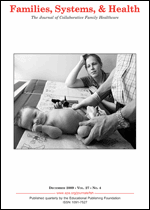
Families Systems & Health
Scope & Guideline
Transforming family dynamics into health solutions.
Introduction
Aims and Scopes
- Family-Centered Care:
The journal promotes research that emphasizes the significance of family involvement in health care decision-making and treatment processes, highlighting how family dynamics can impact individual health outcomes. - Integrated Behavioral Health:
A core area of focus is the integration of behavioral health services into primary care. This includes studies on collaborative care models that aim to improve access to mental health services and enhance the overall quality of care. - Equity and Inclusion in Health Systems:
Research addressing disparities in health care access and outcomes, particularly for underrepresented populations, is a key aim. The journal explores how health systems can become more inclusive and equitable. - Impact of Social Determinants on Health:
The journal investigates how social factors such as socioeconomic status, cultural background, and community resources affect health outcomes, emphasizing the need for a systems approach in health care. - Innovative Care Models:
The journal showcases innovative practices and models in health care delivery, particularly those that incorporate technology and interdisciplinary collaboration to improve patient outcomes.
Trending and Emerging
- Telehealth and Virtual Care:
There is a growing trend towards exploring the role of telehealth and virtual care models, particularly in response to the COVID-19 pandemic. This includes studies on patient engagement and the effectiveness of remote care. - Family Resilience and Well-Being:
Research focusing on family resilience, particularly in the context of crises such as the pandemic, is gaining traction. This theme examines how families cope with stress and maintain health and well-being. - Intersectionality in Health Care:
An increasing emphasis on intersectionality in health research highlights how overlapping social identities affect health experiences and outcomes, promoting a more nuanced understanding of health disparities. - Collaborative Care Models:
Emerging themes include the effectiveness of collaborative care models that integrate various health professionals to address complex health needs, particularly for vulnerable populations. - Community-Based Participatory Research (CBPR):
There is a rising interest in community-based participatory approaches that engage families and communities in the research process to improve health outcomes and foster trust in health systems.
Declining or Waning
- Traditional Medical Models:
There has been a noticeable decline in publications centered solely on traditional medical approaches that do not incorporate family or systemic perspectives, as the journal increasingly emphasizes integrative and holistic care. - Single-Disease Focus Studies:
Research that focuses exclusively on single-disease outcomes without considering the broader family or systems context appears to be diminishing, as the journal seeks to highlight interconnected health issues. - Generalized Health Policy Discussions:
There seems to be a waning interest in generalized discussions of health policy that do not specifically address family dynamics or integrated care models, with a shift towards more targeted, actionable research.
Similar Journals
Journal of Gerontological Nursing
Transforming Nursing Practice for Older AdultsThe Journal of Gerontological Nursing, published by SLACK INC, is a leading peer-reviewed journal dedicated to advancing the field of gerontological nursing through innovative research, clinical practice, and educational advancements. Since its inception in 1975, this journal has become a crucial resource for researchers, healthcare professionals, and students interested in the care and management of older adults. With an impact factor that reflects its significance within the disciplines of gerontology and nursing (Category Quartiles: Q3 in Gerontology and Q3 in Nursing), it serves as a platform for disseminating vital findings, best practices, and evidence-based approaches aimed at improving the quality of life for the aging population. While the journal maintains a print-only format, its content is invaluable for those looking to stay ahead in the rapidly evolving landscape of gerontological care. As it continues to publish until 2024, the Journal of Gerontological Nursing invites contributions that foster dialogue and innovation within this essential area of healthcare.
Journal of Family Medicine and Primary Care
Enhancing Community Care Through Scholarly ExcellenceThe Journal of Family Medicine and Primary Care is a premier, peer-reviewed academic journal dedicated to the fields of family medicine and primary healthcare. Published by Wolters Kluwer Medknow Publications, this Open Access journal has been providing a platform for the dissemination of valuable research since 2012, offering researchers, practitioners, and scholars unrestricted access to a wealth of knowledge in primary care practices, policies, and innovations. The journal seeks to bridge the gap between academia and practice by publishing original articles, reviews, and case studies that address contemporary issues in family medicine, thereby enhancing patient care and outcomes. With a commitment to advancing the field, the journal serves as an essential resource for those striving to improve the delivery and effectiveness of healthcare services within families and communities.
Australian Journal of Rural Health
Championing the health of Australia’s rural communities.Australian Journal of Rural Health, published by WILEY, is a leading peer-reviewed journal dedicated to advancing the understanding of health issues affecting rural populations in Australia and beyond. Established in 1992, this journal has successfully converged its focus into the contemporary landscape of rural health, promoting innovative research and practical solutions. With an impressive positioning in various categories—ranked Q2 in Family Practice and Q3 in Public Health, Environmental and Occupational Health for 2023—the journal is pivotal for researchers, healthcare professionals, and students aiming to explore pivotal studies and developments within these fields. The journal is indexed in Scopus, showcasing its credibility and impact within the academic community; it holds a rank of 24/56 in Family Practice and 386/665 in Public Health, emphasizing its relevance and contribution to the discourse on rural health challenges. While it does not operate under an open access model, the Australian Journal of Rural Health remains a vital resource for exploring the intricacies of rural healthcare provision and its implications for policy and practice.
Australian Journal of Primary Health
Empowering Health Professionals through Scholarly DiscourseWelcome to the Australian Journal of Primary Health, a vital resource for researchers and practitioners in the evolving fields of health policy and public health. Published by CSIRO PUBLISHING, this journal has established itself as a significant platform for sharing groundbreaking research and insights since its inception in 2001. With an ISSN of 1448-7527 and an E-ISSN of 1836-7399, it provides scholarly articles addressing crucial topics in health policy and public health, and is recognized in 2023 as a Q3 journal in both domains. While it currently does not offer open access, the journal is committed to disseminating high-quality, peer-reviewed research that informs health practices and policies across Australia and beyond. By contributing to the conference of academic knowledge, the Australian Journal of Primary Health plays an essential role in enhancing the understanding of health systems and influencing health outcomes, making it indispensable for students, researchers, and health professionals alike.
Medicina de Familia-SEMERGEN
Bridging the gap between research and practice in family medicine.Medicina de Familia-SEMERGEN is a pivotal Spanish journal focused on the field of family medicine and public health, published by the esteemed Elsevier. With an ISSN of 1138-3593 and an E-ISSN of 1578-8865, this journal provides a platform for researchers and practitioners to disseminate innovative studies, clinical practices, and case reports that advance the understanding of family healthcare dynamics. As of 2023, it is categorized in Q3 in Family Practice and Q4 in Public Health, reflecting its significant contributions to the respective fields. The journal is indexed in Scopus, holding ranks of 31/56 and 473/665 for family practice and public health respectively, showcasing its relevance in academic discourse. While maintaining a commitment to quality research, Medicina de Familia-SEMERGEN remains accessible for professionals seeking to improve patient outcomes in family medicine, making it an essential resource for anyone in the health domain.
JOURNAL OF HEALTH CARE FOR THE POOR AND UNDERSERVED
Pioneering research to dismantle health disparities.JOURNAL OF HEALTH CARE FOR THE POOR AND UNDERSERVED, published by Johns Hopkins University Press, serves as a pivotal platform dedicated to advancing knowledge and research in the fields of public health, healthcare accessibility, and social determinants of health. With its ISSN 1049-2089 and E-ISSN 1548-6869, this esteemed journal has been at the forefront of addressing health disparities and improving health outcomes for marginalized populations since its inception in 1990. As a distinguished Q2 journal in Public Health and Environmental and Occupational Health, it ranks in the 36th percentile of its category according to Scopus, underscoring its relevance and impact within the academic community. The journal offers a range of articles, including original research, review articles, and case studies, focusing on innovative strategies and policies to enhance healthcare delivery for underserved populations. By contributing significant insights and evidence-based practices, the JOURNAL OF HEALTH CARE FOR THE POOR AND UNDERSERVED is an essential resource for researchers, health professionals, and students committed to fostering equity in healthcare access and outcomes.
Journal of the American Board of Family Medicine
Advancing the Future of Family Medicine.The Journal of the American Board of Family Medicine, with ISSN 1557-2625 and E-ISSN 1558-7118, is a prestigious publication dedicated to advancing the field of family medicine. Published by the American Board of Family Medicine, this journal has established itself as a vital resource for researchers, practitioners, and students interested in both family practice and public health. As of 2023, it boasts impressive rankings, being in the Q1 category of Family Practice and the Q2 category of Public Health, Environmental and Occupational Health according to Scopus metrics, reflecting its significant impact and influence in the academic community. The journal's focus on high-quality research ensures that it remains at the forefront of evidence-based practice, fostering the dissemination of knowledge that is critical for improving patient care and outcomes. This journal, although not open-access, provides a wealth of insights and findings relevant to professionals striving to enhance their understanding and implementation of best practices in family medicine. With a converged publication history starting in 2002, it continues to serve as an essential platform for innovative studies and discussions that shape the future of family medicine.
FAMILY MEDICINE
Shaping the Future of Family Medicine TogetherFAMILY MEDICINE is a prestigious peer-reviewed journal published by the SOC TEACHERS FAMILY MEDICINE, dedicated to advancing the field of family practice. With an ISSN of 0742-3225 and an E-ISSN of 1938-3800, this journal serves as a vital resource for researchers, healthcare professionals, and students involved in family medicine. Founded in 1985, it has consistently contributed to the growth of knowledge in this critical area, showcasing a wide range of original research, reviews, and practical applications. Recognized for its impact, the journal holds a Q2 quartile ranking in Family Practice, placing it in the top tier within its category, and ranks 22nd out of 56 in the Scopus database, reflecting its influence and relevance. While the journal operates under a subscription model, it remains committed to providing high-quality discourse and insights that shape the practice of family medicine. With a focus on current issues and evidence-based practices, FAMILY MEDICINE continues to be an essential publication for those dedicated to improving patient outcomes and advancing the field.
Academic Pediatrics
Inspiring breakthroughs in the field of pediatrics.Academic Pediatrics is a premier, peer-reviewed journal dedicated to advancing the field of pediatrics, with a particular focus on the unique challenges and innovations that arise in child health and care. Published by ELSEVIER SCIENCE INC, this esteemed journal boasts an impressive Q1 ranking in Pediatrics, Perinatology, and Child Health as per the 2023 category quartiles, highlighting its significant impact and contribution to the discipline. The journal, which has been published continuously since 2009 and is set to converge its coverage through 2024, is a vital resource for researchers, clinicians, and students seeking to stay at the forefront of pediatric medicine. With an ISSN of 1876-2859 and an E-ISSN of 1876-2867, Academic Pediatrics ensures immediate access to crucial research findings, clinical guidelines, and comprehensive reviews, all accessible through both subscription and open-access options. Its robust Scopus ranking of #70 out of 330 underscores its value in the academic community, appealing to a diverse audience seeking to foster knowledge and improve outcomes in pediatric healthcare.
Journal of Primary Care and Community Health
Championing primary care excellence for global health.Journal of Primary Care and Community Health, published by SAGE Publications Inc, is a leading open-access journal dedicated to advancing the understanding and practice of primary care and community health. With an ISSN of 2150-1319 and E-ISSN 2150-1327, it has positioned itself as a vital resource since its inception in 2010, providing a platform for rigorous research that impacts public health and community welfare. Recognized with a prestigious Q1 ranking in both Community and Home Care and Public Health, Environmental and Occupational Health as of 2023, the journal boasts an impressive Scopus rank of #4 among 40 journals in its category, marking it as a top-tier publication in the nursing field. This journal emphasizes the significance of integrating research and practice, fostering a collaborative approach among researchers, healthcare professionals, and students. With open access availability since 2017, the journal ensures that vital findings and innovative practices remain accessible to a global audience, furthering the collective mission of improving health outcomes in communities around the world.