
Frontiers in Human Dynamics
Scope & Guideline
Connecting Perspectives to Understand Human Dynamics
Introduction
Aims and Scopes
- Human Migration and Refugee Studies:
The journal emphasizes research on migration patterns, refugee experiences, and the socio-political dynamics surrounding displacement, highlighting the challenges and resilience of displaced populations. - Socio-Ecological Interactions:
It explores the relationships between human societies and their environments, particularly in the context of climate change, resource management, and community resilience. - Technological Impact on Society:
The journal investigates how digital technologies and AI influence human behavior, social interactions, and governance, particularly in relation to health, education, and migration. - Gender and Social Justice:
A core focus is on gender dynamics, particularly how they intersect with migration, violence, and socio-economic factors, aiming to promote equity and inclusion in policy and practice. - Collective Action and Community Dynamics:
Research on collective behaviors, community resilience, and participatory approaches to problem-solving is central, emphasizing the importance of collaboration in addressing societal challenges.
Trending and Emerging
- Digital Transformation and Migration Management:
A growing body of work examines the role of digital technologies in migration management, exploring how data and AI can enhance or hinder the experiences of migrants and refugees. - Climate Change and Displacement:
Research on the impacts of climate change on migration patterns is trending, emphasizing the urgent need to understand environmental factors that drive human displacement. - Intersectionality in Human Dynamics:
There is a notable increase in studies that adopt an intersectional approach, considering how various identities (gender, ethnicity, class) intersect to influence experiences and outcomes in migration and social dynamics. - Participatory Approaches in Humanitarian Responses:
Emerging themes focus on participatory methodologies in humanitarian contexts, highlighting the importance of involving affected communities in the decision-making processes. - Mental Health and Wellbeing of Displaced Populations:
The mental health of migrants and refugees is gaining prominence, with research addressing the psychological impacts of displacement and the importance of tailored mental health interventions.
Declining or Waning
- Traditional Models of Integration:
There is a noticeable decrease in studies that focus solely on traditional models of immigrant integration, as newer frameworks emphasizing multi-dimensional and participatory approaches gain traction. - Static Gender Roles in Migration:
Research that strictly adheres to fixed notions of gender roles in migration contexts is waning, as more nuanced and intersectional perspectives gain prominence. - Single-Factor Analyses of Migration Factors:
Papers that analyze migration through a singular lens—such as economic or political factors—are becoming less common, replaced by more holistic approaches that consider a range of influences. - Historical Narratives of Migration:
While historical perspectives are still valued, the emphasis on contemporary and future-oriented studies is overshadowing traditional historical analyses. - Generalized Health Studies:
Studies that offer broad, generalized insights into health issues among migrants are declining, with a shift towards targeted, context-specific health interventions and analyses.
Similar Journals

Organisational and Social Dynamics
Exploring the Interplay of Society and OrganizationOrganisational and Social Dynamics is a dynamic academic journal published by PHOENIX PUBLISHING HOUSE, focusing on the intricate intersections of social psychology and organizational studies. With an ISSN of 1474-2780 and an E-ISSN of 2044-3765, this journal offers a platform for high-quality research from 2017 to 2024, shedding light on contemporary issues and theories that influence human behavior within organizational settings. Despite its current ranking in the Q4 category of Social Psychology, and a Scopus percentile of 7th, the journal is committed to fostering scholarly discourse and providing invaluable insights to researchers, professionals, and students alike. Although it operates on a subscription basis, readers can access thought-provoking articles and studies that are essential for understanding organizational dynamics in various social contexts. The journal's contributions are particularly crucial in an ever-evolving sociocultural landscape, making it an important resource for anyone interested in the nuances of social interactions within organizations.
Perfiles Latinoamericanos
Exploring the Depths of Sociology and Political SciencePerfiles Latinoamericanos is a prominent academic journal published by FLACSO-MEXICO, dedicated to advancing scholarly discourse in the fields of Sociology and Political Science. Since its inception in 1992, this Open Access journal has made significant contributions to the understanding of Latin American societal and political dynamics, providing researchers, professionals, and students with valuable insights and analysis. With an ISSN of 0188-7653 and an E-ISSN of 2309-4982, the journal has established itself as a reliable source of knowledge, boasting a respectable Scopus rank within the 36th percentile among its peers. As of 2023, it holds a Q3 ranking in Sociology and Political Science, reflecting its commitment to maintaining rigorous academic standards and fostering impactful scholarship. Researchers can easily access its published articles, contributing to a wider dialogue on critical issues affecting the region. The journal’s coverage span from 2008 to 2024 affirms its ongoing relevance in the academic community.

AUSTRALIAN GEOGRAPHER
Shaping the Future of Earth-Surface ResearchAUSTRALIAN GEOGRAPHER, published by Routledge Journals, Taylor & Francis Ltd, is a leading scholarly journal that captures the dynamic and multifaceted field of geography. With an ISSN of 0004-9182 and an E-ISSN of 1465-3311, this peer-reviewed journal has a long-standing tradition, dating back to its origins between 1928 and 1929, and is essential for those engaged in cutting-edge research in Earth-Surface Processes and Geography, Planning and Development. Recognized for its academic rigor, the journal holds a prestigious Q1 ranking in both Earth-Surface Processes and Geography categories as of 2023. Furthermore, its Scopus rankings underscore its influence, placing it in the top 30% of its field. Although it does not currently offer Open Access, AUSTRALIAN GEOGRAPHER remains a critical platform for presenting significant geographic research and fostering academic dialogue, making it indispensable for researchers, professionals, and students eager to contribute to the evolving landscape of geographic scholarship.
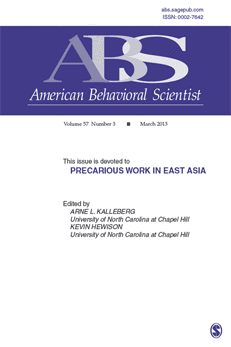
AMERICAN BEHAVIORAL SCIENTIST
Advancing Insights into Human BehaviorAmerican Behavioral Scientist is a prestigious academic journal published by SAGE Publications Inc. since 1957, dedicated to advancing the fields of Cultural Studies, Education, Social Psychology, and Sociology and Political Science. With an impressive impact factor and ranked in the Q1 category across several social science disciplines, it stands as a vital resource for researchers and practitioners seeking to explore complex human behaviors and societal dynamics. The journal’s rigorous publication standards ensure that only high-quality research is disseminated, affirming its status within the academic community, evidenced by its exceptional Scopus rankings. Although it is not an open-access journal, subscriptions to American Behavioral Scientist provide invaluable insights and empirical findings that contribute to the understanding of behavioral sciences. For those committed to the exploration of social phenomena, this journal remains an essential tool in facilitating scholarly dialogue and fostering impactful research.
ZEITSCHRIFT FUR SOZIOLOGIE
Illuminating Social Relationships and Institutions Since 1972ZEITSCHRIFT FUR SOZIOLOGIE is a distinguished journal in the field of sociology, published by WALTER DE GRUYTER GMBH, a renowned academic publisher based in Germany. Since its inception in 1972, the journal has consistently contributed to the advancement of sociological knowledge, bridging theoretical frameworks and empirical research. With an impact factor reflecting its relevance in the academic community, it has achieved a commendable ranking of Q3 in the Sociology and Political Science category as of 2023. Its Scopus ranking positions it among the top half in its field, with a notable percentile of 49th. Although it does not offer open access, the journal remains a vital resource for researchers, professionals, and students seeking to explore contemporary sociological issues and critical analyses. Its comprehensive scope includes topics that address the complexities of social relationships and institutions, making it a pivotal publication for those committed to understanding the dynamics of society.

Espaces-Populations-Societes
Unveiling Interactions Between People and PlacesEspaces-Populations-Sociétés is a distinguished journal published by UNIV LILLE I SCI & TECH, focusing on the fields of demography and geography. Established in 1983, this open-access journal has committed itself to providing a platform for innovative research and discussions around population dynamics and spatial organization, with accessibility to its content available since 2004. Based in France, at the UFR Géographie & Aménagement, the journal plays a crucial role in advancing understanding of demographic trends and planning developments. With current Scopus rankings highlighting its position in the 25th and 14th percentiles for Demography and Geography, Planning and Development respectively, it maintains a reputable standing within academic circles, establishing its importance in contemporary research landscapes. Researchers, professionals, and students alike will find valuable insights in its comprehensive overview of sociocultural and environmental interactions, as well as place-based issues at the heart of societal development.

Global Discourse
Connecting Scholars to Shape Global ConversationsGlobal Discourse is a preeminent journal in the fields of Political Science, International Relations, and Sociology, published by BRISTOL UNIVERSITY PRESS & POLICY PRESS. With an ISSN of 2326-9995 and an E-ISSN of 2043-7897, this journal provides scholarly insights that bridge theoretical frameworks and practical implications in global social dynamics. Operating as an open-access publication, Global Discourse is dedicated to advancing the understanding of contemporary societal challenges through rigorous analysis and interdisciplinary approaches. Its impressive rankings, including Q2 status in 2023 for both Political Science and International Relations and Sociology, reflect its vital role within the academic community—positioning it within the top 15% and 19% of its respective fields. Researchers, practitioners, and students alike are encouraged to contribute to and benefit from the journal's rich repository of knowledge, fostering dialogue that shapes the future of global discourse.
SOCIETY
Fostering Innovative Research in Social SciencesSOCIETY is a distinguished academic journal published by SPRINGER, dedicated to advancing the understanding of critical issues in sociology and political science. With its ISSN 0147-2011 and E-ISSN 1936-4725, the journal has been a key resource since its inception in 1968, maintaining a consistent commitment to quality scholarship through its convergence over the decades. In the 2023 Scopus rankings, it holds an impressive Q3 designation in the categories of Social Sciences (Miscellaneous) and Sociology and Political Science, reflecting its solid reputation within the academic community. The impact factor of the journal underscores its relevance, making it a vital platform for researchers, professionals, and students aiming to contribute to and engage with contemporary social discourse. Although not an open-access journal, it offers a wealth of peer-reviewed articles that explore multifaceted dimensions of society, shedding light on societal trends, policies, and challenges that shape our world today. Located at One New York Plaza, Suite 4600, New York, NY, SOCIETY invites you to join its community of scholars driving innovative research and thought-provoking discussion.

Nature Human Behaviour
Transforming understanding of human dynamics.Nature Human Behaviour, published by Nature Portfolio in the United Kingdom, stands at the forefront of interdisciplinary research, connecting the fields of Behavioral Neuroscience, Experimental and Cognitive Psychology, and Social Psychology. With its commitment to publishing groundbreaking studies, this prestigious journal is categorized within the Q1 quartiles for 2023, indicating its elite status and significant influence in the academic community. Recognized globally with a remarkable Scopus ranking of #1 in multiple psychology and neuroscience categories, it showcases the highest quality research, thus appealing to students, professionals, and researchers alike. Despite being a subscription-based journal, its impactful scientific discourse continues to shape understanding of human behavior in social contexts. With the ambition to elucidate the complexities of human interaction and cognition, Nature Human Behaviour serves as an essential resource for anyone dedicated to advancing the realm of human behavioral sciences.

Social Analysis
Connecting Ideas, Cultures, and DisciplinesSocial Analysis, an esteemed academic journal published by BERGHAHN JOURNALS, is at the forefront of interdisciplinary research, focusing on the dynamic intersections of anthropology, cultural studies, sociology, and the arts and humanities. Since its inception in 2002 and having transitioned to an Open Access model in 2020, the journal ensures that critical social research is widely accessible to scholars and the public alike. With an impressive Q1 ranking in Anthropology and cultural studies and holding a notable Q2 in Sociology and Political Science, it garners attention from a large academic audience, as evidenced by its high Scopus rankings: 10th in general arts and humanities and 153rd in cultural studies. This signifies its influential role in shaping contemporary discourse and providing a platform for innovative ideas and methodologies in understanding social phenomena. Based in Brooklyn, NY, the journal is dedicated to fostering scholarly dialogue and advancing the field, making it an essential resource for researchers, professionals, and students eager to engage with and contribute to the field of social analysis.