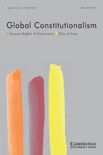
Global Constitutionalism
Scope & Guideline
Exploring the Frontiers of Global Governance and Rights
Introduction
Aims and Scopes
- Transnational Constitutionalism:
The journal explores how constitutional principles transcend national boundaries, examining the implications of transnational legal frameworks and their impact on local governance. - Comparative Constitutional Analysis:
A core focus is on comparative studies of constitutional law, scrutinizing different systems and their responses to global challenges such as democracy, human rights, and governance. - Impact of Globalization on Constitutional Norms:
The journal addresses how globalization affects constitutional norms, including the adaptation of traditional constitutional theories to contemporary global realities. - Emerging Legal Frameworks and Norm Contestation:
It investigates new legal frameworks and the contestation of norms, particularly in the context of human rights, environmental law, and social justice. - Political and Social Dimensions of Constitutionalism:
The journal emphasizes the political and social dimensions of constitutionalism, exploring issues related to power dynamics, social movements, and the role of civil society in constitutional processes.
Trending and Emerging
- Feminist Constitutionalism:
Recent issues highlight the intersection of feminist theories with constitutionalism, examining how gender dynamics influence legal frameworks and the role of women in constitutional processes. - Climate Justice and Constitutionalism:
There is an increasing focus on the relationship between constitutionalism and climate justice, exploring how constitutional frameworks can address environmental challenges and promote sustainability. - Populism and Democratic Backsliding:
The journal has published numerous articles analyzing the impact of populism on constitutional norms and democratic institutions, reflecting growing concerns about authoritarianism and democratic decay. - Digital Constitutionalism:
Emerging discussions on digital constitutionalism address the implications of technology and digital rights within constitutional frameworks, responding to the challenges posed by digital governance. - Social Rights and Global Justice:
A notable trend is the exploration of social rights in the context of global justice, examining how constitutional frameworks can support social equity and address inequalities in a globalized world.
Declining or Waning
- Traditional Nationalism in Constitutionalism:
There has been a noticeable decrease in articles emphasizing traditional nationalist perspectives of constitutionalism, as the focus shifts towards more global and transnational frameworks. - Static Constitutional Models:
The journal has moved away from discussions centered on static or rigid constitutional models, favoring analyses that engage with dynamic and adaptive constitutional processes instead. - Exclusively Western Perspectives:
There is a decline in papers that solely focus on Western constitutional models, reflecting a growing interest in diverse, non-Western constitutional experiences and perspectives. - Historical Constitutionalism:
Themes surrounding historical constitutionalism and its legacies have waned, as contemporary issues such as climate change, digital rights, and global governance take precedence. - Purely Legalistic Approaches:
Discussions that concentrate solely on legalistic interpretations without considering socio-political contexts have become less frequent, indicating a shift towards more interdisciplinary approaches.
Similar Journals

German Law Journal
Unlocking Insights into German and EU LawGerman Law Journal, published by Cambridge University Press, stands as a leading open-access platform for scholarly discourse in the field of law, having made its content freely available since 2019. With an impressive impact factor that places it in the Q1 category for Law as of 2023, and a robust Scopus ranking of #164 out of 1025 in the social sciences category, this journal is recognized for its high-quality research and significant contributions to legal scholarship. The journal encompasses a wide array of topics pertinent to the German legal system, European Union law, and comparative legal studies, thus catering to researchers, legal practitioners, and students alike. Located in the heart of the UK, at Edinburgh Building, Shaftesbury Rd, Cambridge, this journal not only fosters academic engagement but also promotes interdisciplinary dialogues that enrich the understanding of legal principles in an evolving global context. Emphasizing accessibility and high academic standards, the German Law Journal serves as an essential resource for those seeking to explore and contribute to contemporary legal discussions.

Novum Jus
Fostering global access to legal and social insights.Novum Jus is a prominent academic journal dedicated to advancing knowledge in the fields of Law, Sociology, and Political Science. Published by UNIV CATOLICA COLOMBIA, FAC DERECHO, this open-access journal has been providing a platform for scholarly communication since 2008, making valuable research freely accessible to readers around the globe. With an impressive impact reflected in its 2023 category quartiles—Q1 in Law and Q2 in Sociology and Political Science—Novum Jus is ranked favorably within Scopus, standing at #479 out of 1025 for Law and #823 out of 1466 for Sociology and Political Science, indicating its significant contribution to the academic community. The journal aims to foster interdisciplinary dialogue and disseminate innovative ideas that shape contemporary legal and social landscapes, catering to researchers, professionals, and students alike. With its commitment to quality and rigorous peer review, Novum Jus remains an essential resource for those engaged in the evolving dynamics of law and society.

UNIVERSITY OF CHICAGO LAW REVIEW
Fostering Innovative Legal Perspectives for TomorrowUniversity of Chicago Law Review is a prestigious academic journal dedicated to advancing legal scholarship, published by the University of Chicago Law School. Renowned for its rigorous peer-review process and high editorial standards, this journal is recognized as a leader in the field of law, achieving a Q1 ranking in the 2023 category of Law and occupying a notable position within the Scopus rankings, specifically at #199 out of 1025 in the Social Sciences - Law category, placing it in the 80th percentile. The journal provides an essential platform for legal scholars, practitioners, and students to engage with cutting-edge research and theory across various legal disciplines, including constitutional law, criminal law, and comparative law. With a commitment to fostering critical discourse, the University of Chicago Law Review has been instrumental in shaping legal thought, making it a vital resource for anyone seeking to contribute to or understand the evolving landscape of legal studies. Although it does not currently offer open access, subscription options provide robust access to its extensive archive of scholarly articles since its inception.

International Journal of Human Rights and Constitutional Studies
Bridging theory and practice in the realm of human rights.The International Journal of Human Rights and Constitutional Studies, published by INDERSCIENCE ENTERPRISES LTD, serves as a pivotal platform for disseminating scholarly research and discussions surrounding human rights and constitutional issues globally. With an ISSN of 2050-103X and E-ISSN of 2050-1048, this journal aspires to bridge theoretical frameworks and practical applications within the fields of law, political science, and public policy. Although it operates on a traditional subscription model, the journal is committed to ensuring that essential research reaches a broad audience of scholars, practitioners, and students dedicated to the protection and promotion of human rights. By providing a forum for innovative ideas and rigorous analysis, the journal plays a crucial role in advancing the understanding of constitutional rights in the context of contemporary challenges. This makes it an invaluable resource for those engaged in the ongoing discourse surrounding democracy, governance, and justice.

CATHOLIC UNIVERSITY LAW REVIEW
Bridging Law, Education, and Religious Thought.CATHOLIC UNIVERSITY LAW REVIEW is a premier legal periodical published by the Catholic University of America Press, located in the heart of Washington, D.C. with a dedicated focus on the intersections of law, education, and religious studies. Since its establishment in 1973, the journal has served as a critical platform for scholarly discourse, presenting innovative legal analysis and thought-provoking research that caters to scholars, practitioners, and students alike. With an ISSN of 0008-8390, this non-open access journal holds a notable place in the academic community, reflected by its category quartiles in 2023, ranking Q4 in Education and Law, and Q3 in Religious Studies. The Catholic University Law Review is distinguished not only by its commitment to advancing legal scholarship but also by its dedication to exploring the implications of law through a distinctly Catholic lens. Its consistent output of high-quality articles contributes to ongoing debates and developments in these fields, making it an essential resource for those interested in the legal implications of contemporary issues.

YALE LAW JOURNAL
Elevating Legal Discourse Since 1891Yale Law Journal, founded in 1891 and published by Yale Law J Co Inc, stands as a preeminent peer-reviewed legal journal in the United States, recognized for its rigorous scholarship and influential contributions to legal theory and practice. With an impact factor that underscores its peerless reputation, this journal maintains a Q1 ranking in the law category, situating it in the top tier of legal publications globally, as indicated by its Scopus rank of 66 out of 1025, placing it in the 93rd percentile. The journal publishes a comprehensive range of articles, essays, and reviews that address vital topics across the legal spectrum, aiming to foster dialogue and innovation within the legal community. Although it does not offer open access, its meticulous curation of content ensures that researchers, practitioners, and students alike have access to the most impactful legal scholarship. Located at 401-A Yale Station, New Haven, CT 06520, the journal continues to shape the legal landscape, making it an essential resource for anyone engaged in the study or practice of law.

UNIVERSITY OF CINCINNATI LAW REVIEW
Innovating Legal Perspectives for Tomorrow's ChallengesUNIVERSITY OF CINCINNATI LAW REVIEW is a distinguished academic journal in the field of legal studies, published by the University of Cincinnati College of Law. With an ISSN of 0009-6881 and an E-ISSN of 1942-8391, this journal serves as an essential platform for the dissemination of scholarly research and critical discourse in law. The review covers a wide range of topics, including constitutional law, contracts, criminal law, and legal theory, appealing to both practitioners and scholars alike. Although it is not open access, the journal maintains a significant influence with an HIndex reflecting its academic impact. As part of the Social Sciences - Law category, it ranks 434 out of 685 journals in Scopus, placing it within the 36th percentile, underscoring its valuable contribution to legal scholarship. Research featured in the University of Cincinnati Law Review aims to foster a deeper understanding of legal issues and stimulate ongoing academic conversations, making it an invaluable resource for anyone engaged in the study or practice of law.
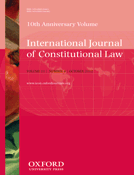
ICON-INTERNATIONAL JOURNAL OF CONSTITUTIONAL LAW
Connecting Theory with Practice in Legal DiscourseThe ICON - International Journal of Constitutional Law is a premier publication in the field of constitutional law, published by the esteemed Oxford University Press. With its ISSN 1474-2640 and E-ISSN 1474-2659, this journal has established itself as a vital resource for legal scholars, practitioners, and students alike, offering nuanced analyses and critical discussions from 2005 to 2024. Ranked in the top Q1 category for law, with a Scopus ranking of 258/1025 (74th percentile), the ICON journal is dedicated to exploring essential themes of constitutional governance and the challenges faced by legal systems worldwide. Although it does not currently offer open access, its rigorous peer-reviewed articles contribute significantly to the scholarly discourse in constitutional law, providing invaluable insights that are integral to both academic research and practical application. The journal's office is located at Great Clarendon Street, Oxford OX2 6DP, England, reinforcing its prestigious position in the legal publishing landscape.

Ius Humani-Revista de Derecho
Igniting Conversations on Global Legal IssuesIus Humani-Revista de Derecho, published by Universidad Hemisferios, serves as a vital platform for discourse in the field of human rights law and its various dimensions. With an Open Access policy established since 2008, this journal ensures that scholarly articles, critical reviews, and original research are readily accessible to a global audience, fostering collaboration and innovation among researchers, professionals, and students alike. Although the journal is based in Quito, Ecuador, its reach extends internationally, making significant contributions to the understanding and application of human rights in legal frameworks. While it is still developing in terms of its HIndex and Scopus rankings, Ius Humani is poised to provide essential insights and discussions that reflect pressing legal issues and emerging trends in human rights law. Join the community of scholars engaging with this important field through Ius Humani, where knowledge is freely shared and impactful conversations are sparked.

WASHINGTON LAW REVIEW
Navigating the Landscape of Modern Legal IssuesWASHINGTON LAW REVIEW, published by the University of Washington School of Law, is a premier legal journal that plays an essential role in the dissemination of scholarly work in the field of law. With a longstanding commitment to excellence, this journal has been pivotal in shaping legal discourse since its inception. It is ranked in the Q2 quartile in Law, as per 2023 evaluations, and holds a notable position within the top 54th percentile of its category on Scopus. The journal’s extensive publication history, covering years from 1973 to 2024, provides a rich repository of legal scholarship, making it a valuable resource for researchers, practitioners, and students alike. While the journal does not currently offer open access, its authoritative articles cover a diverse array of topics within legal studies, ensuring that the most relevant and impactful discussions are accessible to the academic community and beyond. For those looking to stay informed about cutting-edge legal issues and advancements, WASHINGTON LAW REVIEW remains an indispensable asset in the pursuit of knowledge and advocacy in the realm of law.