
Grotiana
Scope & Guideline
Pioneering Research in Historical and Legal Frameworks
Introduction
Aims and Scopes
- Historical Analysis of International Law:
The journal extensively covers the historical evolution of international law, particularly focusing on the works of Hugo Grotius and his contemporaries, analyzing how their ideas shaped modern legal frameworks. - Interdisciplinary Perspectives:
Grotiana encourages contributions that merge legal studies with political theory, philosophy, and history, reflecting the multifaceted nature of law and its societal implications. - Contemporary Legal Issues:
The journal addresses pressing contemporary issues within international law, such as human rights, environmental law, and the legal ramifications of global conflicts, demonstrating the relevance of Grotius's ideas in today's legal landscape. - Exploration of Legal Philosophy:
A significant focus is placed on legal philosophy, particularly natural law theory and its application in various contexts, offering insights into the moral underpinnings of legal systems. - Women in International Law:
The journal also highlights the contributions and roles of women in the field of international law, seeking to rectify historical imbalances and recognize diverse perspectives.
Trending and Emerging
- Human Rights and Asylum Law:
There is a growing emphasis on human rights issues, particularly concerning asylum law and the protection of refugees, showcasing Grotius's enduring influence on contemporary human rights discourse. - Environmental Law and Climate Change:
Emerging discussions on the intersection of international law and environmental issues, especially regarding climate change and maritime limits, reflect a significant trend towards addressing global challenges through a legal lens. - Grotian Moments in Contemporary Contexts:
The concept of 'Grotian moments'—key instances where Grotius's ideas resonate with current legal practices—has gained traction, indicating a renewed interest in applying historical legal thought to present-day scenarios. - Women's Rights in International Law:
An increasing number of papers are exploring the role of women in international law, advocating for recognition of their contributions and emphasizing the need for gender inclusivity in legal frameworks. - Interdisciplinary Approaches to Legal Studies:
There is a notable trend towards interdisciplinary research that combines law with political, social, and historical analysis, enriching the discourse and encouraging a broader understanding of legal principles.
Declining or Waning
- Focus on Early Modern Philosophers:
There has been a noticeable decline in papers centered on early modern legal philosophers other than Grotius, such as Gentili and Pufendorf, indicating a potential narrowing of focus towards Grotius's contributions alone. - Traditional Maritime Law:
Discussions surrounding traditional maritime law, while still relevant, seem to be less frequent in recent publications, possibly overshadowed by contemporary issues like climate change and its impact on maritime boundaries. - Historical Legal Texts:
The frequency of papers analyzing historical legal texts outside of Grotius's works has decreased, suggesting a waning interest in comparative historical legal analysis. - Correlational Studies with Ancient Law:
There appears to be less emphasis on correlational studies between Grotius's theories and ancient legal systems, which previously formed a significant part of the discourse. - Theoretical Legal Constructs:
The exploration of theoretical constructs in law, such as the concept of 'sovereignty' in the context of Grotius's work, has become less prominent, indicating a shift towards more applied legal discussions.
Similar Journals
Indonesia Law Review
Advancing Legal Knowledge in Indonesia and BeyondIndonesia Law Review is a premier open-access academic journal dedicated to advancing knowledge in the fields of law and social sciences, with particular emphasis on the Indonesian legal landscape. Established by the Indonesian Law Review, this journal has made significant strides since becoming open access in 2014, ensuring that research is freely available to a global audience. Based in Depok, West Java, the journal seeks to foster scholarly discourse on legal issues pertinent to Indonesia, while also contributing to the broader field of education and social sciences. With its current Scopus rankings placing it within the top tiers of law and social sciences, including a Q3 categorization in law and a Q4 classification in education and miscellaneous social sciences, the **Indonesia Law Review** serves as a vital platform for researchers, professionals, and students to disseminate their findings and engage with contemporary legal dilemmas. The journal is committed to providing a robust forum for innovative legal scholarship and is an essential resource for anyone seeking to understand the complexities of law in Indonesia and beyond.
Asian Journal of International Law
Connecting Scholars to the Heart of International LawThe Asian Journal of International Law, published by Cambridge University Press, is a premier academic journal dedicated to advancing the discourse on international law across Asia and beyond. With its ISSN 2044-2513 and E-ISSN 2044-2521, the journal has carved a significant niche in the field, achieving a Scopus rank of #463 out of 1025 in the Social Sciences category, placing it in the 54th percentile. As of 2023, it holds a Q3 category in law, reflecting its growing influence and recognition within the academic community. The journal features peer-reviewed articles that critically engage with contemporary legal issues, promote scholarly debate, and provide insights into the legal frameworks affecting the Asia-Pacific region. With no open access options currently available, it caters primarily to academics, professionals, and students seeking in-depth knowledge and critical analysis. The Asian Journal of International Law aims to be at the forefront of international legal scholarship, fostering an understanding of the complex legal landscapes that shape our world.

BUFFALO LAW REVIEW
Advancing Legal Discourse and AnalysisBUFFALO LAW REVIEW, published by University at Buffalo State University of New York, stands as a pivotal resource in the field of law, offering a comprehensive platform for scholarly discourse and analysis. With an ISSN of 0023-9356, this journal has been disseminating critical legal research since its inception and is currently recognized in the Q2 category of Law for 2023. Although it operates under traditional access options, its significant contributions to legal scholarship are underscored by its positioning alongside notable peers, as evidenced by its rank of #552 out of 1025 in the Scopus rankings for Social Sciences _ Law, reflecting a 46th percentile placement. The journal spans an extensive timeline of converged years, notably including a continuous publication record from 1973 to 2024. Researchers, professionals, and students alike will find BUFFALO LAW REVIEW an essential repository of legal scholarship, discussing key issues and evolving trends within the domain.

Cuadernos de Historia del Derecho
Uncovering the Roots of Law.Cuadernos de Historia del Derecho, published by the esteemed Universidad Complutense de Madrid, serves as a vital platform for scholars and practitioners within the field of legal history. This journal, bearing the ISSN 1133-7613 and E-ISSN 1988-2521, focuses on enhancing the understanding of legal developments, practices, and institutions through a rigorous historical lens. While currently not classified as open access, the journal aims to bridge gaps in legal scholarship, providing valuable insights and fostering an academic community dedicated to exploring the evolution of legal systems. With an increasing impact factor attributed to its scholarly contributions, Cuadernos de Historia del Derecho stands out as a key resource for researchers, professionals, and students alike, who are keen on delving into the intricate narratives that have shaped contemporary law. Located in the heart of Madrid, the journal continues to engage a global audience dedicated to the critical analysis of historical legal frameworks.
Oxford Journal of Legal Studies
Connecting Scholars and Practitioners in LawThe Oxford Journal of Legal Studies, published by Oxford University Press, stands as a prestigious platform for scholarly discourse within the field of law. Renowned for its impactful contributions to legal scholarship since its inception in 1981, this journal has established itself in the top tier of its category, currently classified as Q1 in Law based on the 2023 category quartiles. With its ISSN 0143-6503 and E-ISSN 1464-3820, the journal provides a comprehensive exploration of contemporary legal issues, theoretical perspectives, and empirical research, attracting contributions from leading academics and practitioners alike. Residing within the Social Sciences arena, it holds an impressive rank of 194/1025, landing it in the 81st percentile according to Scopus rankings. Though not currently an open-access publication, the Oxford Journal of Legal Studies remains vital for researchers, professionals, and students eager to deepen their understanding of legal frameworks and contemporary challenges within the legal landscape. Located in the heart of the United Kingdom, at Great Clarendon St, Oxford OX2 6DP, England, the journal is an indispensable resource for those advancing the study and practice of law.
Tijdschrift voor Rechtsgeschiedenis-Revue d Histoire du Droit-The Legal History Review
Unraveling Legal Traditions Through TimeTijdschrift voor Rechtsgeschiedenis-Revue d'Histoire du Droit-The Legal History Review is a prestigious academic journal published by BRILL, situated in the Netherlands. With a rich publication history dating back to 1920, this journal serves as a vital resource for scholars and practitioners in the fields of legal history and historical legal studies. Although it currently holds a Q4 ranking in both the History and Law categories, making it a developing journal within its domain, it has been a significant contributor to the discourse surrounding legal traditions, historical context, and the evolution of jurisprudence. Operating within the convergence years of 1920 to 2024, the journal aims to foster scholarly dialogue and promote interdisciplinary research. While it does not offer open access, the unique insights provided within its pages are invaluable for researchers, students, and professionals seeking to enhance their understanding of legal history. By focusing on critical analyses and evidence-based research, the Legal History Review inspires a robust engagement with the past to inform contemporary legal practices and policies.
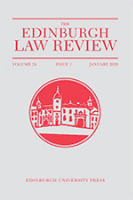
Edinburgh Law Review
Engaging scholars and practitioners in the evolving landscape of law.Edinburgh Law Review is a distinguished journal published by Edinburgh University Press, dedicated to advancing discourse in the realm of law, cultural studies, and history. With its ISSN 1364-9809 and E-ISSN 1755-1692, this journal has been contributing valuable scholarly content since its inception in 1997, and it continues to be a vital resource for researchers, legal practitioners, and students alike. Although it currently does not provide Open Access options, the journal's rigorous peer-review process ensures that each article meets the highest academic standards. Known for its diverse range of topics, the Edinburgh Law Review holds a Q4 ranking within its categories in Cultural Studies, History, and Law in 2023, reflecting a commitment to engaging with contemporary issues in these fields. With a noticeable presence in Scopus rankings, this journal is essential for those seeking to deepen their understanding of the intersections of law, culture, and history within a British context.

NOTRE DAME LAW REVIEW
Navigating the Evolving Landscape of LawNOTRE DAME LAW REVIEW is a premier scholarly journal published by Notre Dame Law School, renowned for its rigorous examination and commentary on legal issues and the evolving jurisprudence of the United States. Established in 1926, the journal has become a vital resource for legal scholars, practitioners, and students, consistently earning a reputation for excellence as evidenced by its Q1 category classification in Law for 2023. With a solid ranking within the Scopus Social Sciences index, placing at #413 among 1025 journals, it captures significant contributions to legal scholarship, making it an essential part of any legal researcher's library. Though it does not currently offer open access options, the journal's impact is underscored by its rich history and commitment to advancing legal discourse. Scholars looking to stay abreast of the latest legal developments and analyses will find NOTRE DAME LAW REVIEW an indispensable tool for their research and practice.
Bulletin of Medieval Canon Law-New Series
Bridging History and Law in the Medieval EraThe Bulletin of Medieval Canon Law-New Series is a premier journal dedicated to advancing the field of canon law during the medieval period. Published by the esteemed Catholic University of America Press, this journal provides a critical platform for scholars and researchers to explore the complexities of ecclesiastical law and its evolution throughout history. With an ISSN of 0146-2989 and an E-ISSN of 2372-2509, the Bulletin aims to disseminate high-quality research articles, book reviews, and critical essays that contribute to a deeper understanding of canon law's impact on society, governance, and religious practices. Although currently non-open access, the publications are accessible through academic databases, ensuring a wide reach among professionals and students alike. As canon law continues to play a crucial role in understanding historical legal frameworks, this journal serves as an essential resource for anyone interested in the intersection of law, history, and theology.
UNIVERSITY OF TORONTO LAW JOURNAL
Advancing Legal Scholarship with DistinctionUNIVERSITY OF TORONTO LAW JOURNAL, published by University of Toronto Press Inc, stands as a distinguished platform in the realm of legal scholarship, having served the academic community since its inception. With an ISSN of 0042-0220 and an E-ISSN of 1710-1174, this quarterly journal is not only recognized for its rigorous peer-review process but also boasts an impressive Q2 rank in Law and a Q3 rank in Sociology and Political Science as per the 2023 category quartiles. The journal aims to foster advanced knowledge and discourse on various legal issues, thereby appealing to researchers, professionals, and students alike who are eager to engage with contemporary legal debates. It is noteworthy that the journal currently does not offer open access, ensuring the integrity and quality of its publications for a subscribed audience. Published in Canada and available for a wide readership, the UNIVERSITY OF TORONTO LAW JOURNAL continues to be a pivotal source for critical analyses and fresh insights in the fields of law and social sciences, contributing significantly to the understanding and evolution of legal frameworks.