INFANCY
Scope & Guideline
Elevating research on the earliest stages of life.
Introduction
Aims and Scopes
- Understanding Cognitive Development:
Research focuses on the cognitive growth of infants, including language acquisition, memory, and problem-solving skills. Studies often employ longitudinal designs to assess developmental trajectories. - Exploring Social Interactions:
The journal highlights the significance of social interactions in infant development, examining how caregiver behaviors, joint attention, and emotional exchanges influence cognitive and emotional outcomes. - Investigating Sensory and Perceptual Abilities:
Papers often delve into infants' sensory processing capabilities, including visual and auditory discrimination, and how these abilities relate to broader developmental milestones. - Impact of Environmental Factors:
Research includes the effects of different caregiving environments, socio-economic factors, and cultural influences on developmental outcomes, particularly in relation to language and emotional regulation. - Role of Play and Exploration:
The journal emphasizes the importance of play in early development, analyzing how object play and exploratory behavior contribute to learning and cognitive development. - Health and Well-being Influences:
Studies investigate the impact of maternal mental health, prenatal factors, and family dynamics on infant development, aiming to uncover protective factors and risk indicators.
Trending and Emerging
- Impact of COVID-19 on Development:
Recent publications have increasingly focused on how the COVID-19 pandemic has affected infant development, maternal mental health, and family dynamics, highlighting the need to understand developmental changes in unprecedented contexts. - Cross-Cultural Perspectives in Development:
There is a growing interest in cross-cultural studies that explore how infant development varies across different cultural contexts, emphasizing the need for a global perspective in understanding developmental processes. - Integration of Technology in Research:
The use of technology, such as eye-tracking and remote observation methods, is becoming more prevalent, enabling researchers to gather data in innovative ways that enhance the understanding of infant behavior. - Interdisciplinary Approaches:
An emerging trend is the incorporation of interdisciplinary methods and theories, drawing from fields such as neuroscience, psychology, and education to provide a more comprehensive understanding of infant development. - Focus on Emotional and Social Development:
There is an increasing emphasis on understanding emotional and social development in infants, particularly in relation to attachment, emotional regulation, and the impact of caregiver interactions on socioemotional outcomes.
Declining or Waning
- Focus on Traditional Developmental Milestones:
There seems to be a waning interest in strictly quantifying traditional developmental milestones (e.g., age at which specific skills are acquired), with a move towards understanding the processes and interactions that underpin development. - Reduction in Studies of Homogeneous Populations:
There is a noticeable decline in research focused on homogeneous groups, such as only studying infants from predominantly Western socio-cultural backgrounds, as the field shifts towards inclusivity and diversity in research samples. - Limited Exploration of Genetic Influences:
Research that primarily examines genetic determinants of infant behavior and development appears to be less prevalent, with current trends favoring environmental and contextual factors. - Decreased Emphasis on Early Behavioral Assessments:
There is a reduced focus on early behavioral assessments in isolation, as the field increasingly values integrated approaches that consider multiple dimensions of infant development.
Similar Journals

Children-Basel
Enhancing scientific understanding in pediatrics and perinatology.Children-Basel is a prestigious peer-reviewed academic journal published by MDPI, focusing on the field of Pediatrics, Perinatology, and Child Health. Established in 2014, it has gained significant recognition, evidenced by its Q2 ranking in the 2023 Category Quartiles, placing it among the top journals in its category. With an E-ISSN of 2227-9067, the journal embraces an Open Access model, making it widely accessible to researchers, practitioners, and students worldwide. This accessibility encourages the dissemination of critical knowledge and innovative research findings that address the myriad challenges and advancements in child health. Operating from its base in Basel, Switzerland, Children-Basel aims to foster a global dialogue among professionals dedicated to improving the health and well-being of children, thereby enhancing the scientific understanding and clinical practice within this vital field.
New Directions for Child and Adolescent Development
Advancing understanding in child and adolescent development.New Directions for Child and Adolescent Development, published by Wiley-Hindawi, is a leading journal dedicated to advancing knowledge in the fields of child and adolescent psychology, educational development, and social psychology. With an impressive Q1 ranking in multiple categories—including Developmental and Educational Psychology and Social Psychology—this journal stands at the forefront of research innovation, making significant contributions to understanding developmental processes and challenges faced by children and adolescents. The journal spans a comprehensive publishing history from 1978 to 2023, allowing for a rich dialogue among researchers, practitioners, and students eager to explore emerging trends and methodologies. Researchers can access a wealth of studies and theoretical frameworks, enhancing the journal's stature within the academic community. New Directions for Child and Adolescent Development remains an invaluable resource for anyone committed to improving the lives of younger populations through evidenced-based practices and policies.
EARLY HUMAN DEVELOPMENT
Empowering research for optimal early life development.EARLY HUMAN DEVELOPMENT is a prestigious journal dedicated to advancing knowledge in the vital fields of Obstetrics and Gynecology as well as Pediatrics, Perinatology, and Child Health. Published by Elsevier Ireland Ltd, this journal has established itself as an essential resource for researchers and practitioners focusing on early life development. With an impressive ranking in the Q1 category for Pediatrics and Q2 for Obstetrics and Gynecology, it provides a platform for high-quality research that informs clinical practice and policy. The journal spans from 1977 to 2024, reflecting over four decades of scholarly contributions. Although currently not open access, the robust impact factor and strong Scopus rankings, including a 76th percentile in Pediatrics, ensure it remains a critical asset for professionals aiming to stay at the forefront of advancements in maternal and child health. Through its curated articles, EARLY HUMAN DEVELOPMENT aims to promote interdisciplinary collaboration and foster innovative research that ultimately enhances the health and development of children worldwide.
CHILD DEVELOPMENT
Advancing knowledge in child psychology and education.CHILD DEVELOPMENT, published by WILEY, stands as a premier journal in the fields of developmental and educational psychology, education, pediatrics, perinatology, child health, and social work. Established in 1945, it has consistently maintained a strong impact, underscored by its 2023 Q1 ranking in multiple relevant categories, as well as its esteemed positions within Scopus rankings, including a remarkable 14th place in Pediatrics. The journal serves as a vital resource for researchers and professionals, offering rigorous peer-reviewed articles that explore pivotal aspects of child development through a multidisciplinary lens. Although it does not currently offer open access options, CHILD DEVELOPMENT remains influential, addressing critical topics in child psychology, policy implications, and educational practices. Researchers and students alike will find the journal’s comprehensive scope instrumental in advancing their understanding and fostering an evidence-based approach to contemporary child development issues.
Early Education and Development
Pioneering Research for Tomorrow's LearnersEarly Education and Development is a prestigious journal published by Routledge Journals, Taylor & Francis Ltd, dedicated to advancing the field of early childhood education and developmental psychology. With an ISSN of 1040-9289 and an E-ISSN of 1556-6935, this journal has garnered an impressive reputation, achieving a Q1 ranking in both Developmental and Educational Psychology as well as Education as of 2023. Its influence is reflected in its Scopus rankings, standing at #236 out of 1,543 in Social Sciences (Education) and #83 out of 360 in Psychology (Developmental and Educational Psychology), positioning it in the 84th and 77th percentiles, respectively. Operative since 1989, Early Education and Development serves as a vital resource for researchers, educators, and policymakers by publishing cutting-edge research, theoretical frameworks, and practical applications that shape early educational practices globally. Though it does not currently offer open access options, its contributions remain essential for those looking to stay abreast of the latest developments and best practices in early education.
Social Neuroscience
Advancing Insights at the Intersection of Brain and SocietySocial Neuroscience is a premier academic journal dedicated to advancing the interdisciplinary field that lies at the intersection of social psychology, behavioral neuroscience, and developmental studies. Published by ROUTLEDGE JOURNALS, TAYLOR & FRANCIS LTD, this journal has made significant strides since its establishment in 2006, with a convergence period extending to 2024. It regularly features innovative research articles that explore the neural basis of social behaviors and the impact of social interactions on brain function. Holding esteemed rankings in Scopus, including Q2 status in both Development and Social Psychology categories, it appeals to a broad array of scholars and practitioners keen on understanding human behavior through a neuroscientific lens. The journal's commitment to fostering critical discussions and publishing impactful research makes it an essential resource for professionals, researchers, and students alike who seek to deepen their understanding of the complex interplay between social processes and neural mechanisms.
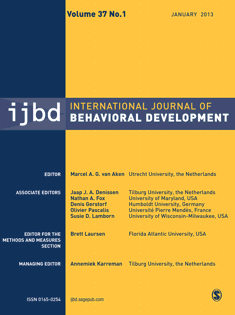
INTERNATIONAL JOURNAL OF BEHAVIORAL DEVELOPMENT
Advancing understanding of human growth and interactions.INTERNATIONAL JOURNAL OF BEHAVIORAL DEVELOPMENT, published by SAGE PUBLICATIONS LTD, is a premier academic journal dedicated to advancing the fields of developmental and educational psychology, developmental neuroscience, and social psychology. With an impressive impact factor and a Q1 ranking across multiple categories for 2023, this journal ranks among the top 25% in various social science domains, including education and lifespan studies. Its commitment to publishing high-quality research makes it an essential resource for researchers, educators, and students focused on understanding behavioral development across the lifespan. The journal aims to disseminate innovative findings, fostering a deeper comprehension of the behavioral factors that shape human growth and interactions. Through its rigorous peer-review process and global editorial standards, it not only enhances the academic conversation but also influences policy and practice in related fields. For more information, readers can access additional content through subscription or institutional access options.

DEVELOPMENTAL SCIENCE
Fostering Innovation in Developmental ResearchDEVELOPMENTAL SCIENCE, published by Wiley, is a premier international journal dedicated to advancing the field of developmental psychology and cognitive neuroscience. With an ISSN of 1363-755X and an E-ISSN of 1467-7687, this journal has established itself as a vital resource for researchers and practitioners alike since its inception in 1998. The journal is esteemed for its rigorous peer-reviewed articles that explore key aspects of human development, contributing to its remarkable impact factor and prestigious rankings: it is categorized in Q1 in both Cognitive Neuroscience and Developmental and Educational Psychology, placing it in the top tiers of scholarly work. Notably, it holds an impressive Scopus rank of #30 out of 360 in Developmental and Educational Psychology and #19 out of 115 in Cognitive Neuroscience. The continuous exploration of developmental processes, education, and cognitive functions makes DEVELOPMENTAL SCIENCE an indispensable tool for those striving to deepen their understanding or contribute to these dynamic fields. Although the journal follows subscription-based access options, its high-quality findings offer invaluable insights for academicians, students, and professionals committed to the evolving landscape of developmental research.
Early Childhood Education Journal
Bridging Research and Practice for Young Learners.Early Childhood Education Journal is a premier scholarly publication dedicated to advancing the field of early childhood education through cutting-edge research and innovative practices. Published by Springer, this journal serves as a pivotal platform for educators, researchers, and policymakers interested in the developmental and educational psychology of young children. With an esteemed impact factor reflecting its significant influence, the journal ranks in the top quartile (Q1) for Education and in Q2 for Developmental and Educational Psychology, positioning it among the most respected avenues for scholarly exchange in these disciplines. The journal has been consistently publishing impactful research since its inception in 1995, fostering discussions that shape educational policies and practices globally. Although it maintains a subscription model, the accessibility of its research through esteemed databases ensures that vital knowledge reaches a broad audience, empowering practitioners and researchers alike to enhance educational outcomes for children. For those invested in the future of education, the Early Childhood Education Journal is an indispensable resource that bridges theory and practice.
Infants & Young Children
Illuminating the Pathways of Infancy and ChildhoodInfants & Young Children is a pioneering journal established in 1988 and published by Lippincott Williams & Wilkins, focusing on the critical developmental phases of infancy and early childhood. With a commitment to advancing research in Developmental and Educational Psychology, Pediatrics, Perinatology and Child Health, as well as Psychiatry and Mental Health, this journal serves as an essential resource for professionals and scholars dedicated to understanding and enhancing the early years of life. As a member of the Q3 category in multiple relevant fields, it informs and stimulates discourse with its impactful scholarly articles, meeting the diverse needs of researchers, practitioners, and policymakers alike. Though access is not currently open, subscribers can expect high-quality, peer-reviewed research that underscores the importance of early experiences in shaping lifelong outcomes. Located in Philadelphia, this journal continues to make significant contributions to child health and education, aiming to bridge gaps in knowledge and ensure a foundation for thriving, healthy futures.