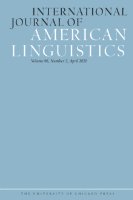
INTERNATIONAL JOURNAL OF AMERICAN LINGUISTICS
Scope & Guideline
Unveiling Insights into American Linguistic Diversity.
Introduction
Aims and Scopes
- Documentation of Indigenous Languages:
The journal prioritizes the documentation and analysis of lesser-studied indigenous languages across the Americas, providing a platform for original research that contributes to the preservation of linguistic heritage. - Linguistic Structures and Typologies:
Research often explores the structural aspects of languages, including phonology, morphology, syntax, and semantics, aiming to identify typological patterns and unique linguistic features. - Historical and Comparative Linguistics:
The journal features studies that delve into the historical relationships among languages, including reconstruction of proto-languages and examination of language change over time. - Fieldwork and Ethnographic Studies:
A significant focus on fieldwork methodologies is evident, with papers discussing the challenges and findings from linguistic fieldwork, thus enriching theoretical frameworks with empirical data. - Cultural Contexts of Language Use:
The intersection of language and culture is a recurring theme, with papers analyzing how language reflects and shapes cultural practices, narratives, and identity.
Trending and Emerging
- Prosodic and Phonological Studies:
There is a noticeable increase in research addressing prosody and phonological patterns, highlighting the importance of these aspects in understanding language structure and speaker perception. - Language Contact and Borrowing:
Emerging studies on language contact, particularly involving indigenous languages and Spanish or English, indicate a growing interest in sociolinguistic dynamics and the impact of globalization on linguistic practices. - Grammaticalization Processes:
A trend towards examining grammaticalization, especially in indigenous languages, reflects a growing emphasis on understanding how languages evolve over time and how grammatical structures develop. - Fieldwork Methodologies:
An increased emphasis on fieldwork methodologies suggests a shift towards valuing the firsthand collection of linguistic data, with researchers documenting languages in their natural contexts. - Cognitive and Perceptual Linguistics:
Research exploring the cognitive aspects of language use, including how speakers perceive and process linguistic information, is gaining traction, indicating a multidisciplinary approach to linguistic inquiry.
Declining or Waning
- Traditional Narrative Forms:
Papers focused on traditional narratives and folklore seem to have decreased, possibly indicating a shift towards more analytical and theoretical discussions rather than purely descriptive accounts. - Morphosyntactic Studies of Major Languages:
Research on morphosyntactic phenomena in widely spoken indigenous languages appears less frequent, possibly due to a saturation of existing studies or a shift in interest towards more endangered or lesser-known languages. - Comparative Studies Across Larger Language Families:
The trend of broad comparative studies among major language families is declining, suggesting a move towards more focused and localized studies that reflect individual languages' unique characteristics.
Similar Journals
INDOGERMANISCHE FORSCHUNGEN
Bridging Past and Present in Language ResearchINDOGERMANISCHE FORSCHUNGEN is a prominent academic journal, published by WALTER DE GRUYTER GMBH, focused on the field of linguistics and language studies. With an impressive history that dates back to 1892, this journal has been a vital resource for researchers and professionals exploring the intricacies of Indo-European languages. Although it does not offer open access, its comprehensive and rigorous articles—published in both print (ISSN: 0019-7262) and electronic formats (E-ISSN: 1613-0405)—are instrumental for anyone delving into historical linguistics and comparative studies. The journal currently holds a Q3 ranking in Linguistics and Language, indicating its significance within the academic community, as evidenced by its Scopus rankings in both the Arts and Humanities and Social Sciences domains. Spanning decades of scholarship, INDOGERMANISCHE FORSCHUNGEN plays a pivotal role in advancing the study of language and is essential for scholars aiming to contribute to the dialogue in this ever-evolving discipline.

Voprosy Yazykoznaniya
Innovating Perspectives in Language and SocietyVoprosy Yazykoznaniya, published by the esteemed Russian Academy of Sciences and the State Academy of Humanities (GAUGN), stands as a leading journal in the field of linguistics and language studies. With an impressive Q2 rank in Linguistics and Language for 2023 and a strong position within Scopus rankings, this journal fosters scholarly dialogue and pushes the boundaries of linguistic research by providing a platform for innovative studies, reviews, and analyses. Although not open access, its publication ensures high academic standards and visibility within the global academic community. Researchers, professionals, and students alike can benefit from the rich insights and diverse perspectives presented in this journal, serving as a vital resource for anyone interested in the intricacies of language and its role in society. Operating since 2009 and continuing to 2024, Voprosy Yazykoznaniya is an essential reference point for contemporary linguistic scholarship in the Russian Federation and beyond.
Journal of African Languages and Linguistics
Diving Deep into the Linguistic Heritage of AfricaThe Journal of African Languages and Linguistics, published by DE GRUYTER MOUTON, is a premier academic journal dedicated to the study and analysis of the diverse languages spoken across Africa. With an ISSN of 0167-6164 and an E-ISSN of 1613-3811, this journal has been pivotal since its inception in 1979, engaging readers with rigorous research and scholarly articles that span across critical themes in linguistics and language studies. Based in Germany, the journal holds a distinguished Q2 category ranking in the field of Linguistics and Language, according to the latest 2023 metrics, and features a commendable Scopus ranking, positioning it well within the 56th and 52nd percentiles in its respective categories. Although it currently does not provide open access, it is an essential resource for researchers, professionals, and students alike, striving to deepen their understanding of African languages, their structures, and their sociocultural contexts. With a continuously expanding scope and a commitment to advancing linguistic scholarship, the journal remains a significant platform for fostering academic dialogue and promoting innovative research in African linguistics.

Mandenkan-Bulletin Semestriel d Etudes Linguistiques Mande
Connecting Cultures through Language ExplorationMandenkan-Bulletin Semestriel d'Etudes Linguistiques Mande is an esteemed academic journal dedicated to the exploration of Mande languages and linguistics, published by the Centre National de Recherche Scientifique in France. With its ISSN 0752-5443, this journal has established itself within the linguistic community, holding a notable Q3 ranking in both the Linguistics and Language category as well as respectable standings in Scopus ranks, placing it in the 55th percentile for language and linguistics. Since its inception in 2018, it has been pivotal in publishing groundbreaking research that advances our understanding of the Mande language family and its cultural implications. Although currently not open access, the journal offers a wealth of knowledge fostered through rigorous peer-reviewed articles aimed at linguists, researchers, and students alike, making significant contributions to the fields of linguistics and African studies.
Sign Language & Linguistics
Elevating Research in Sign Language StudiesSign Language & Linguistics is an esteemed academic journal published by John Benjamins Publishing Co, dedicated to advancing the field of sign language studies and linguistics. With an ISSN of 1387-9316 and an E-ISSN of 1569-996X, this journal has earned a prominent place in the linguistic community, achieving a Q1 ranking in both the Linguistics and Language category, and standing out within the Scopus rankings, placing in the 77th percentile among the Arts and Humanities and 75th percentile in the Social Sciences categories. Sign Language & Linguistics spans over two decades of research, offering comprehensive insights and analyses from 1998 to 2024, promoting high-quality scholarly communication. Aimed at researchers, professionals, and students alike, this journal is essential for those exploring the intersection of sign languages, linguistics, and cultural studies, facilitating progressive discourse and fostering an understanding of this vital mode of human communication.
OCEANIC LINGUISTICS
Advancing Understanding of Oceania's Linguistic HeritageOCEANIC LINGUISTICS is a premier academic journal published by UNIV HAWAII PRESS, dedicated to the study of languages spoken in the Pacific region. This esteemed journal, bearing ISSN 0029-8115 and E-ISSN 1527-9421, serves as a vital platform for linguists, researchers, and scholars to disseminate significant findings and insights related to Oceania's rich linguistic diversity. With a commendable impact factor and categorized in the Q2 Quartile for the field of linguistics and language, OCEANIC LINGUISTICS ranks 335th out of 1088 in Arts and Humanities and 395th out of 1167 in Social Sciences, reflecting its relevance and influence in ongoing linguistic discourse. The journal is a subscription-based publication, committed to advancing research and fostering scholarly communication from 2004 to 2024, making it an essential resource for anyone engaged in the study of linguistic phenomena in the Oceania region and beyond.

Suvremena Lingvistika
Championing Scholarly Dialogue in Linguistics Worldwide.Suvremena Lingvistika is a distinguished open-access journal published by the Croatian Philological Society, dedicated to advancing research in the field of linguistics and language. Since its establishment, the journal has been pivotal in promoting scholarly dialogue within the linguistics community, especially among researchers and academics in Croatia and beyond. With an ISSN of 0586-0296 and an E-ISSN of 1847-117X, the journal has transitioned to an open-access model since 2007, ensuring that research is freely accessible to all. As of 2023, it holds a respectable Q3 ranking in the Linguistics and Language category, reflecting its potential contribution to the field. The journal's scope encompasses a wide array of linguistic disciplines, encouraging both theoretical and empirical studies. Supportive of new research, Suvremena Lingvistika aims to foster innovative approaches and methodologies in linguistics, making it an essential resource for students, researchers, and professionals eager to explore the complexities of language. With its ongoing publication until 2024, it continues to shape the linguistic landscape, providing valuable insights and fostering collaboration among scholars globally.
JOURNAL OF EAST ASIAN LINGUISTICS
Advancing Knowledge in East Asian LinguisticsJOURNAL OF EAST ASIAN LINGUISTICS, published by SPRINGER, is a premier academic journal that focuses on the rich and diverse linguistic phenomena from East Asia. With an ISSN of 0925-8558 and an E-ISSN of 1572-8560, this journal has steadily contributed to the fields of linguistics and the history and philosophy of science since its inception in 1992. Operating from its base in the Netherlands, the journal is recognized for its impactful research, holding a Q2 category ranking in both the History and Philosophy of Science and Linguistics and Language. It boasts an impressive standing in Scopus rankings, highlighting its relevance and contribution to the academic community with a 66th percentile ranking in Language and Linguistics. The journal is not currently open access, ensuring a rigorous peer-review process that elevates the quality of published articles. By bridging theory and empirical research, the JOURNAL OF EAST ASIAN LINGUISTICS plays a vital role in advancing knowledge in linguistics, making it an essential resource for researchers, professionals, and students interested in East Asian languages and their complexities.

Jezikoslovlje
Fostering Dialogue in Linguistic ResearchJezikoslovlje, published by the Josip Juraj Strossmayer University, Faculty of Philosophy in Croatia, is an essential publication in the field of Linguistics and Language Studies. Launched in 2008 and extending its contributions to the academic community through 2024, this journal addresses a spectrum of linguistic research, facilitating scholarly dialogue around both theoretical and applied aspects of language. With a current Scopus ranking placing it in the 54th percentile in the Arts and Humanities and the 50th percentile in Social Sciences, Jezikoslovlje serves as a vital resource for researchers and students looking to engage with contemporary linguistic issues. Although it operates under a traditional access model, its indexed presence and rigorous peer-review process ensure that published works maintain a high scholarly standard, inviting contributions that advance understanding in this dynamic discipline. The journal's commitment to fostering knowledge in linguistics makes it a significant platform for academics in Croatia and beyond.
STUDIES IN LANGUAGE
Pioneering Insights into Language's Multifaceted DimensionsSTUDIES IN LANGUAGE is a distinguished academic journal published by John Benjamins Publishing Co, focusing on the dynamic fields of Linguistics and Communication. With an ISBN of 0378-4177 and E-ISSN 1569-9978, this journal has become an essential platform for researchers, professionals, and students seeking to advance their understanding of language and its multifaceted dimensions. The journal has been recognized in 2023 with a prestigious Q1 categorization in Linguistics and Language and a Q2 ranking in Communication, reflecting its vital contributions to these fields. Its Scopus rankings further emphasize its relevance, ranking 299 out of 1088 in Language and Linguistics, positioning it within the 72nd percentile. Published continuously since its inception in 1977, STUDIES IN LANGUAGE plays a pivotal role in disseminating cutting-edge research and fostering academic dialogue around contemporary linguistic theories and communication practices. While it is not an open-access journal, it offers valuable insights that make it a must-read for anyone committed to exploring the intricate relationships between language, culture, and society.