International Studies Review
Scope & Guideline
Advancing Understanding in International Relations
Introduction
Aims and Scopes
- Critical International Relations Theory:
The journal focuses on advancing critical theories in international relations, examining power dynamics, social constructs, and the implications of global governance. - Interdisciplinary Approaches:
It promotes interdisciplinary research that integrates insights from various fields such as sociology, political science, economics, and environmental studies to enrich the understanding of international phenomena. - Global and Local Perspectives:
The journal emphasizes the importance of both global perspectives and local contexts, highlighting the interplay between international norms and domestic realities. - Methodological Pluralism:
A commitment to methodological pluralism is evident, with the journal encouraging diverse research methodologies, including qualitative and quantitative approaches, to address complex international issues. - Engagement with Contemporary Issues:
The journal regularly addresses pressing contemporary issues such as climate change, migration, and security, reflecting the evolving nature of international studies. - Inclusivity and Diversity:
The International Studies Review prioritizes inclusivity and diversity in scholarship, advocating for underrepresented voices and perspectives in the field of international relations.
Trending and Emerging
- Climate Change and Security:
There is a growing focus on the intersection of climate change and security, exploring how environmental issues influence conflict, migration, and international cooperation. - Decolonization and Global IR:
The journal is increasingly addressing themes of decolonization, emphasizing the need to rethink international relations theories and practices from non-Western perspectives. - Populism and Global Politics:
Emerging scholarship on populism is gaining traction, analyzing its impact on foreign policy, international cooperation, and global governance. - Technology and International Relations:
The rise of technology, particularly artificial intelligence and cyber issues, is becoming a significant area of inquiry, prompting discussions on its implications for international security and diplomacy. - Social Movements and Agency:
There is an increasing emphasis on the role of social movements and non-state actors in shaping international relations, highlighting grassroots agency in global governance. - Intersectionality in Global Politics:
Research that employs intersectional analysis to understand the complexities of identity, power, and privilege in international relations is gaining prominence, reflecting a more nuanced approach to global issues.
Declining or Waning
- Traditional Security Studies:
While security studies remain important, there has been a noticeable decline in the emphasis on traditional military-focused security issues, as newer frameworks prioritize human security and non-traditional threats. - State-Centric Paradigms:
The journal has moved away from state-centric paradigms that dominated earlier scholarship, reflecting a broader shift towards examining non-state actors and transnational networks. - Eurocentrism in Analysis:
There is a decreasing focus on Eurocentric perspectives in international relations, as the journal increasingly seeks to incorporate diverse viewpoints from the Global South and marginalized communities. - Methodological Rigor in Traditional Approaches:
There seems to be a waning interest in rigid methodological frameworks that emphasize quantitative analysis without acknowledging contextual complexities, as scholars advocate for more reflexive and context-sensitive methodologies. - Historical Analysis in Isolation:
The trend towards isolating historical analysis from contemporary issues is declining, as scholars now favor approaches that connect historical legacies with current international dynamics.
Similar Journals
Cambridge Review of International Affairs
Exploring the Dynamics of Global DiscourseCambridge Review of International Affairs, published by Routledge Journals, Taylor & Francis Ltd, stands as a leading platform for scholarly discourse in the fields of Political Science and International Relations. Operating since 1986, this prestigious journal has firmly established itself in the academic community, evidenced by its commendable Q1 ranking and notable position in the 83rd percentile among Social Sciences journals according to Scopus rankings. With a commitment to exploring pressing global issues, the journal delivers rigorous analyses and diverse perspectives, making it an essential resource for researchers, practitioners, and students who strive to deepen their understanding of international affairs. Although the journal is not an Open Access publication, it ensures broad accessibility to its influential research, contributing significantly to the ongoing discourse in international relations until 2024 and beyond.
Journal of International Political Theory
Fostering Dialogue on International Political ChallengesThe Journal of International Political Theory, published by SAGE Publications Ltd, is an esteemed academic journal dedicated to advancing the field of political theory on a global scale. With an ISSN of 1755-0882 and an E-ISSN of 1755-1722, this journal serves as a crucial platform for rigorous scholarship that intersects various domains including sociology and political science. Recognized as a leading publication in both the Q1 category for Social Sciences (miscellaneous) and Sociology and Political Science, it ranks in the top tiers of Scopus’ rankings, evidencing its influence and rigor within the academic community. From its base in the United Kingdom, the journal promotes a diverse range of theoretical perspectives and methodologies, fostering a vibrant dialogue among researchers and practitioners. While it does not operate under an open access model, the journal remains accessible to a broad audience of scholars eager to engage with cutting-edge debates in international political theory. The Journal of International Political Theory is committed to shaping contemporary understanding of political challenges, making it an essential read for researchers, professionals, and students alike.
International Politics
Fostering Critical Analysis of Global StrategiesInternational Politics, published by PALGRAVE MACMILLAN LTD, stands as a pivotal scholarly resource in the field of international relations and political science. With a strong impact factor and a commendable ranking within the Q1 and Q2 quartiles for 2023, the journal is recognized for its rigorous analysis and insightful contributions to both theoretical and practical aspects of global politics. Covering a wide array of topics, from geopolitical strategies to socio-economic transformations, it serves as an essential platform for researchers, professionals, and students alike. The journal, ISSN 1384-5748 and E-ISSN 1740-3898, is based in the United Kingdom and has been converging knowledge since 1996, continuing to provide relevant and authoritative perspectives up until 2024. Despite its lack of Open Access options, the journal remains a wealth of information for anyone engaged in the intricate web of international affairs, ensuring that quality research continues to shape the discourse in this vital field.

Relaciones Internacionales-Madrid
Connecting Minds, Transforming Global UnderstandingRelaciones Internacionales-Madrid is a distinguished open-access journal published by the Universidad Autónoma de Madrid that has been at the forefront of international relations scholarship since its inception in 2005. With its ISSN 1699-3950, this journal provides an essential platform for researchers, professionals, and students interested in exploring contemporary global issues, diplomatic strategies, and the intricate dynamics of international politics. Located in Madrid, Spain, Relaciones Internacionales-Madrid is committed to promoting high-quality research and fostering interdisciplinary dialogue within the field. The journal emphasizes accessibility through its open-access policy, ensuring that vital findings and discussions reach a broad audience. As a vital resource for those seeking to navigate the complexities of international relations, this journal plays a significant role in shaping discussions and advancing scholarship in this critical area of study.
INTERNATIONAL AFFAIRS
Championing Rigorous Scholarship in International RelationsINTERNATIONAL AFFAIRS, published by OXFORD UNIVERSITY PRESS, stands as a premier journal in the fields of political science and international relations, boasting an impressive Impact Factor and a reputation for rigorous scholarship. Established in the United Kingdom, the journal's ISSN is 0020-5850 and its E-ISSN is 1468-2346. From its inception to the present, it has played a crucial role in analyzing and interpreting global issues that shape our world, with a notable mention of its Q1 quartile ranking in both Political Science and Sociology according to 2023 metrics. Researchers and practitioners alike benefit from its high-quality, peer-reviewed articles, which consistently rank it in the top percentile of its category, underscoring its significance in contemporary discourse. As the journal continues to evolve, it remains a vital resource for those looking to deepen their understanding of international affairs and sociopolitical dynamics.
INTERNATIONAL JOURNAL
Connecting Scholars to Global PerspectivesWelcome to the International Journal, a premier academic publication in the fields of Political Science and International Relations, published by SAGE Publications Ltd.. With a distinguished history dating back to 1981, this journal has become a vital resource for scholars and practitioners worldwide, offering insights into complex global issues and fostering critical discourse. As of 2023, it proudly holds a Q2 category ranking, reflecting its influential position within the academic community, as evidenced by its Scopus ranking of #288 out of 706 in the related fields. The journal provides non-open access articles, ensuring high-quality peer-reviewed content that is accessible through institutional subscriptions. By maintaining rigorous editorial standards and promoting interdisciplinary research, International Journal continues to contribute significantly to the evolution of political theory and international studies, making it essential reading for anyone committed to understanding the dynamics shaping our world today.
INTERNATIONAL POLITICAL SCIENCE REVIEW
Elevating Perspectives on International Relations Since 1980INTERNATIONAL POLITICAL SCIENCE REVIEW is a leading journal in the fields of Political Science and International Relations, published by SAGE PUBLICATIONS LTD. With a rich history dating back to 1980 and converging its expertise up to 2024, this esteemed publication holds a notable position in academia, evidenced by its impressive Q1 quartile rankings in both Political Science and Sociology categories for 2023. The journal’s Scopus rankings further enhance its reputation, proudly sitting in the top percentiles in its respective fields, which underscores its influence and importance for both researchers and practitioners. With a commitment to publishing rigorous research and comprehensive analyses, INTERNATIONAL POLITICAL SCIENCE REVIEW serves as a vital resource for those seeking to engage with the latest debates and developments in political science. Readers are encouraged to explore insightful articles and contribute to the discourse shaping our understanding of global political dynamics.
British Journal of Politics & International Relations
Exploring the complexities of politics and global dynamics.The British Journal of Politics & International Relations, published by SAGE Publications Inc, serves as a vital platform for scholarly discourse in the fields of political science and international relations. With an impressive impact factor and a Scopus rank of #64 out of 706 in Political Science, this journal is recognized for its rigorous, peer-reviewed articles that contribute significantly to academic knowledge and policy discussion. With a focused scope that spans both theoretical and empirical research, the journal holds a prestigious Q1 ranking in Political Science and International Relations, as well as a Q2 designation in Management, Monitoring, Policy, and Law. Established in 2005, it has emerged as an essential resource for researchers, professionals, and students alike, engaging with contemporary challenges and fostering critical analyses. Access options are available through institutional subscriptions, ensuring wide availability for those seeking to enrich their understanding of the complex interplay between politics and international dynamics.
Global Change Peace & Security
Transforming Global Challenges into Opportunities for PeaceGlobal Change Peace & Security is a prominent scholarly journal published by Routledge Journals, Taylor & Francis Ltd, focusing on the intricate interplay between global change and peace efforts within the realms of political science and international relations. With an ISSN of 1478-1158 and an E-ISSN of 1478-1166, this esteemed journal spans from 2008 to 2024, consistently contributing to critical discourse in its field. Ranked in the second quartile (Q2) for both Political Science and International Relations as well as Sociology, it occupies a distinguished position with a Scopus ranking of 134 out of 706 and a percentile standing of 81st in Political Science. The journal’s objective is to bridge the gap between theoretical frameworks and functional policy discussions, thereby fostering dialogue that addresses contemporary challenges in global governance and human security. By offering rich, research-based insights and analysis, Global Change Peace & Security serves as a vital resource for academics, practitioners, and policy-makers committed to advancing peace and security amidst pervasive global transformations.
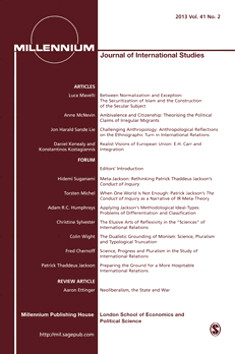
MILLENNIUM-JOURNAL OF INTERNATIONAL STUDIES
Challenging Perspectives, Shaping FuturesMILLENNIUM: JOURNAL OF INTERNATIONAL STUDIES, published by SAGE PUBLICATIONS LTD, is a leading academic journal in the realms of political science and international relations. Established in 1971, this prestigious publication has continuously provided a critical forum for innovative and rigorous scholarship that challenges conventional perspectives and advances theoretical knowledge. With an impressive 2023 Scopus rank of #156/706 in Political Science and International Relations, and a prominent Q1 category ranking reflecting its influence and reach, MILLENNIUM stands at the forefront of contemporary debates in sociology and politics. Researchers and professionals keen to stay engaged with the latest findings and discussions in these fields will find this journal invaluable. While not an open-access outlet, MILLENNIUM ensures wide dissemination of impactful research and maintains a rigorous peer-review process, making it an imperative resource for scholars and students alike. With a commitment to exploring the intricacies of global and societal issues, this journal is essential for anyone looking to deepen their understanding of international affairs.