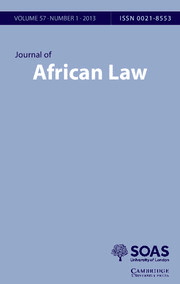
Journal of African Law
Scope & Guideline
Empowering voices in African law and justice.
Introduction
Aims and Scopes
- Legal and Human Rights Issues:
The journal frequently explores legal frameworks concerning human rights, including issues related to gender, political participation, and social justice, highlighting the ongoing struggles for rights and equality in various African contexts. - Comparative Legal Analysis:
Many articles provide comparative analyses of legal systems across African countries, as well as comparisons with international legal standards, aiming to enhance understanding of regional legal dynamics and promote best practices. - Socio-Legal Research:
The journal emphasizes the importance of socio-legal research methodologies, encouraging studies that examine the impact of law on society and vice versa, especially in relation to marginalized groups and vulnerable populations. - Environmental and Resource Management Law:
There is a consistent focus on legal frameworks governing natural resources and environmental sustainability, reflecting the critical challenges posed by climate change and resource management on the continent. - Innovation and Technology in Law:
The journal also addresses the intersection of law with technology, particularly concerning issues like digital rights, privacy, and the implications of technological advancements on legal practices and governance.
Trending and Emerging
- Gender and Law:
There is an increasing emphasis on gender-related legal issues, including women's rights and representation, signifying a broader recognition of gender equality as a critical area of legal reform and advocacy in Africa. - COVID-19 and Its Legal Implications:
The pandemic has catalyzed a surge in publications analyzing the legal ramifications of COVID-19, exploring themes such as public health law, emergency legislation, and the protection of rights during crises, reflecting the urgent need for legal frameworks that respond to health emergencies. - Climate Change and Environmental Law:
Recent articles highlight the intersection of law with climate change and environmental sustainability, demonstrating an emerging focus on legal responses to environmental challenges and the rights of communities affected by environmental degradation. - Digital Rights and Technology Law:
The journal is increasingly publishing works that explore digital rights, privacy, and the implications of technological advancements on legal systems, indicating a growing recognition of the importance of technology in contemporary legal discourse. - Indigenous Rights and Customary Law Adaptation:
There is a notable trend toward examining indigenous rights within the context of contemporary legal frameworks, showcasing efforts to adapt and incorporate traditional legal principles into modern legal systems to enhance cultural relevance and community engagement.
Declining or Waning
- Colonial Legal Frameworks:
There has been a noticeable reduction in articles focusing explicitly on colonial legal legacies and their impacts on contemporary legal systems. This may indicate a shift towards addressing more current legal challenges rather than historical contexts. - Traditional Law and Customary Practices:
The focus on traditional law and customary practices appears to be waning, possibly as legal scholars increasingly prioritize modern legal frameworks and statutory laws over customary systems that may be seen as less relevant in contemporary governance. - Corporate Law and Business Regulation:
While still present, the number of articles specifically addressing corporate law and business regulation issues has decreased, suggesting a potential shift in interest towards more pressing social justice and human rights issues. - International Law and African Union Mechanisms:
Articles discussing international law and the mechanisms of the African Union have decreased, indicating a potential shift towards more localized legal discussions that focus on national and regional legal systems rather than broader international frameworks.
Similar Journals
SOCIAL & LEGAL STUDIES
Advancing Interdisciplinary Insights in Law and SocietySOCIAL & LEGAL STUDIES, published by SAGE Publications Ltd, stands at the forefront of interdisciplinary research within the spheres of law, sociology, and political science. With an ISSN of 0964-6639 and an E-ISSN of 1461-7390, the journal has established a significant presence in academia since its inception in 1992. This esteemed journal, recognized as a Q1 publication in Law and holding Q2 status in both miscellaneous Social Sciences and Sociology & Political Science categories, garners attention from leading scholars and practitioners alike, evidenced by its impressive Scopus rankings, including a top 88th percentile in Law. Although it does not offer open access, researchers and students can rely on this journal for high-quality, peer-reviewed articles that synthesize theoretical and empirical insights, addressing contemporary legal and social issues. As it converges into 2024, SOCIAL & LEGAL STUDIES continues to be a vital platform for advancing discussions that shape the interplay between societal norms and legal frameworks.

De Jure Law Journal
Innovating Legal Research for a Global Community.De Jure Law Journal, published by Pretoria University Law Press, is a reputable open access journal that has been serving the legal community since its establishment in 2011. With its commitment to disseminating high-quality research, this journal focuses on various aspects of law and legal principles, encompassing a broad range of topics from constitutional law to international legal frameworks. The journal's ISSN 1466-3597 and E-ISSN 2225-7160 ensure that it is easily accessible and widely recognized in academic circles. Positioned as a significant contributor to legal scholarship in South Africa and beyond, De Jure Law Journal is dedicated to fostering a critical dialogue among researchers, practitioners, and students alike, making it an essential resource for anyone engaged in legal studies.

Vestnik of Saint Petersburg University-Law-Vestnik Sankt-Peterburgskogo Universiteta-Pravo
Exploring Contemporary Challenges in LawVestnik of Saint Petersburg University-Law, published by St Petersburg University Press, is a vital academic resource in the field of law, particularly significant within the Russian legal landscape. With an ISSN of 2074-1243 and an E-ISSN of 2587-5833, this journal serves as a platform for rigorous research, critical analysis, and scholarly discourse, contributing to the advancement of legal knowledge and practice. Although currently classified in the Q4 quartile for the year 2023 by Scopus rankings, it holds a unique position within the academic community, catering to a diverse audience of researchers, legal professionals, and students, especially those interested in the evolving nuances of law in Russia. You can explore comprehensive studies and articles that reflect the contemporary challenges and developments in law, while benefiting from the journal's focus on fostering a deep understanding of legal principles. The journal runs from 2019 to 2024, encapsulating emerging trends and insights in law that are critical for continuous learning and growth in this discipline.

Ciencia Juridica
Cultivating a Platform for Legal Excellence and DialogueCiencia Juridica is a distinguished academic journal published by UNIV GUANAJUATO, dedicated to advancing the field of legal studies. With its ISSN 2007-3577 and E-ISSN 2007-6142, this journal serves as a pivotal platform for scholars, researchers, and practitioners to disseminate innovative legal research and analysis. Although currently not an open-access journal, it ensures robust peer-reviewed content that maintains the highest academic standards. By focusing on a comprehensive range of legal topics, Ciencia Juridica aims to contribute significantly to the scholarly dialogue within the legal community, fostering critical thinking and innovative approaches to complex legal issues. The journal's commitment to enhancing legal scholarship makes it an essential resource for anyone engaged in the study or practice of law in Mexico and beyond.

UNIVERSITY OF NEW SOUTH WALES LAW JOURNAL
Fostering Informed Dialogue in the Legal CommunityUniversity of New South Wales Law Journal, published by the University of New South Wales, Faculty of Law, is a leading academic journal that serves as an essential platform for discourse in the field of legal studies. With an ISSN of 0313-0096 and an E-ISSN of 1839-2881, the journal has been a beacon of legal scholarship since its inception in 1983. Operating from Kensington, New South Wales, Australia, it provides profound insights into various legal issues, emphasizing interdisciplinary perspectives by also being recognized in the fields of philosophy, sociology, and political science. While it maintains a Q3 ranking in Law and has shown increased visibility in Philosophy at Q2 according to the 2023 category quartiles, the journal assures a diverse range of critical analyses from scholars, professionals, and students alike. It is particularly valuable for researchers seeking to engage with contemporary legal debates, ensuring they remain at the forefront of academic and practical discussions in law and related disciplines.

National Taiwan University Law Review
Exploring the Dynamics of Law in AsiaNational Taiwan University Law Review, with ISSN 1812-6324, is a prestigious academic journal published by the NATIONAL TAIWAN UNIVERSITY COLLEGE OF LAW. As a pivotal platform in the field of law, this journal aims to foster scholarly discourse and promote the exchange of ideas regarding legal theories, practices, and developments, particularly within the context of Taiwan and the broader Asian legal landscape. Although it does not currently offer open access, its selectivity ensures a high standard of peer-reviewed research, appealing to researchers, legal practitioners, and students alike. The journal's commitment to exploring contemporary legal challenges and ideologies positions it as an essential resource for those seeking to enhance their understanding of the dynamic legal systems in Asia and beyond. Located in Taipei City, Taiwan, the National Taiwan University Law Review invites contributors and readers who are passionate about advancing legal scholarship and practice.
African Journal of International and Comparative Law
Bridging Theory and Practice in African LawAfrican Journal of International and Comparative Law is a distinguished publication that serves as a vital forum for scholarly discourse in the fields of international and comparative law, with a specific focus on legal issues pertinent to the African continent. Published by Edinburgh University Press, this journal boasts a respectable impact factor and finds its reputation bolstered by its strategic ranking within the Q3 category of law, according to Scopus metrics, where it occupies the 681st rank out of 1025 journals. Although it does not currently offer open access, the journal remains committed to fostering legal scholarship and providing critical insights that bridge the gap between theory and practice. The journal's coverage encompasses scholarly articles, case studies, and analyses of contemporary legal challenges from 2005 to 2024, making it an indispensable resource for researchers, practitioners, and students dedicated to advancing their understanding of international and comparative legal frameworks in the African context. The editorial team encourages submissions that contribute to the dialogue on legal reforms, human rights, and the impact of globalization on African law.

Cadernos de Dereito Actual
Fostering dialogue in modern law.Cadernos de Dereito Actual is a distinguished peer-reviewed journal published by the University of Santiago de Compostela, focusing on contemporary legal studies and current issues within the field of law. With its open access model instituted since 2013, the journal aims to enhance the accessibility of legal research and foster academic dialogue among researchers, professionals, and students globally. Featuring an ISSN of 2340-860X and an E-ISSN of 2386-5229, Cadernos de Dereito Actual is committed to publishing high-quality articles that contribute to the advancement of legal scholarship. Although specific metrics such as the H-index and Scopus rankings are not currently available, the journal remains a pivotal platform for innovative research and insights within the field of law, promoting rigorous academic standards and interdisciplinary approaches. For further information or to submit your research, please contact the publication service at SERVICIO DE PUBLICACIONES E INTERCAMBIO CIENTIFICO, CAMPUS UNIV SUR, SANTIAGO DE COMPOSTELA 15782, SPAIN.

Dixi
Unlocking Insights Through Open Access ScholarshipDixi is an esteemed academic journal published by UNIV COOPERATIVA COLOMBIA, focusing on a wide range of disciplines within the humanities and social sciences. Since its transition to Open Access in 2012, Dixi has committed to democratizing knowledge by providing a platform for researchers and scholars to disseminate their findings without barriers. The journal is dedicated to fostering interdisciplinary dialogue and is particularly well-regarded for its contributions to cultural studies, sociology, and educational research. Located in Bucaramanga, Santander, Colombia, Dixi aims to engage a global audience of researchers, professionals, and students eager to advance their understanding of complex social issues. With its accessible format and commitment to rigorous peer review, Dixi is a vital resource for those seeking to enrich their academic work and influence contemporary discussions in their respective fields.
Derecho PUCP
Connecting researchers with contemporary legal challenges.Derecho PUCP is a distinguished open access journal published by the Pontificia Universidad Católica del Perú, specifically from the Faculty of Law. With a commitment to advancing legal scholarship, this journal has been an essential resource in the field of law since 2005, providing researchers, practitioners, and students with access to critical analyses and discussions on various legal topics. Based in Lima, Peru, Derecho PUCP holds a prestigious position with a Q2 ranking in the Law category, reflecting its impactful contributions to the social sciences, particularly in the legal domain. The journal publishes cutting-edge research and promotes innovative discourse, aiming to foster academic excellence and engage with contemporary legal challenges. As it continues to converge into its future issues from 2019 to 2024, Derecho PUCP exemplifies a vital platform for those committed to the pursuit of legal knowledge and research.