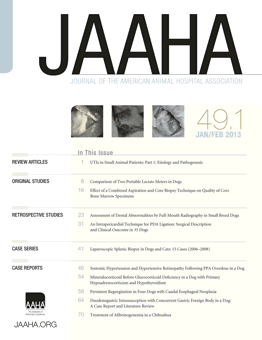
JOURNAL OF THE AMERICAN ANIMAL HOSPITAL ASSOCIATION
Scope & Guideline
Championing the future of veterinary medicine with rigorous research.
Introduction
Aims and Scopes
- Veterinary Clinical Research:
The journal emphasizes original research in various aspects of veterinary medicine, including clinical trials, laboratory studies, and epidemiological research that inform veterinary practices. - Case Reports and Clinical Studies:
It publishes detailed case reports and clinical studies that provide insights into unique veterinary cases, treatment outcomes, and advancements in surgical and medical techniques. - Guidelines and Best Practices:
The journal disseminates guidelines and recommendations for veterinary practitioners, helping to standardize care and improve treatment protocols across veterinary practices. - Emerging Veterinary Technologies:
JAAHA explores new technologies and methodologies in veterinary medicine, including advancements in diagnostics, surgical techniques, and treatment options. - Multidisciplinary Approaches:
The journal encourages interdisciplinary research that integrates various fields of veterinary medicine, enhancing the breadth of knowledge applicable to animal healthcare.
Trending and Emerging
- Oncology and Cancer Treatment:
There is an increasing focus on oncology, with numerous studies exploring novel treatment protocols and outcomes for various types of cancers in pets, reflecting the growing incidence of cancer in companion animals. - Clinical Case Management Innovations:
Emerging themes in clinical case management highlight innovative treatment strategies and collaborative care approaches, promoting better outcomes through multidisciplinary veterinary teams. - Advanced Imaging and Diagnostic Techniques:
A rise in research on advanced imaging techniques, such as MRI and CT scans, is evident, showcasing the importance of precise diagnostics in veterinary medicine. - Chronic Disease Management:
Research addressing the management of chronic diseases, such as diabetes and renal disease, is increasingly prominent, indicating a shift towards long-term care strategies for aging pet populations. - Veterinary Public Health and One Health Initiatives:
There is a growing trend towards research that intersects veterinary medicine with public health, emphasizing the importance of zoonotic diseases and the One Health approach.
Declining or Waning
- Traditional Infectious Disease Studies:
Research focused on traditional infectious diseases appears to be declining, possibly due to advancements in vaccination and preventive measures that have reduced the incidence of these diseases. - Basic Pharmacology Research:
There seems to be a waning interest in basic pharmacology studies, as the focus shifts towards clinical applications and outcomes rather than foundational pharmacokinetics and pharmacodynamics. - Longitudinal Studies of Common Conditions:
Longitudinal studies examining common conditions, such as obesity or dental disease, have become less frequent, possibly due to a shift toward more acute case studies and surgical interventions. - Conventional Diagnostic Techniques:
The prevalence of publications on conventional diagnostic techniques, such as basic blood tests and urinalysis, is decreasing as more advanced diagnostic imaging and laboratory methods gain traction. - Studies on Breed-Specific Conditions:
There is a noticeable reduction in the frequency of studies specifically targeting breed-related conditions, likely reflecting a broader focus on general veterinary practices and less on niche breed issues.
Similar Journals

CANADIAN VETERINARY JOURNAL-REVUE VETERINAIRE CANADIENNE
Pioneering research for the advancement of veterinary care.Canadian Veterinary Journal - Revue Vétérinaire Canadienne is a prominent peer-reviewed journal published by the Canadian Veterinary Medical Association. Established in 1965, this journal aims to advance knowledge within the field of veterinary medicine and contributes significantly to the development of veterinary practices through the dissemination of high-quality research. With a robust focus on both general and specialized veterinary studies, the journal holds a Q2 ranking in the Veterinary (miscellaneous) category and a Q3 categorization in Medicine (miscellaneous) as of 2023, reflecting its vital role in academic discourse. Researchers and professionals can expect a diverse range of topics that explore the intricacies of animal health and welfare, making it a vital resource for advancing veterinary science in Canada and beyond. Although the journal does not operate under an open access model, it remains a respected platform for disseminating impactful research. With a long-standing tradition of excellence, the Canadian Veterinary Journal is an invaluable tool for veterinarians, researchers, and students committed to enhancing animal health and veterinary practices.

CANADIAN JOURNAL OF VETERINARY RESEARCH-REVUE CANADIENNE DE RECHERCHE VETERINAIRE
Bridging the Gap Between Research and Practice in Veterinary MedicineCanadian Journal of Veterinary Research - Revue Canadienne de Recherche Vétérinaire is a leading publication in the veterinary science community, published by the Canadian Veterinary Medical Association. Established in 1986, the journal serves as a crucial resource for researchers and practitioners alike, covering a broad spectrum of topics pertinent to veterinary medicine and animal health. With a current impact factor placing it in Q2 in the Veterinary (miscellaneous) category, it holds a rank of #85 out of 194 in Scopus for general veterinary research, demonstrating its influence and importance within the field. While the journal is not open access, it remains committed to the dissemination of high-quality research that fosters advancements in veterinary practice and education. Based in Ottawa, Canada, it strives to connect the international community of veterinary researchers and professionals through rigorous peer-reviewed articles that advance knowledge and methodologies in veterinary science.

ACTA VETERINARIA BRNO
Pioneering Insights in Veterinary Medicine Since 1974ACTA VETERINARIA BRNO is a distinguished journal published by the Veterinární a farmaceutická univerzita Brno in the Czech Republic, focusing on innovative and scholarly research in the field of veterinary sciences. With an established history dating back to 1974, this journal has evolved to maintain its relevance in contemporary veterinary research, as evidenced by its inclusion in Scopus and a respectable Q3 rank in the miscellaneous veterinary category. Despite operating under traditional access models, ACTA VETERINARIA BRNO remains a vital resource for researchers and practitioners seeking to advance their understanding of veterinary medicine and related disciplines. With its commitment to publishing high-quality, peer-reviewed articles, the journal serves as a crucial platform for disseminating significant findings, thereby contributing to the enhancement of animal health and welfare globally.

AUSTRAL JOURNAL OF VETERINARY SCIENCES
Exploring the Frontiers of Veterinary ScienceAUSTRAL JOURNAL OF VETERINARY SCIENCES is a prominent platform for innovative research in the field of veterinary science, published by UNIV AUSTRAL CHILE, FAC CIENCIAS VETERINARIAS. This journal, bearing the ISSN 0719-8000 and E-ISSN 0719-8132, serves as a vital resource for researchers, veterinarians, and students interested in advancing their knowledge in veterinary practices and animal health. With its influence reflected in its Q3 category ranking in the Veterinary (miscellaneous) field, and its Scopus rank of #95 out of 194, the journal highlights a robust commitment to disseminating valuable findings and insights. Between the years 2017 to 2024, it aims to provide open access to significant advancements and discussions in veterinary science, ensuring that vital research is accessible to a global audience. Located in Valdivia, Chile, the journal emphasizes its role in enhancing veterinary scholarship and fostering professional development within the community.

Revista Romana de Medicina Veterinara
Exploring innovative solutions for animal health.Revista Romana de Medicina Veterinara is a leading peer-reviewed journal dedicated to the field of veterinary medicine, published by the General Association of Romanian Veterinarians. With its ISSN 1220-3173 and E-ISSN 2457-7618, the journal aims to advance the domain of veterinary science through dissemination of high-quality research articles, case studies, and reviews that cover a wide array of topics including animal health, veterinary diagnostics, and treatment methodologies. Although primarily focused on the Romanian veterinary landscape, its scope is designed to engage a global audience of researchers, practitioners, and students seeking to enhance their knowledge and practice in veterinary medicine. The journal is committed to open accessibility, ensuring that vital research is readily available to the academic community without financial barriers, thereby encouraging collaboration and innovation. By providing a platform for cutting-edge veterinary research, Revista Romana de Medicina Veterinara plays a crucial role in fostering advancements that can significantly impact animal health and welfare both locally and internationally.
Journal of the South African Veterinary Association
Pioneering Research for Animal WelfareJournal of the South African Veterinary Association is a prominent Open Access journal dedicated to advancing the field of veterinary science since its inception in 1945. Published by MEDPHARM PUBLICATIONS PTY LTD, this journal stands out with an impactful HIndex and a commendable categorization in 2023, ranking Q3 in Medicine (miscellaneous) and Q2 in Veterinary (miscellaneous). With a Scopus rank of 96 out of 194 in the veterinary field, it serves as an essential resource for researchers, veterinary professionals, and students, promoting the dissemination of high-quality research and knowledge. The journal offers a platform for peer-reviewed articles covering diverse topics relevant to veterinary and animal health issues, encouraging expansive dialogue and collaboration within the academic community. Based in Centurion, South Africa, and accessible globally since it adopted an Open Access model in 1997, the journal exemplifies a commitment to accessibility and the sharing of knowledge.

Kleintierpraxis
Transforming insights into impactful veterinary care.Kleintierpraxis is a prominent journal dedicated to the field of small animal veterinary science, published by M H SCHAPER GMBH CO KG in Germany. With an ISSN of 0023-2076, the journal aims to disseminate cutting-edge research, clinical findings, and advancements in veterinary practices affecting small animals. Although it is categorized within the Q4 quartile for Small Animals in 2023 and holds a Scopus rank of 20 out of 20, its role in providing valuable insights to practitioners, researchers, and students in veterinary medicine cannot be underestimated. The journal covers a wide range of topics pertinent to veterinary care, diagnostics, and treatment methodologies, offering an essential resource for understanding the complexities of small animal health. While currently not open access, Kleintierpraxis continues to be a vital contribution to the veterinary literature landscape from 1996 through 2024, fostering professional development and knowledge within the community.
AMERICAN JOURNAL OF VETERINARY RESEARCH
Connecting Research and Clinical Practice in Veterinary MedicineAmerican Journal of Veterinary Research, published by the American Veterinary Medical Association, serves as a cornerstone of the veterinary medical community, providing essential insights from 1945 to the present. With an ISSN of 0002-9645 and E-ISSN of 1943-5681, this esteemed journal focuses on a diverse range of topics within the veterinary field, contributing to the advancement of veterinary science through rigorous peer-reviewed research. Ranking in the Q2 category in Veterinary (miscellaneous) and Q3 in Medicine (miscellaneous) category as of 2023, it holds a respectable position in Scopus rankings, further emphasizing its impact in the field. While currently not an Open Access journal, its objective remains clear: to disseminate cutting-edge research that informs clinical practice and enhances animal health and welfare. The American Journal of Veterinary Research is invaluable for researchers, professionals, and students seeking to stay at the forefront of veterinary advancements and innovations.

Journal of Veterinary Research
Exploring the frontiers of veterinary knowledge.The Journal of Veterinary Research, published by SCIENDO, is a leading open-access journal dedicated to advancing the field of veterinary science. Established in Poland and accessible globally since 2012, this journal serves as a pivotal platform for researchers, professionals, and students, promoting the dissemination of high-quality research and innovative findings in veterinary medicine. With a robust impact factor reflective of its Q2 ranking in the Veterinary (miscellaneous) category for 2023, it ranks 54th out of 194 in the general veterinary field, placing it in the 72nd percentile among its peers. The Journal of Veterinary Research explores a wide variety of topics pertinent to veterinary practice, animal health, and research methodologies, making it an essential resource for academics and practitioners alike. Authors benefit from the journal's open-access model, which ensures their research is freely available to a broader audience, thus fostering collaboration and innovation within the veterinary community.

IRISH VETERINARY JOURNAL
Pioneering advancements in animal health and welfare.IRISH VETERINARY JOURNAL is a premier open-access publication in the field of veterinary science, established to disseminate high-quality research and innovations that advance the veterinary profession and animal health. Published by BMC since 2004, this journal not only ensures worldwide access to cutting-edge findings but also maintains an impressive ranking as Q1 in the Veterinary (miscellaneous) category according to the 2023 metrics, highlighting its significance and influence. With an impressive Scopus rank of #19/194 and a 90th percentile placement, it provides a robust platform for researchers, professionals, and students alike to engage with the latest studies, reviews, and case reports. The journal's coverage spans from its inception in 1973 to the present, catering to a diverse audience interested in various aspects of veterinary science, ensuring that it remains an essential resource for those passionate about the welfare of animals and the advancement of veterinary practices.