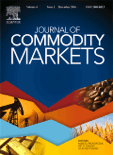
Journal of Commodity Markets
metrics 2024
Charting the Course for Informed Commodity Strategies
Introduction
The Journal of Commodity Markets, published by ELSEVIER, is a leading academic platform dedicated to the multifaceted field of commodity markets, encompassing various aspects of economics, finance, and econometrics. Established in 2016, this journal has rapidly gained recognition, reflected in its respectable impact factor and Scopus rankings, which place it in the Q2 category for both Economics and Finance, situating it among the top 20% of journals in these areas. With an accessible ISSN (2405-8513) and E-ISSN (2405-8505), the journal appeals to researchers, professionals, and students alike, providing a rich resource for understanding the dynamics of commodity trading, market analysis, and economic implications. Although it does not currently offer open access, its rigorous peer-review process ensures high-quality publications that contribute significantly to the discourse in commodity market studies. Housed in the Netherlands, the journal uniquely positions itself to influence and reflect on global commodity market trends up to the present year, 2024.
Metrics 2024
 0.803.703.7026
Metrics History
Rank 2024
Scopus
IF (Web Of Science)
JCI (Web Of Science)
Quartile History
Similar Journals
Journal of Empirical Finance
Exploring the empirical foundations of global economies.Journal of Empirical Finance, published by Elsevier, stands as a key resource in the areas of finance and economics, with a definitive focus on empirical studies. As a prominent journal since its inception in 1993, it has made significant strides in contributing to the academic community, evidenced by its soaring categorization in Q1 for Finance and Q2 for Economics and Econometrics as of 2023. With an ISSN of 0927-5398 and an E-ISSN of 1879-1727, the journal emphasizes robust, data-driven analysis to inform both theoretical and practical aspects of financial research. While access options do not include open access, the journal ensures that its content remains accessible to a diverse audience of researchers, professionals, and students. It fosters a platform for innovative research and discourse, significantly impacting the fields of finance, economics, and econometrics. The Scopus rankings further bolster its reputation, placing it in the 61st percentile in both categories, reflecting a commitment to high-quality research output. As the journal continues to evolve, it invites contributions that push the boundaries of empirical finance, enabling a deeper understanding of financial mechanisms that drive global economies.
Review of Asset Pricing Studies
Advancing Asset Pricing KnowledgeThe Review of Asset Pricing Studies, published by Oxford University Press, stands as a leading journal in the fields of Economics and Finance, recognized for its rigorous analyses and innovative research since its inception in 2011. This esteemed publication maintains an impressive impact factor and ranks in the Q1 category for both Economics and Finance as of 2023, consistently occupying top positions in Scopus rankings across its relevant categories. With a clear focus on advancing knowledge in asset pricing and investment strategies, the journal serves as a vital platform for researchers, professionals, and students seeking to contribute to and stay informed on the latest developments in these dynamic fields. Despite its lack of open access, the journal ensures wide circulation and accessibility through its reputable publisher, thereby fostering an engaged academic community.
Journal of Behavioral Finance
Unraveling Behavioral Insights in FinanceThe Journal of Behavioral Finance is a pivotal publication examining the intersection of psychology and finance, offering insights into the behavioral aspects that influence financial decision-making. Published by Routledge Journals, Taylor & Francis Ltd in the United Kingdom, this journal provides a platform for researchers and practitioners to engage with cutting-edge research that covers diverse topics such as investor behavior, market dynamics, and emotional finance. With an ISSN of 1542-7560 and an E-ISSN of 1542-7579, the journal has established itself with an impressive standing, achieving a Q2 ranking in Finance and a Q3 ranking in Experimental and Cognitive Psychology according to the 2023 category quartiles. Furthermore, it ranks in the top 74th and 73rd percentiles in their respective fields within Scopus. The Journal of Behavioral Finance not only disseminates scholarly research but also fosters critical discourse, essential for academics, industry professionals, and students seeking to deepen their understanding of behavioral finance dynamics.
FINANCIAL MANAGEMENT
Leading the Way in Financial Management ExcellenceFINANCIAL MANAGEMENT is a premier academic journal published by Wiley, focusing on the intricate domains of Accounting, Economics, and Finance. With an ISSN of 0046-3892 and an E-ISSN of 1755-053X, this esteemed journal has made significant contributions to the global discourse on financial practices and theories since its establishment in 1996. Situated within the top tier (Q1) in its respective fields, FINANCIAL MANAGEMENT ranks impressively in Scopus, positioned at 30 out of 176 in Accounting and 57 out of 317 in Finance, reflecting its high impact and relevance in the scholarly community. The journal is known for its rigorous peer-review process and publishes cutting-edge research aimed at advancing knowledge and practice in financial management. Although it does not offer Open Access, it remains accessible through institutional subscriptions, ensuring that researchers, professionals, and students remain at the forefront of developments in financial management. With a commitment to excellence, FINANCIAL MANAGEMENT continues to be an indispensable resource for those seeking to deepen their understanding of this critical field.
Journal of Risk Finance
Pioneering research for a secure financial future.The Journal of Risk Finance, published by Emerald Group Publishing Ltd, is a premier academic journal dedicated to advancing the understanding of risk management and finance practices since its inception in 1999. With a strong foothold within the Q2 rankings in both Accounting and Finance categories, it proudly holds a significant place in the scholarly landscape, ranking #54 out of 317 in the Scopus Economics and Finance category, placing it in the 83rd percentile. The journal aims to facilitate the exchange of innovative research and practical insights, catering to an audience of researchers, professionals, and students eager to explore contemporary issues in risk finance. While not an open access journal, it provides numerous access options, ensuring that essential findings reach a broad readership. Set in the United Kingdom and covering publications up to 2024, the Journal of Risk Finance continues to be an indispensable resource for those committed to this critical field.

Quantitative Finance and Economics
Bridging Theory and Practice in Finance and EconomicsQuantitative Finance and Economics, published by the American Institute of Mathematical Sciences (AIMS), is a pioneering open-access journal committed to advancing the fields of finance and economics. Established to disseminate high-quality research, this journal has been an open-access platform since 2017, promoting wider accessibility to vital academic findings. It serves as a crucial resource for researchers and professionals alike, offering valuable insights through rigorous studies in quantitative methods that influence financial and economic decision-making. Although current Scopus rankings indicate emerging challenges, with a rank in the lower percentiles across various categories, Quantitative Finance and Economics strives to gain recognition by bridging theoretical frameworks with practical applications. The journal invites contributions that explore innovative quantitative techniques and their implications in contemporary economic scenarios, thus underscoring its role in shaping discourse and research in this critical sector.

Journal of Energy Markets
Innovating Methodologies for Energy Market AnalysisJournal of Energy Markets, published by Incisive Media, is a vital platform dedicated to advancing the understanding of energy market dynamics, with an ISSN of 1756-3607 and an E-ISSN of 1756-3615. Established in the United Kingdom, the journal explores the intersection of economics, energy, and strategic management, serving as a key resource for researchers, professionals, and students alike. While the journal is currently categorized in the Q4 quartile across relevant fields such as Economics and Econometrics, it aims to stimulate scholarly dialogue, enhance empirical research, and present innovative methodologies in the rapidly evolving energy sector. Despite its nascent impact factor in 2023, the Journal of Energy Markets remains committed to publishing high-quality articles that address critical issues and trends affecting the global energy landscape. The journal is essential for those looking to deepen their knowledge and contribute to ongoing debates within this important field.
Global Finance Journal
Advancing knowledge in global finance.Global Finance Journal is an esteemed periodical published by Elsevier, dedicated to the dynamic fields of finance and economics. With an impressive history spanning from 1989 to 2024, this journal holds a significant position in the academic community, boasting a Q1 quartile ranking in both Economics and Econometrics, as well as Finance, as of 2023. It is highly regarded in Scopus rankings, placing 40th out of 317 in Finance and 99th out of 716 in Economics and Econometrics, demonstrating its influence and reach among researchers and practitioners alike. Although not an open-access journal, the Global Finance Journal provides rigorous peer-reviewed articles that explore critical issues, advance theoretical frameworks, and address practical applications in global finance. As such, it serves as a vital resource for researchers, financial professionals, and students aiming to deepen their understanding of economic phenomena and contribute to the ongoing discourse in these vibrant disciplines.
Journal of International Financial Markets Institutions & Money
Exploring the Nexus of Finance and InstitutionsThe Journal of International Financial Markets, Institutions & Money, published by Elsevier, serves as a leading platform for the dissemination of high-quality research in the fields of finance, economics, and econometrics. With an impressive impact factor reflected in its status as a Q1 journal in both categories for 2023, it ranks among the top journals, positioned at #47 out of 317 in Finance and #111 out of 716 in Economics. This journal offers a unique focus on the interplay between financial markets and institutions on a global scale, making it an essential resource for scholars, practitioners, and students alike. The journal welcomes innovative theoretical, empirical, and applied research, contributing to an exciting dialogue that shapes the future of international finance. For researchers looking to publish their findings, this journal is committed to rigorously engaging with contemporary financial phenomena, positioning itself as a vital cornerstone of academic and professional discourse.
Financial Markets and Portfolio Management
Empowering Insights for Financial Innovators.Financial Markets and Portfolio Management is a renowned peer-reviewed journal published by Springer, focusing on the dynamic and evolving intersections of finance, economics, and accounting. With an ISSN of 1934-4554 and an e-ISSN of 2373-8529, the journal provides a platform for innovative research on financial markets, investment strategies, and portfolio management techniques. It boasts an impactful presence in the academic community, with a Scopus ranking placing it in the 58th percentile in Finance and the 51st percentile in Accounting, underscoring its significance in both fields. Spanning coverage from 2006 to 2024, the journal offers essential insights for researchers, practitioners, and students interested in the latest developments and empirical analyses in financial practices. Although it does not offer open access options, its rigorous editorial standards ensure high-quality content accessible to library and institutional resources. The journal plays a pivotal role in advancing knowledge and fostering dialogue in an increasingly complex financial landscape.