
Journal of Dynamical Systems and Geometric Theories
Scope & Guideline
Transforming Knowledge in Dynamical Systems
Introduction
Aims and Scopes
- Dynamical Systems Theory:
The journal emphasizes research in dynamical systems, including stability analysis, bifurcation theory, and chaos theory, providing insights into the behavior of complex systems over time. - Geometric Analysis and Differential Geometry:
A core area of focus is the application of geometric principles to analyze and solve problems in differential geometry, including the study of curvature, manifold structures, and geometric flows. - Mathematical Modelling:
The journal publishes papers that develop mathematical models to describe real-world phenomena, particularly in physics, engineering, and biology, linking abstract theories with practical applications. - Cosmological Models and Theoretical Physics:
Research on cosmological models, especially in the context of general relativity and modified theories of gravity, is highlighted, contributing to the understanding of the universe's structure and dynamics. - Graph Theory and Topological Spaces:
The exploration of graph theory and its applications in various mathematical contexts, including topological spaces, forms a significant part of the journal's contributions.
Trending and Emerging
- Modified Gravity Theories:
There is a notable increase in research related to modified gravity theories, particularly f(R,T) gravity, reflecting a growing interest in alternative theories to explain cosmic phenomena. - Nonlinear Dynamics and Chaos:
Emerging themes in nonlinear dynamics and chaos theory are prevalent, showcasing a trend towards understanding complex systems and their unpredictable behaviors in various mathematical contexts. - Applications of Differential Geometry:
The application of differential geometry in diverse fields, including cosmology and fluid dynamics, has gained traction, indicating a trend towards interdisciplinary approaches that leverage geometric insights. - Mathematical Models in Cosmology:
The journal is witnessing a surge in contributions focusing on mathematical models that describe cosmological phenomena, reflecting the integration of theoretical physics with advanced mathematical techniques. - Advanced Computational Techniques:
There is an increasing trend towards the use of advanced computational techniques in solving differential equations and modeling, highlighting the journal's adaptation to modern computational methods.
Declining or Waning
- Classical Mechanics and Traditional Physics:
Research related to classical mechanics and traditional physics theories has diminished, possibly due to the increasing focus on more modern and complex systems in dynamical studies. - Elementary Number Theory:
Papers focusing on elementary number theory, such as those investigating basic properties of numbers, have become less frequent, suggesting a shift towards more applied and complex mathematical theories. - Basic Fixed Point Theory:
Although fixed point theorems remain important, the specific focus on basic fixed point theory in abstract spaces has waned, with more emphasis being placed on advanced applications and generalizations. - Basic Theorems in Graph Theory:
While graph theory remains relevant, fundamental theorems and studies within basic graph theory have seen a decline as researchers move towards more sophisticated applications within the field.
Similar Journals
INDIAN JOURNAL OF PURE & APPLIED MATHEMATICS
Elevating Research Standards in MathematicsINDIAN JOURNAL OF PURE & APPLIED MATHEMATICS, published by the INDIAN NATIONAL SCIENCE ACADEMY, stands as a vital resource in the realm of pure and applied mathematics since its inception in 1996. With ISSN 0019-5588 and E-ISSN 0975-7465, this journal aims to disseminate original research that advances the understanding and application of mathematical principles. Operating out of New Delhi, India, it serves a diverse readership comprising researchers, scholars, and practitioners in the mathematical sciences. Recognized within the Q3 category in both Applied Mathematics and Miscellaneous Mathematics as per the 2023 category quartiles, the journal emphasizes rigorous peer-reviewed articles that contribute to its impact in academia, reflected in its Scopus rankings. Although it does not currently operate as an open-access journal, it maintains a commitment to quality and accessibility of scholarly content, striving to foster academic collaboration and innovation. The convergence of full-text issues from 1996 to 2024 highlights its ongoing dedication to the evolution of mathematical research.
MICHIGAN MATHEMATICAL JOURNAL
Elevating Scholarship through Innovative Mathematical DiscoveriesThe MICHIGAN MATHEMATICAL JOURNAL is a prestigious and influential publication in the field of mathematics, founded by the University of Michigan. With an ISSN of 0026-2285 and an E-ISSN of 1945-2365, this journal is recognized for its high-quality research and has achieved a commendable Q1 ranking in the category of Mathematics (miscellaneous) as of 2023. Published by the esteemed Michigan Mathematical Journal, it provides a platform for the dissemination of innovative mathematical theories and findings, playing a crucial role in advancing knowledge and scholarship within the mathematical community. With coverage spanning from 1996 to 2024, the journal emphasizes rigorous theoretical development and fosters collaboration among researchers, professionals, and students alike. While not an open-access journal, its contributions are invaluable for those looking to stay abreast of cutting-edge mathematical research.
Journal of Topology and Analysis
Advancing the Frontiers of Topology and AnalysisJournal of Topology and Analysis, published by WORLD SCIENTIFIC PUBL CO PTE LTD, is a distinguished peer-reviewed journal that focuses on advanced topics in mathematics, specifically within the fields of topology and analysis. Established in 2009 and running through 2024, the journal is based in Singapore and strives to present cutting-edge research that contributes to the mathematical community's understanding of geometric structures and analytical theories. Holding a respected position with a Q2 ranking in Analysis and a Q3 ranking in Geometry and Topology according to the 2023 category quartiles, the journal is indexed in Scopus, where it ranks #49 in Geometry and Topology and #118 in Analysis, showcasing its significance in the scholarly landscape. The Journal of Topology and Analysis aims to foster interdisciplinary collaboration by providing a platform for researchers, professionals, and students to share innovative findings and insights. Although it does not currently offer open access, its contributions are vital for advancing knowledge in these mathematical domains.
Kodai Mathematical Journal
Nurturing Insights in Diverse Mathematical RealmsKodai Mathematical Journal is a distinguished publication dedicated to advancing the field of mathematics, particularly in miscellaneous areas. Established in 1949, this esteemed journal has been a reputable source for researchers and practitioners who seek to contribute to the rich landscape of mathematical knowledge. Published by KINOKUNIYA CO LTD, the journal is based in the academic environment of Tokyo Institute of Technology and serves a global audience with rigorous and insightful research articles. Despite its current Q3 quartile ranking in the Scopus Mathematics category, which reflects its niche but impactful contributions, the journal is poised for growth; the convergence of traditional and novel mathematical techniques promises to enhance its relevance further. Researchers, professionals, and students are encouraged to engage with the rich content of the journal, aimed at fostering collaboration and nurturing innovation in the mathematical community. While currently not available as Open Access, Kodai Mathematical Journal remains a critical resource for those passionate about mathematics and its applications.
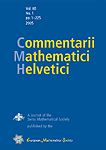
COMMENTARII MATHEMATICI HELVETICI
Empowering Scholars through Accessible Mathematical ResearchCOMMENTARII MATHEMATICI HELVETICI, published by the EUROPEAN MATHEMATICAL SOCIETY, is a premier open-access journal in the field of mathematics, specifically categorized within the Q1 quartile of miscellaneous mathematics as of 2023. With an ISSN of 0010-2571 and an E-ISSN of 1420-8946, this esteemed journal has a rich history, having commenced its publication journey in 1929 and set to continue until at least 2024. Based in Germany, it provides a valuable platform for original research and significant advancement in mathematical theory and application, appealing to researchers, professionals, and students alike. The journal's commitment to open access since 2022 further enhances its accessibility and outreach, ensuring that cutting-edge mathematical developments are readily available to a global audience. Its Scopus ranking, which places it at the 165th position out of 399 in the general mathematics category (58th percentile), exemplifies its impact and relevance in the academic community.

Archivum Mathematicum
Unveiling the Depths of Mathematical ScienceArchivum Mathematicum is an open-access journal dedicated to the broad spectrum of Mathematics, published by Masaryk University, Faculty of Science in the Czech Republic. Since its inception in 1965, this journal has provided a platform for the dissemination of research and advancements within the mathematical sciences. It spans converged years from 2004 to 2024, ensuring ongoing relevance in a rapidly evolving discipline. Currently categorized in Q4 for 'Mathematics (miscellaneous)' and ranked #316/399 in general mathematics by Scopus, the journal aims to foster a collaborative environment for researchers, practitioners, and students alike, encouraging submissions that contribute to mathematical theory, applications, and education. With its commitment to open access, Archivum Mathematicum is a vital resource for anyone seeking to stay informed about emerging trends and findings in the field.
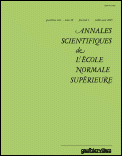
ANNALES SCIENTIFIQUES DE L ECOLE NORMALE SUPERIEURE
Advancing Mathematical Frontiers with ExcellenceANNALES SCIENTIFIQUES DE L ECOLE NORMALE SUPERIEURE is a distinguished journal published by the Société Mathématique de France, dedicated to advancing the field of mathematics through high-quality research articles. With a robust impact factor and categorized as Q1 in Mathematics (Miscellaneous) as of 2023, this journal ranks in the top 16% of mathematics publications, showcasing its importance and influence in the discipline. Available in both print (ISSN: 0012-9593) and electronic formats (E-ISSN: 1873-2151), ANNALES SCIENTIFIQUES serves as a central hub for innovative mathematical theories and methodologies, appealing to a diverse audience of researchers, professionals, and students alike. The journal publishes research that spans various domains within mathematics, fostering a collaborative environment for idea exchange. As it converges from 1997 to 2024, it continues to shape the mathematical landscape, providing essential insights and developments within the global academic community. Located in Paris, France, the journal invites contributions that push boundaries and advance the understanding of complex mathematical concepts.

ANNALES DE L INSTITUT FOURIER
Connecting Scholars Through Cutting-Edge MathematicsANNALES DE L INSTITUT FOURIER is a premier academic journal published by ANNALES INST FOURIER, specializing in the fields of Algebra and Number Theory as well as Geometry and Topology. Since its establishment, the journal has garnered a distinguished reputation, evidenced by its Q1 quartile ranking in the 2023 category assessments and its Scopus Rank of #37 out of 119 in Algebra and Number Theory, and #34 out of 106 in Geometry and Topology, placing it within the top percentile of its field. The journal serves as a vital platform for disseminating groundbreaking research and innovative methodologies, catering to a global audience of researchers, professionals, and students. With a commitment to the advancement of mathematical sciences, ANNALES DE L INSTITUT FOURIER invites contributions that push the boundaries of knowledge and foster collaboration across disciplines. Although it does not offer open access, the rigorous peer-review process ensures that published papers meet the highest academic standards, making it a critical resource for anyone engaged in advanced mathematical research.

JOURNAL OF DIFFERENTIAL GEOMETRY
Charting new territories in the world of mathematics.JOURNAL OF DIFFERENTIAL GEOMETRY, a premier publication by INT PRESS BOSTON, INC, has established itself as a leading forum for the dissemination of high-quality research in the fields of differential geometry, algebra, and analysis. With an impressive history that spans from 1967 to 2024, this journal is recognized for its rigorous peer-reviewed articles, contributing significantly to the advancement of mathematical theories and innovative approaches. Notably, the journal boasts a Q1 ranking in key categories such as Algebra and Number Theory, Geometry and Topology, and Analysis, reflecting its pivotal role within the mathematics community. Its Scopus rankings reinforce its reputation, placing it among the top-tier journals in its respective fields, with a 97th percentile ranking in Algebra and Number Theory, further emphasizing its influence. While the journal does not offer Open Access options, it remains a critical resource for researchers, professionals, and students aiming to stay at the forefront of developments in differential geometry and related domains. Engage with groundbreaking research and explore new methodologies that are shaping the future of mathematics.

Pure and Applied Mathematics Quarterly
Elevating Research in Pure and Applied MathematicsPure and Applied Mathematics Quarterly is a prestigious journal published by INT PRESS BOSTON, INC, focusing on the diverse and evolving field of mathematics. Since its inception in 2007, this journal has grown significantly, currently holding a Q1 ranking in the Mathematics (Miscellaneous) category for 2023, positioning it among the leading publications in the discipline. With a commitment to publishing high-quality research, Pure and Applied Mathematics Quarterly fosters innovation and dialogue within the mathematical community by providing a platform for theoretical advancements and practical applications. The journal remains accessible to researchers and professionals through its ISSN 1558-8599 and E-ISSN 1558-8602, although it does not currently offer open access. As a vital resource for mathematicians, educators, and students, this journal endeavors to expand the frontiers of mathematical knowledge and contribute to the academic dialogue surrounding this fundamental science.