JOURNAL OF ECONOMIC HISTORY
metrics 2024
Illuminating Historical Economic Dynamics
Introduction
JOURNAL OF ECONOMIC HISTORY, published by Cambridge University Press, is a renowned academic platform dedicated to the exploration and analysis of economic history from its inception in 1941 through the forthcoming decades. With its ISSN 0022-0507 and e-ISSN 1471-6372, this journal occupies a prestigious place in the field, as evidenced by its impressive Q1 rankings in both Economics and Econometrics and History categories for 2023. It is positioned among the top tier of journals, ranking #42 out of 1760 in the Arts and Humanities (History) and #75 out of 242 in Economics, Econometrics, and Finance (Miscellaneous) according to Scopus metrics. The journal's rigorous peer-reviewed articles aim to bridge theoretical frameworks with empirical research, fostering an understanding of historical economic dynamics and their relevance in contemporary society. Although the journal does not offer open access, it continues to serve as an essential resource for researchers, professionals, and students aiming to deepen their knowledge and contribute to critical discussions within the fields of economics and history. The journal publishes diverse articles that engage critically with both primary and secondary sources, ensuring that its contributions remain impactful and influential within the academic community.
Metrics 2024
 1.982.503.1070
Metrics History
Rank 2024
Scopus
IF (Web Of Science)
JCI (Web Of Science)
Quartile History
Similar Journals

Asia-Pacific Economic History Review
Advancing Knowledge at the Intersection of History and EconomicsAsia-Pacific Economic History Review is a distinguished journal published by WILEY, focusing on the rich and dynamic intersection of economic and historical perspectives within the Asia-Pacific region. With the ISSN 2832-157X, this peer-reviewed journal stands out for its commitment to open access, ensuring that groundbreaking research is readily available to academics and practitioners alike. As a newly established platform from 2023 to 2024, it has rapidly garnered attention, earning a Q1 classification in History and Q3 in Economics and Econometrics for 2023, reflecting its dual significance in both fields. The journal's ranking within the Scopus database showcases its rising impact, particularly within the top percentile for Arts and Humanities in History. Scholars are encouraged to contribute to this high-quality, interdisciplinary forum that explores the economic histories of the Asia-Pacific region, providing valuable insights and fostering discourse among researchers, professionals, and students passionate about this vital area of study.
Cliometrica
Exploring the Intersections of History and EconometricsCliometrica, published by Springer Heidelberg, is a prestigious journal that has made significant contributions to the fields of Economics and Econometrics as well as History. With an impressive 2023 Scopus ranking placing it in the Q2 category for Economics and Econometrics and the Q1 category for History, this journal stands out as an essential resource for researchers, professionals, and students alike. Known for its rigorous scholarly approach, Cliometrica merges quantitative and qualitative methodologies to uncover insights into historical economic analysis, reflecting the interdisciplinary nature of contemporary research. With access strictly through subscription, it continues to uphold high academic standards, making it a vital addition to any academic library. Published in Germany, Cliometrica serves as a key platform for advancing the discussion and understanding of historical econometric techniques, ensuring its relevance and importance in both historical and economic research circles.
Journal of the Economic and Social History of the Orient
Unveiling the Past: Insights into Economic and Social TransformationsThe Journal of the Economic and Social History of the Orient, published by BRILL, serves as an essential platform for researchers, historians, and social scientists interested in the economic and social dynamics of the Orient. Since its inception in 1957, this journal has contributed significantly to the understanding of historical economic structures and societal transformations, offering insights that engage a wide academic audience. With an ISSN of 0022-4995 and an E-ISSN of 1568-5209, the journal maintains a reputation for quality scholarship, as reflected in its Q2 ranking in History and notable standings in the fields of Sociology and Economics. Although it is not an open-access journal, it ensures accessibility to vital research through institutional subscriptions. By exploring diverse topics within the realms of economics, sociology, and history, the journal plays a crucial role in fostering academic discourse and enhancing knowledge regarding the complex historical narratives of the Orient.

Journal of Belgian History-Revue Belge d Histoire Contemporaine-Belgisch Tijdschrift voor Nieuwste Geschiedenis
Exploring the Depths of Belgium's PastThe Journal of Belgian History-Revue Belge d'Histoire Contemporaine-Belgisch Tijdschrift voor Nieuwste Geschiedenis is a prominent academic publication dedicated to the exploration and analysis of contemporary Belgian history. Published by SOMA-CEGES, this journal serves as a vital resource for researchers, professionals, and students alike, providing a platform for scholarly discourse and the dissemination of innovative research in the field. Despite its historical significance, the journal faced a hiatus in its Scopus coverage from 2019, yet it retains a strong identity within the Arts and Humanities category, holding a Scopus rank of #1123 out of 1328, placing it in the 15th percentile. This underscores the opportunities for growth and impactful contributions within the journal's scope. By focusing on the intricacies of Belgian history, the journal encourages rigorous investigation and a deeper understanding of Belgium's past, making it an essential reference for anyone interested in European historical narratives.

History of Economic Thought and Policy
Exploring the Past to Shape Tomorrow's Economic PoliciesHistory of Economic Thought and Policy is a vital journal published by FRANCO ANGELI, dedicated to exploring the intersections of economic theory, historical context, and public policy. With ISSN 2240-9971 and E-ISSN 2280-188X, this journal serves as an essential platform for scholars interested in the evolution of economic ideas and their implications for contemporary policy-making. Operating from Italy, it has established a comprehensive framework for interdisciplinary research in the fields of Economics and Econometrics, History, and Public Administration, although it currently holds a Q4 ranking in these categories according to 2023 metrics. The journal already encompasses multiple converging years from 2018 to 2024, underscoring its commitment to timely contributions to economic discourse. It aims to provide open access to its content, fostering a collaborative environment for researchers, professionals, and students keen on enhancing their understanding of economic thought throughout history. Despite its current challenges in Scopus rankings, with notable positions in arts, humanities, and social sciences, History of Economic Thought and Policy remains a promising outlet for significant and critical discussions surrounding the historical pathways that shape today’s economic policies.
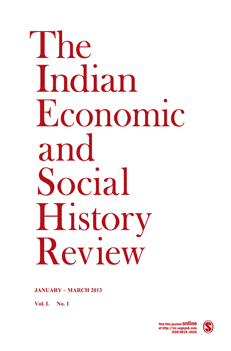
INDIAN ECONOMIC AND SOCIAL HISTORY REVIEW
Advancing Insights into India's Rich Economic and Social HeritageINDIAN ECONOMIC AND SOCIAL HISTORY REVIEW, published by SAGE PUBLICATIONS INDIA PVT LTD, stands as a pivotal platform in the fields of economics, history, and social sciences. With an ISSN of 0019-4646 and E-ISSN 0973-0893, this journal has been documenting the evolution of India's socioeconomic landscape since its inception in 1963 and will continue to do so until 2024. Despite its current Q4 ranking in Economics and Econometrics, the journal proudly holds a Q3 ranking in History, emphasizing its enriched content that appeals to a diverse audience of scholars and practitioners. Although not an open-access publication, it provides valuable, peer-reviewed research that contributes significantly to the academic discourse. With its Scopus rankings indicating a respectable 80th percentile in History, the journal is a key resource for understanding the nuanced interplay of economic and social factors throughout India's history. Researchers, students, and professionals alike will find this journal an essential reference point for advancing their understanding of historical economic trends and social dynamics.
VSWG-Vierteljahrschrift fur Sozial-und Wirtschaftsgeschichte
Illuminating the Complexities of Socio-Economic ChangeVSWG - Vierteljahrschrift für Sozial- und Wirtschaftsgeschichte is a distinguished academic journal published by Franz Steiner Verlag GmbH in Germany, focusing on the interdisciplinary fields of social and economic history. With an ISSN and E-ISSN of 0340-8728, this journal serves as a vital resource for scholars, researchers, and students interested in the complexities of socio-economic transformations across historical contexts. While it currently does not offer open access, its contributions are significant in raising critical discussions within cultural studies and economic history, as evidenced by its Q3 and Q4 rankings in various categories, including Cultural Studies and Sociology. Although the Scopus rankings reflect competitive standings, the journal continues to provide meaningful discourse and insights, supporting academic endeavors in an increasingly interconnected world.
TRIMESTRE ECONOMICO
Illuminating Economic Trends Through Rigorous Research.TRIMESTRE ECONOMICO, published by FONDO CULTURA ECONOMICA, is a prominent open access journal in the field of Economics and Econometrics based in Mexico. Since its inception in 1979, this journal has served as a critical platform for disseminating scholarly research and theoretical advancements within economic sciences, addressing both contemporary issues and historical perspectives. With an impact factor that ranks it within the Q3 category among 716 journals in its field, TRIMESTRE ECONOMICO continues to contribute significantly to the academic community, providing readers with insights into economic modeling, policy analysis, and empirical research. The journal has embraced open access since 2011, fostering a broad reach and encouraging innovation and collaboration among researchers, professionals, and students. It is essential reading for those seeking to deepen their understanding of economic trends and theories, making valuable contributions to both local and global discussions.

Lietuvos istorijos studijos
Connecting Global Narratives with Lithuanian HistoryLietuvos istorijos studijos is a prominent open access journal devoted to the multifaceted exploration of Lithuanian history and its broader implications in the context of global historical narratives. Published by Vilnius University Press, this journal has been fostering scholarly communication in its field since 2013, making a significant contribution to the advancement of historical research in Lithuania. With a focus on innovative historical methodologies and interdisciplinary approaches, Lietuvos istorijos studijos serves as a crucial platform for researchers, professionals, and students who are keen to engage with both primary and secondary sources pertaining to the diverse tapestry of Lithuanian heritage. The journal operates under the ISSN 1392-0448 and E-ISSN 1648-9101 and has been classified in the Q4 category in History for 2023, indicating a growing interest and engagement within the academic community. The ongoing convergence of historical studies from 2022 through 2024 further highlights its commitment to evolving research trends. Interested readers can access the journal freely, making it a vital resource for anyone seeking to deepen their understanding of Lithuania's historical landscape.
Journal of Institutional Economics
Unraveling the Impact of Institutions on Economic SystemsJournal of Institutional Economics, published by Cambridge University Press, stands as a premier forum for the dissemination of research at the intersection of economics, institutions, and governance. With an ISSN of 1744-1374 and E-ISSN 1744-1382, this journal has established itself as a vital resource within the academic community, achieving an impressive Q1 ranking in the field of Economics, Econometrics and Finance as of 2023. The journal's focus on institutional analysis not only enhances our understanding of economic phenomena but also fosters interdisciplinary dialogue among scholars and practitioners alike. With a commendable rank of 39 out of 288 in Scopus rankings, placing it in the 86th percentile, the Journal of Institutional Economics provides access to groundbreaking research that holds significant implications for policy and decision-making. Researchers, professionals, and students engaged in the study of economic systems will find this journal an invaluable addition to their academic resources.