
Journal of European Real Estate Research
Scope & Guideline
Advancing Insights in European Real Estate.
Introduction
Aims and Scopes
- Real Estate Market Dynamics:
The journal explores the complexities of real estate markets, including price dynamics, market responses, and the effects of external factors such as economic changes, policy interventions, and social trends. - Sustainability and ESG Factors:
A significant focus is placed on environmental, social, and governance (ESG) issues, investigating how sustainability impacts real estate investment, valuation, and management practices. - Technological Innovations in Real Estate:
The journal emphasizes the role of technology, particularly PropTech and FinTech, in transforming the real estate landscape, including property management, valuation, and investment strategies. - Behavioral Insights in Real Estate:
Research often delves into the behavioral aspects of real estate, studying how perceptions, preferences, and social dynamics influence market behaviors and decision-making. - Comparative Analysis Across European Markets:
The journal encourages comparative studies that highlight differences and similarities in real estate markets across various European countries, contributing to a broader understanding of regional dynamics.
Trending and Emerging
- Impact of Technology on Real Estate Practices:
There is a burgeoning interest in how technology, including blockchain and property management software, is reshaping real estate practices, enhancing efficiency, and creating new opportunities. - Sustainability and Environmental Considerations:
Research on sustainability, particularly regarding ESG dynamics and the financial implications for real estate investment trusts (REITs), is on the rise, reflecting an increasing awareness of environmental issues in real estate. - Behavioral Economics in Real Estate Decision-Making:
Emerging studies are focusing on behavioral economics and its impact on real estate market behaviors, revealing insights into consumer preferences and decision-making processes. - Adaptation to Economic Shifts and Crises:
The journal is increasingly publishing work that examines how real estate markets adapt to economic shifts, including the effects of the COVID-19 pandemic and geopolitical events, showcasing the resilience and evolution of these markets. - Changing Demographics and Housing Needs:
There is a growing focus on demographic changes, such as the needs for student housing and the impact of international migration on housing markets, indicating a shift towards understanding diverse housing demands.
Declining or Waning
- Traditional Valuation Methods:
There has been a noticeable reduction in publications focusing on traditional real estate valuation methods, possibly due to the rising interest in innovative valuation techniques and the impact of technology on this area. - Historical Market Analyses:
Research centered on historical analyses of real estate markets appears to be declining, as contemporary and forward-looking studies gain more attention in light of rapid market changes and emerging trends. - Local Market Studies:
While local market studies were once prevalent, there seems to be a shift towards more comparative and cross-national analyses, indicating a waning interest in isolated case studies. - Regulatory Frameworks:
The focus on regulatory frameworks and policies governing real estate markets has diminished, likely overshadowed by the more pressing concerns around sustainability, technology, and market dynamics. - Macro-Economic Impacts on Real Estate:
Research exploring macro-economic factors in isolation has decreased, as there is a growing preference for integrated approaches that consider multiple dimensions affecting real estate.
Similar Journals

EKONOMICKY CASOPIS
Illuminating the Path of Economic UnderstandingEKONOMICKY CASOPIS is a distinguished journal published by the Institute of Economics Research SAS and the Institute of Forecasting CSPS SAS, offering a comprehensive platform for the dissemination of innovative research in the field of economics and econometrics. Since its inception in 1978, the journal has been committed to fostering scholarly discourse, showcasing empirical studies, theoretical advancements, and policy analyses that contribute to the understanding of economic phenomena. Although categorized in the Q4 quartile in 2023 and ranking in the lower percentiles within Scopus, EKONOMICKY CASOPIS remains a critical resource for researchers and practitioners seeking to engage with the economic challenges of our time. As the journal continues to evolve through 2024, it invites contributions that align with its objectives of enhancing economic insights and promoting academic discussion in Slovakia and beyond. For researchers looking to publish their work or expand their knowledge, EKONOMICKY CASOPIS serves as a vital resource in the expanding landscape of economic research.
INTERNATIONAL JOURNAL OF FINANCE & ECONOMICS
Catalyzing Research in Global Financial LandscapesInternational Journal of Finance & Economics, published by Wiley, is a premier academic journal that serves as a vital resource for researchers and professionals in the fields of finance, accounting, and economics. With an impressive impact factor and a reputation for excellence, the journal is recognized in the 2023 Scopus rankings, placing in the top quartiles across multiple categories, including Q2 in Accounting, Economics, and Finance. The journal has been a significant contributor to academic discourse since its inception in 1996, with its converged years extending to 2024, thereby ensuring the continuous advancement of knowledge in these critical areas. Although it operates under a traditional subscription model, its comprehensive articles provide insightful analyses, empirical research, and theoretical advancements that cater to a diverse audience—from seasoned scholars to emerging students in the field.

Journal of Structured Finance
Catalyzing Research in Structured Financial SolutionsThe Journal of Structured Finance, published by PAGEANT MEDIA LTD, is a pivotal resource for professionals and academics engaged in the finance sector. With its ISSN 1551-9783 and E-ISSN 2374-1325, this journal explores cutting-edge concepts in structured finance, offering insights into risk management, financial derivatives, and innovative financing strategies. As of 2023, it proudly holds a Q3 ranking in the finance category, with a Scopus rank of #280 out of 317, contributing valuable perspectives in a competitive field. Operating from the United States and serving a global audience, the journal encourages research that bridges theoretical foundations and practical applications, enhancing the understanding of complex financial instruments. With no Open Access options currently available, readers can access this valuable content through institutional subscriptions or individual purchases, reaffirming its relevance and importance for researchers, professionals, and students alike who seek to navigate the dynamic world of finance.
FINANCE AND STOCHASTICS
Advancing the Frontiers of Financial MathematicsFinance and Stochastics is a leading academic journal published by Springer Heidelberg, focusing on the intricate interplay of finance, probability, and statistics. With an impressive impact factor and ranked within the Q1 category in both finance and statistics, it serves as an essential resource for researchers and professionals seeking to advance their understanding of stochastic modeling in financial contexts. The journal has maintained a strong reputation since its inception, with contributions from renowned scholars worldwide. The editorial team prioritizes high-quality research that addresses contemporary challenges in financial mathematics and extends the boundaries of statistical methods. Nestled in the heart of Germany, Finance and Stochastics embraces a broad scope, inviting submissions that explore innovative approaches to economic theory and quantitative methodologies. This combination of rigorous academic standards and commitment to impactful research makes the journal a pivotal avenue for disseminating knowledge and fostering collaboration in the finance and statistics communities.
JOURNAL OF REAL ESTATE FINANCE AND ECONOMICS
Driving impactful research in the realm of real estate finance.JOURNAL OF REAL ESTATE FINANCE AND ECONOMICS, published by Springer, stands as a vital resource in the field of real estate economics, bringing together innovative research, theoretical frameworks, and empirical studies since its inception in 1988. With an evolving focus that spans various aspects of real estate finance and urban economic dynamics, this journal occupies a prominent position in the academic landscape, reflected in its Q2 ranking in Accounting, Economics and Econometrics, and Finance, alongside a prestigious Q1 status in Urban Studies. Boasting a significant international readership, this journal serves as a key platform for researchers and industry professionals to share groundbreaking findings, thus facilitating knowledge exchange in a rapidly changing economic environment. While the journal currently operates under a subscription model, it remains committed to advancing scholarship with a high impact factor that underscores its relevance and contributions to the ongoing discourse in real estate finance and economics.
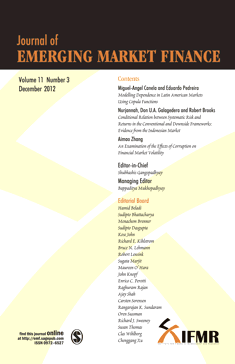
Journal of Emerging Market Finance
Transforming Perspectives on Emerging Market FinanceThe Journal of Emerging Market Finance, published by SAGE Publications India Pvt Ltd, is a premier academic journal that serves as a vital resource for researchers, professionals, and students in the fields of finance and economics. Established in 2002, this journal focuses on the multifaceted dynamics of emerging market economies and their financial systems. With an ISSN of 0972-6527 and an E-ISSN of 0973-0710, it has garnered attention with its respectable Q3 rankings in both the Economics and Econometrics and Finance categories, reflecting its commitment to high-quality research. Despite its limited open-access options, the journal remains a significant platform for scholarly discussions, providing insights on emerging financial instruments, market behaviors, and economic policies in developing economies. As a continuously evolving publication, it aims to bridge the gap between theory and practice, promoting an understanding of the complexities faced in these vibrant markets, ultimately serving the academic community with relevant and impactful research until 2024 and beyond.
Asia-Pacific Journal of Financial Studies
Empowering Insights for Tomorrow's Financial LeadersAsia-Pacific Journal of Financial Studies is a premier academic journal published by WILEY, dedicated to advancing the field of finance within the dynamic Asia-Pacific region. With an ISSN of 2041-9945 and an E-ISSN of 2041-6156, this journal stands out for its rigorous peer-reviewed research spanning various topics in finance, making it a vital resource for researchers, practitioners, and students alike. It has achieved an impressive Q2 ranking in Finance as of 2023, placing it within the top half of finance journals as measured by its relevance and quality of contributions in the Scopus Economics, Econometrics and Finance category. Additionally, the journal supports researchers with robust access options, promoting broader dissemination of knowledge. Its dedicated focus from 2006 to 2024 highlights the journal's commitment to continuous scholarly exchange and innovation in financial studies. As it thrives in the competitive landscape of scholarly publishing, the Asia-Pacific Journal of Financial Studies not only enriches academic discourse but also informs practices that shape financial markets and policies in the region.

International Real Estate Review
Advancing Knowledge in Urban Dynamics and Real EstateInternational Real Estate Review, published by the GLOBAL SOCIAL SCIENCE INST, is a vital source of scholarly articles and research findings in the fields of real estate, urban studies, and related social sciences. With an ISSN of 2154-8919, this journal serves as an important forum for academic discourse from its inception in 1998 until 2024. Its impact across various categories is evident, with rankings in the Q3 tier for Demography and Urban Studies, and Q4 in other relevant fields such as Economics and Finance, making it a valuable resource for researchers and practitioners alike. Despite its open-access limitations, the journal provides a unique perspective on the interrelation of real estate markets and societal dynamics. Situated in Rockville, Maryland, the journal supports a diverse array of articles that foster critical discussions and insights, essential for those engaged in the urban development sector and beyond. As the industry grapples with ever-changing dynamics, International Real Estate Review remains a crucial reference point for advancing knowledge and understanding in this complex field.

National Accounting Review
Fostering Open Access to Essential Financial ResearchNational Accounting Review is a distinguished journal published by the American Institute of Mathematical Sciences (AIMS), dedicated to the field of accounting and finance. With its Open Access model established in 2019, it aims to provide unrestricted access to high-quality research, facilitating knowledge dissemination among researchers, professionals, and students alike. The journal addresses a diverse range of topics within accounting, finance, and economic analysis, making it a critical resource for those interested in the latest methodologies and applications in the field. Although specific metrics such as H-Index and Scopus rankings are not available, the commitment to rigorous peer review ensures that publications maintain high academic standards. With its insightful contributions and dedication to advancing the discipline, the National Accounting Review plays a vital role in shaping the future of accounting research.
Financial Markets and Portfolio Management
Navigating the Future of Finance and Investment.Financial Markets and Portfolio Management is a renowned peer-reviewed journal published by Springer, focusing on the dynamic and evolving intersections of finance, economics, and accounting. With an ISSN of 1934-4554 and an e-ISSN of 2373-8529, the journal provides a platform for innovative research on financial markets, investment strategies, and portfolio management techniques. It boasts an impactful presence in the academic community, with a Scopus ranking placing it in the 58th percentile in Finance and the 51st percentile in Accounting, underscoring its significance in both fields. Spanning coverage from 2006 to 2024, the journal offers essential insights for researchers, practitioners, and students interested in the latest developments and empirical analyses in financial practices. Although it does not offer open access options, its rigorous editorial standards ensure high-quality content accessible to library and institutional resources. The journal plays a pivotal role in advancing knowledge and fostering dialogue in an increasingly complex financial landscape.