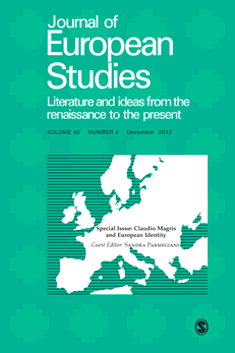
JOURNAL OF EUROPEAN STUDIES
Scope & Guideline
Exploring Europe's Complex Tapestry of Society and Culture
Introduction
Aims and Scopes
- European Integration and Policy Analysis:
Research exploring the multifaceted aspects of European integration, including legal, economic, and political implications, particularly in the context of the EU's policies and member states' responses. - Socioeconomic Development and Inequality:
Focus on the socioeconomic disparities across European nations, examining issues such as income inequality, labor market dynamics, and the impact of public policies on various demographics. - Cultural and Historical Perspectives:
Investigations into the cultural and historical dimensions of European societies, including nationalism, identity, and the effects of historical events on contemporary political landscapes. - Resilience and Crisis Management:
Studies that analyze resilience in the face of crises, such as pandemics or geopolitical conflicts, and how these crises shape policy responses and societal dynamics in Europe. - Sustainable Development and Environmental Policy:
Research addressing sustainable development practices within Europe, focusing on environmental policies, regional development strategies, and the interplay between economic growth and ecological sustainability.
Trending and Emerging
- Impact of Crises on Policy and Society:
An increasing number of studies explore how recent crises, such as the COVID-19 pandemic and geopolitical tensions, have influenced European policies and societal resilience, indicating a trend towards crisis-focused research. - Gender and Social Equality:
Research addressing gender disparities and women's empowerment has gained traction, showcasing a growing commitment to understanding and promoting social equality in various European contexts. - Digitalization and Technological Change:
Emerging themes around digital skills, generative AI technologies, and their socio-economic implications reflect the journal's response to the rapid pace of technological change and its impact on European societies. - Regional Development and Urban Resilience:
There is a notable emphasis on regional development strategies and urban resilience, with studies focusing on how local actions can drive sustainable growth and adapt to changing circumstances. - Cultural Dynamics and Identity Politics:
An uptick in research examining cultural dynamics, nationalism, and identity showcases an interest in understanding the social fabric of European societies amidst rising populism and cultural shifts.
Declining or Waning
- Traditional Political Structures and Theories:
Research on classical political theories and traditional structures has diminished, possibly overshadowed by the urgent need to address contemporary issues such as populism and hybrid governance models. - Static Economic Models:
There has been a noticeable reduction in papers relying on static economic models, as researchers increasingly favor dynamic approaches that account for real-time data and the complexities of modern economies. - Historical Analyses of Pre-2000 European Politics:
Studies focusing solely on historical analyses of European politics before the year 2000 are less prevalent, indicating a shift towards contemporary issues and their implications for future policymaking. - Eurocentric Perspectives on Global Issues:
The journal has gradually moved away from Eurocentric views, instead embracing a more global perspective that considers the interconnectedness of global challenges and their local impacts. - Legalistic Approaches to EU Governance:
The focus on strictly legalistic analyses of EU governance frameworks has waned, as interdisciplinary approaches that combine law with political science and sociology gain prominence.
Similar Journals
Journal of Modern European History
Charting New Frontiers in European Historical ResearchThe Journal of Modern European History, published by SAGE PUBLICATIONS LTD, is an essential resource for scholars and practitioners in the field of history, particularly focusing on modern European developments. With an ISSN of 1611-8944 and E-ISSN of 2631-9764, this journal boasts a reputation as a Q2 journal in the Arts and Humanities - History category, ranking in the top 25% of its field with a Scopus rank of #404 out of 1760 publications. With its converged years spanning from 2010 to 2024, this journal aims to provide cutting-edge research articles that deepen the understanding of modern European historical events, themes, and methodologies. As a pivotal platform for scholarly discourse, it supports vibrant academic exchange while offering avenues for researchers, professionals, and students to engage with innovative thought in the history domain. For those seeking to expand their knowledge or contribute to the field, the Journal of Modern European History serves as a vital tool for both insight and inspiration.
EUROPEAN UNION POLITICS
Connecting Scholars to the Heart of European PoliticsEUROPEAN UNION POLITICS, published by SAGE PUBLICATIONS LTD, is a premier journal in the realm of political science, specializing in the intricate dynamics of the European Union and its multifaceted impact on global governance. With an ISSN of 1465-1165 and an E-ISSN of 1741-2757, this journal serves as a critical platform for scholarly discourse, featuring articles that address pressing political issues and policy debates affecting EU member states and beyond. The journal's significance is underscored by its impressive impact factor and a remarkable position in the Q1 category across various disciplines, including Demography and Health (Social Science), as well as Political Science and International Relations. With a strong Scopus ranking, notably Rank #70 out of 706 in Political Science and International Relations (90th percentile), it attracts a diverse array of contributions from leading academics and practitioners. The scope of EUROPEAN UNION POLITICS spans analyses of EU policies, member state interactions, and broader implications for international relations, making it an essential resource for researchers, professionals, and students engaged in understanding the ever-evolving political landscape of Europe.
JCMS-Journal of Common Market Studies
Pioneering Research on Cross-Border CollaborationsAbout JCMS - Journal of Common Market Studies
Published by Wiley, the JCMS - Journal of Common Market Studies has been at the forefront of research in economics, political science, and international relations since its inception in 1962. With an impressive track record, the journal holds a Q1 ranking in multiple categories, including Business and International Management, Economics and Econometrics, and Political Science, reflecting its esteemed position in the academic community. As of 2023, it ranks 52nd out of 706 in Political Science and International Relations and 155th out of 716 in Economics and Econometrics. The journal aims to provide insightful analyses and comprehensive studies on common market integration and its implications on business practices and policies globally. Although it operates under a traditional access model, the content it disseminates is invaluable for researchers, practitioners, and students aiming to deepen their understanding of market dynamics and cross-border collaborations. With plans to continue exploring emerging trends up to 2024 and beyond, JCMS remains a vital resource for advancing knowledge in these critical fields.

Contemporary Europe-Sovremennaya Evropa
Illuminating Political and Economic LandscapesContemporary Europe-Sovremennaya Evropa is a leading academic journal published by ROSSIIKAYA AKAD NAUK, INST EVROPY that delves into the intricacies of European political, economic, and social landscapes. With an ISSN of 0201-7083, this journal caters to an essential niche within Social Sciences, particularly focusing on Political Science and Economics. The journal holds a commendable Q3 ranking in both Economics and Econometrics and Political Science and International Relations, reflecting its commitment to disseminating high-quality research relevant to contemporary challenges in Europe. As part of its mission, Contemporary Europe seeks to provide scholars, practitioners, and policy-makers with empirical insights and theoretical frameworks that enhance understanding and foster dialogue in a rapidly evolving geopolitical landscape. Although currently not categorized as Open Access, the journal continues to strive for broader academic reach and accessibility. With a convergence of content from 2016 to 2024, it addresses pressing issues and trends, establishing itself as a valuable resource for those interested in European studies.

Politique Europeenne
Fostering Interdisciplinary Dialogue in Political SciencePolitique Europeenne, published by EDITIONS L HARMATTAN, is a distinguished academic journal dedicated to the fields of Political Science, International Relations, and Sociology. With an ISSN of 1623-6297 and an E-ISSN of 2105-2875, this journal serves as a vital platform for the dissemination of scholarly research and critical discourse on European political dynamics. Currently classified in Q3 quartile rankings in both Political Science and International Relations, and Sociology, it aims to foster interdisciplinary dialogue and enhance understanding of contemporary political issues across Europe. As of 2023, Politique Europeenne has established itself within the Scopus rankings, standing at the 38th percentile among its peers. Although it does not offer Open Access, its contributions are invaluable for researchers, professionals, and students seeking to engage with pressing political paradigms and theories through its comprehensive articles and reviews. With coverage extending from 2017 to 2024, the journal is poised to continue shaping the academic landscape and encouraging impactful discussions in political studies.

Croatian Yearbook of European Law & Policy
Advancing Knowledge in European Legal StudiesCroatian Yearbook of European Law & Policy, published by the University of Zagreb, Faculty of Law, stands as a vital resource in the realm of European legal studies and policymaking. This open-access journal, operational since 2005, provides a platform for scholarly discourse and is dedicated to the exploration of contemporary European legal issues, fostering a deeper understanding of law and policy across the continent. With its ISSN 1845-5662 and its designation as Q4 in the law category for 2023, the journal engages a diverse audience, including researchers, professionals, and students, while holding a significant Scopus ranking of Rank #623/1025 within the social sciences law domain, placing it in the 39th percentile. Located in Zagreb, Croatia, the journal not only contributes to the academic landscape but also enriches the practical applications of European law and policy, making it an indispensable tool for those engaged in this dynamic field.

South East European Journal of Economics and Business
Fostering Innovation in Economics and Business.South East European Journal of Economics and Business (ISSN: 1840-118X, E-ISSN: 2233-1999), published by WALTER DE GRUYTER GMBH, stands as a pivotal platform for the dissemination of innovative research in the fields of economics, business, management, and accounting. Since its inception in 2007, this Open Access journal has provided unrestricted access to a wealth of knowledge generated by scholars and practitioners alike, enriching the academic landscape in the South East European region and beyond. Located in Bosnia and Herzegovina, the journal has consistently aimed to foster interdisciplinary dialogue among researchers, offering insights into current trends and challenges facing the global economy. The journal's impressive positioning in the Q3 quartile for both Business and Economics categories, alongside its Scopus ranks—#103/288 in Economics and #118/218 in Business, reflects its commitment to high-quality research. By continually evolving to meet the demands of its academic audience, the South East European Journal of Economics and Business is poised to make significant contributions to its fields, engaging professionals, researchers, and students who desire to stay at the forefront of economic and business advancements.

Romanian Journal of European Affairs
Connecting scholars to the pulse of European affairs.Romanian Journal of European Affairs is an esteemed open-access academic journal published by the EUROPEAN INST ROMANIA, dedicated to advancing research in the fields of political science and international relations. Established in 2001, the journal has positioned itself at the forefront of European studies, encompassing a diverse range of topics pertinent to the evolution of European policies and their global implications. With an impact factor substantiated by its Q3 ranking in the 2023 category of Political Science and International Relations, the journal stands at a pivotal intersection for researchers, practitioners, and students alike. Its Scopus ranking reflects a growing presence in the scholarly community, making it an essential platform for disseminating innovative research and fostering academic discourse. Based in Bucharest, Romania, the journal not only caters to local scholars but also engages a global audience interested in the dynamic interplay between European affairs and international contexts. By facilitating open access to its content, the Romanian Journal of European Affairs strives to enhance the visibility and impact of research, contributing significantly to the academic dialogue surrounding European integration and policy development.

Comparative Southeast European Studies
Advancing Knowledge through Comparative Perspectives on Southeast EuropeComparative Southeast European Studies, published by WALTER DE GRUYTER GMBH, is an esteemed open-access journal that has been contributing to scholarly discourse since its inception in 2021. With its ISSN 2701-8199 and E-ISSN 2701-8202, the journal is dedicated to the multidisciplinary examination of Southeast European societies, cultures, and economies. The journal strives to foster a nuanced understanding of historical and contemporary issues through an array of perspectives, appealing to researchers, professionals, and students alike. While it currently resides in Q4 for several categories including Anthropology, Economics, and Political Science, it maintains a robust platform for innovative research and dialogue within the region. Situated in Germany, this journal serves not only as a repository of knowledge but also as a catalyst for future scholarly endeavors, with the aim to elevate the discourse surrounding Southeast Europe during the converging years of 2021 to 2024. Its commitment to open access ensures that critical research is readily available, inspiring collaboration and engagement across academic and professional communities.

European Judaism-A Journal for the New Europe
Connecting Cultures: Jewish Studies for the New EuropeEuropean Judaism - A Journal for the New Europe, published by Berghahn Journals, serves as a pivotal platform for scholarly dialogue within the realms of Religion, History, Psychology, and Cultural Studies, particularly focused on the contemporary Jewish experience. With its ISSN 0014-3006 and e-ISSN 1752-2323, this journal offers a robust examination of Judaism in the context of modern European society, aiming to bridge traditional scholarship and current cultural phenomena. The journal has a palpable impact within its diverse categories, reflecting a Q4 ranking in Applied Psychology, Cultural Studies, and Philosophy, a Q3 in History, and noteworthy engagement in Religious Studies as of 2023. While currently not adopting an open-access model, it remains an essential resource for researchers and academics seeking to contribute to ongoing discussions about Jewish identity and thought within the European context, emphasizing the journal's objectives of fostering informed interdisciplinary research. Situated in the United States, at 20 Jay St, Suite 512, Brooklyn, NY 11201, European Judaism continues to explore vital themes relevant to both the past and future of Jewish scholarship, making it a critical addition to any academic library.