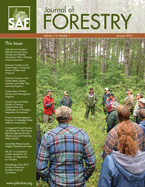
JOURNAL OF FORESTRY
Scope & Guideline
Fostering interdisciplinary collaboration for a greener future.
Introduction
Aims and Scopes
- Forest Ecosystem Management:
Research on sustainable management practices that balance ecological integrity, economic viability, and social equity in forest ecosystems. - Climate Change Impacts and Adaptation:
Studies assessing the effects of climate change on forest ecosystems and exploring adaptive management strategies for resilience. - Forest Health and Disturbance Dynamics:
Investigations into the effects of pests, diseases, and disturbances (like wildfires) on forest health and strategies for mitigation. - Socioeconomic Aspects of Forestry:
Analysis of the social and economic dimensions of forestry, including landowner attitudes, community engagement, and forest-based economies. - Innovative Forestry Practices:
Exploration of new technologies and practices in forestry, such as precision forestry, remote sensing, and adaptive management strategies. - Conservation and Biodiversity:
Research focusing on the conservation of forest biodiversity and the role of forests in ecosystem services. - Policy and Governance in Forestry:
Examinations of forest policy, governance structures, and their impacts on forest management and conservation efforts.
Trending and Emerging
- Climate Resilience and Adaptive Management:
There is a growing emphasis on strategies that enhance forest resilience to climate change, focusing on adaptive management practices and ecosystem-based approaches. - Community Engagement and Social Dimensions:
Research highlighting the importance of community involvement and social factors in forest management is gaining traction, reflecting a recognition of the role of local stakeholders. - Technological Advances in Forestry:
The incorporation of advanced technologies, such as remote sensing and GIS, is becoming more prevalent, enabling better monitoring and management of forest resources. - Forest Carbon Management and Sequestration:
Increasing attention is being paid to the role of forests in carbon sequestration and management practices that enhance carbon storage capabilities. - Integration of Indigenous Knowledge:
Emerging research is focusing on the integration of Indigenous knowledge systems with contemporary forestry practices, promoting collaborative and culturally sensitive management approaches. - Wildfire Management Innovations:
As wildfire incidents rise, innovative management strategies and policies addressing wildfire risk reduction and community preparedness are becoming a significant focus.
Declining or Waning
- Traditional Timber Production:
Research focused primarily on traditional timber production practices has seen a decline, possibly due to a growing emphasis on sustainable and multifunctional forest management. - Purely Economic Analyses:
Studies that emphasize solely economic aspects of forestry, without considering ecological or social factors, have become less common as interdisciplinary approaches gain traction. - Historical Perspectives on Forestry:
While historical studies are valuable, there appears to be a waning interest in purely historical analyses of forestry practices in favor of contemporary and forward-looking research. - Narrowly Defined Species Studies:
Research that focuses exclusively on single species without considering broader ecological interactions or management implications is becoming less frequent.
Similar Journals

Forestist
Uniting professionals to tackle forestry challenges.Forestist, published by AVES, is a pivotal open-access journal dedicated to the field of Forestry, providing a platform for researchers, professionals, and students to explore cutting-edge developments and research within the discipline since 1980. Operating from Turkey, this journal offers a unique opportunity for scholars to share their findings with a broad audience, contributing to the global discourse on sustainable forest management, conservation practices, and ecological research. With an impressive impact factor and a current categorization in the Q3 quartile for 2023, Forestist ranks among the essential resources in Agricultural and Biological Sciences, particularly within the realm of Forestry, as indicated by its Scopus ranking of #119 out of 174 journals. This publication is committed to fostering open access to knowledge, making research freely available while encouraging innovative studies that address the pressing challenges in forestry and environmental science.

FORESTRY
Elevating forestry management through peer-reviewed excellence.FORESTRY is a prestigious journal dedicated to the advancing knowledge and innovative practices in the field of forestry, published by Oxford University Press. Established in 1927, it encompasses a rich history of scholarly contributions and has evolved to maintain its relevance, addressing contemporary issues and research in forestry and related disciplines. With an impressive Q1 ranking in the category of Forestry, this journal holds a notable position within the Scopus rankings, being placed 20th out of 174 in the Agricultural and Biological Sciences domain, highlighting its significant impact with an 88th percentile standing. Researchers, professionals, and students can access critical insights into forestry management, ecology, and policy, facilitating informed decision-making and fostering sustainable practices. While Open Access options are currently not available, the journal's rigorous peer-review process ensures the publication of high-quality research that contributes both to academic advancement and practical applications in forestry worldwide. The comprehensive coverage from 1927 to 2024 makes FORESTRY an invaluable resource for anyone invested in enhancing the field of forestry.

Revista Cubana de Ciencias Forestales
Championing accessible research for global forestry challenges.Revista Cubana de Ciencias Forestales, published by UNIV PINAR RIO HERMANOS SAIZ MONTES OCA, is a vital resource in the field of forestry and environmental sciences. Since its inception in 2013, this Open Access journal has dedicated itself to disseminating high-quality research and innovations pertinent to forest ecology, sustainable management, and conservation strategies within the Cuban context and beyond. The journal aims to foster academic dialogue among researchers, professionals, and students by providing a platform for the sharing of interdisciplinary studies that address contemporary challenges in forestry. With its commitment to accessibility, Revista Cubana de Ciencias Forestales ensures that knowledge is available to a global audience, thereby contributing to the advancement of forest sciences and ecological awareness.

BOSQUE
Pioneering Research in Forestry and BeyondBOSQUE, published by Universidad Austral de Chile, Facultad de Ciencias Forestales, stands as a pivotal platform for advancing the field of forestry and related environmental sciences. With an ISSN of 0717-9200, this journal has been committed to disseminating original research, reviews, and case studies essential for understanding forest ecosystems and management practices since its inception in 2006. As of 2023, it holds a Q3 ranking in the forestry category, showcasing a significant yet developing influence in the broader academic landscape, evidenced by its Scopus ranking placing it at the 12th percentile in Agricultural and Biological Sciences - Forestry. While boasting a diverse range of articles, BOSQUE promotes open access to a growing community of researchers, professionals, and students eager to contribute to sustainable forest management and conservation efforts. The journal continues to foster critical dialogue and innovation, making it an invaluable resource for those dedicated to enhancing forest sciences.

Austrian Journal of Forest Science
Exploring the intersection of ecology and forest management.Austrian Journal of Forest Science, published by OSTERREICHISCHER AGRARVERLAG, is a distinguished peer-reviewed journal dedicated to advancing knowledge in the fields of forestry and ecological science. With an ISSN of 0379-5292 and an E-ISSN of 0375-524X, this journal serves as a vital platform for researchers, professionals, and students alike, aiming to disseminate innovative research findings, methodologies, and case studies pertinent to forest conservation, management, and policy. Situated in Austria, its diverse scope encompasses critical topics within ecology, evolution, and biodiversity, evidenced by its competitive quartile rankings in 2023, placing it in Q2 for Forestry and Q3 in other related fields. The journal is committed to fostering a deeper understanding of forest ecosystems, making it an essential resource for anyone invested in sustainable forestry practices and environmental policy.
NEW FORESTS
Advancing the Science of Sustainable Forestry.NEW FORESTS, published by SPRINGER, stands at the forefront of forestry research, delivering cutting-edge insights into forest science, management, and conservation. With an ISSN of 0169-4286 and an E-ISSN of 1573-5095, this esteemed journal has earned a distinguished reputation as it continues to contribute significantly to the field since its inception in 1986. As evidenced by its impressive ranking in the Q1 category for Forestry and being positioned at #32/174 in the Scopus Ranks for Agricultural and Biological Sciences, NEW FORESTS maintains an 81st percentile standing, emphasizing its influential role in advancing scientific discourse. The journal focuses on a diverse array of topics within the realm of forestry, making it an essential resource for researchers, professionals, and students eager to engage with contemporary developments and challenges in forest ecosystems. Although it is not an open-access journal, access to its articles can be facilitated through various academic institutions and libraries, ensuring that vital research is available to a broad audience. As we look toward the future, NEW FORESTS continues to strive for excellence, fostering dialogue and collaboration among scholars committed to sustainable forest management and restoration until at least 2024.
Forest Science and Technology
Transforming forest management with open access insights.Forest Science and Technology is a premier open access journal published by Taylor & Francis Ltd, based in the United Kingdom. Established in 2005, this journal has become a key platform for disseminating high-quality research in the fields of Forestry and Environmental Science, maintaining a strong impact factor and impressive Scopus rankings. As of 2023, it proudly holds a Q2 quartile ranking in Forestry and a Q3 quartile ranking in Management, Policy, and Law categories, highlighting its significance in addressing contemporary challenges in forest management and conservation. With a dedication to fostering scholarly communication, the journal supports open access since 2017, making valuable findings accessible to a wider audience, including researchers, professionals, and students. With the coverage period extending to 2024, Forest Science and Technology continues to contribute to the discourse on sustainable forestry practices and innovative management strategies.

Sumarski List
Advancing Forestry Knowledge for a Sustainable FutureSumarski List, published by the Croatian Forestry Society, serves as a key platform for the dissemination of knowledge and research within the field of forestry. Established in the early 1980s, this journal has maintained a consistent commitment to advancing the understanding of forest management, ecology, and conservation. With an ISSN of 0373-1332 and an E-ISSN of 1846-9140, it provides researchers and practitioners with valuable insights into current trends and practices in forestry, although it currently falls within the Q4 category in the 2023 forestry rankings. The journal is accessible primarily in printed format, promoting rigorous scholarship and discussion. The important contributions of Sumarski List are vital for fostering a greater appreciation of forestry in Croatia and beyond, making it an essential resource for those dedicated to tackling the pressing challenges in forest ecosystems.

Floresta e Ambiente
Championing open access to vital environmental research.Floresta e Ambiente is a pioneering open-access journal dedicated to advancing knowledge in forestry and environmental science, published by the Federal Rural University of Rio de Janeiro's Institute of Forests. Since its inception in 2012, this journal has emerged as a crucial platform for researchers, professionals, and students to disseminate innovative findings and foster discussions on sustainable forest management, conservation practices, and the ecological significance of forests in Brazil and beyond. With an impressive impact factor and a commendable ranking in the SCOPUS database, positioned in the 49th percentile of the Agricultural and Biological Sciences category, Floresta e Ambiente actively supports the dissemination of high-quality research while contributing to the global discourse on forestry. As an open access journal since 2013, it ensures that valuable knowledge is readily available to all, enhancing collaboration and engagement within the scientific community.
Cerne
Pioneering Research for the Future of ForestryCerne is a distinguished open-access journal dedicated to advancing knowledge in the field of forestry, published by the Universidade Federal de Lavras (UFLA). Since its inception in 1994, the journal has actively contributed to the global discourse on sustainable forest management and biodiversity conservation, presenting research findings that are both relevant and impactful. With its ISSN 0104-7760, Cerne aims to foster collaboration among researchers, professionals, and students, enhancing the understanding of forestry practices in Brazil and beyond. As of 2023, it holds a respectable Q3 ranking in the forestry category, further cementing its position within the academic community, illustrated by a Scopus ranking of #97 out of 174 in the Agricultural and Biological Sciences - Forestry field. Operating under an open-access model allows for wide dissemination of research outputs, ensuring that critical findings reach a broad audience, fueling further innovation and discovery in the field. With converged years extending from 2007 to 2024, Cerne continues to be a vital resource for anyone engaged in forestry research and practices.