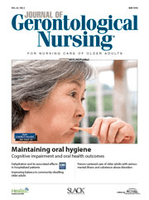
Journal of Gerontological Nursing
Scope & Guideline
Championing Quality of Life for Seniors
Introduction
Aims and Scopes
- Gerontological Nursing Practice:
Focused on research that enhances nursing practice in caring for older adults, including studies on effective interventions, care models, and best practices in various settings. - Aging and Health Policy:
Explores the implications of aging on health policy, including legislative efforts, funding, and health care system adaptations to meet the needs of an aging population. - Cognitive and Mental Health:
Investigates cognitive impairments, mental health issues, and dementia care, emphasizing innovative strategies for assessment, treatment, and caregiver support. - Technology in Aging Care:
Examines the role of technology in enhancing the care of older adults, including telehealth, assistive devices, and health information systems. - Quality of Life and Well-Being:
Researches factors influencing the quality of life and psychosocial well-being of older adults, focusing on interventions that promote healthy aging. - Cultural Competence in Care:
Addresses the needs of diverse older adult populations, emphasizing culturally competent care practices and the impact of social determinants on health.
Trending and Emerging
- Impact of COVID-19 on Older Adults:
A significant increase in research addressing the effects of the COVID-19 pandemic on older adults, including mental health, caregiving, and care delivery adaptations. - Technology-Enhanced Care:
Growing emphasis on the integration of technology in gerontological care, including telehealth, remote monitoring, and digital health interventions to support aging in place. - Person-Centered and Holistic Care Approaches:
An emerging focus on person-centered care models that prioritize the individual needs and preferences of older adults, including psychosocial factors and quality of life. - Diversity and Health Equity:
Increased attention to health disparities among older adult populations, particularly regarding race, ethnicity, and socioeconomic status, highlighting the need for culturally competent care. - Interdisciplinary Collaboration:
A trend towards interdisciplinary research and practice models that involve multiple healthcare professionals working together to address the complex needs of older adults.
Declining or Waning
- Traditional Long-Term Care Models:
Research focusing on traditional long-term care models is diminishing as innovative models and person-centered care approaches gain prominence. - Pharmacological Interventions:
There appears to be a waning interest in studies solely focused on pharmacological interventions without considering non-pharmacological approaches or holistic care models. - General Aging Research:
Publications that address broad aging topics without a specific focus on nursing practice or health outcomes are becoming less common, as the journal narrows its focus to more applicable research. - Institutional Care Perspectives:
Research centered on institutional care settings is less prevalent as there is a growing emphasis on home-based care and community support systems for older adults.
Similar Journals
Advances in Gerontology
Connecting Scholars to the Science of AgingAdvances in Gerontology is a pivotal academic journal dedicated to the field of gerontology, published by PLEIADES PUBLISHING INC. With its ISSN 2079-0570 and E-ISSN 2079-0589, this journal serves as an essential platform for researchers, healthcare professionals, and students focused on aging and related health issues. Although currently not an open-access journal, it aspires to enrich the scholarly community by disseminating high-quality research from 2011 through 2024. The journal is recognized in the lower quartile of its category, ranking Q4 in both Geriatrics and Gerontology, reflecting its commitment to addressing emerging topics in the aging population despite its lower visibility in the competitive landscape. As it continues to explore critical areas in gerontology, Advances in Gerontology invites contributions that advance knowledge, foster understanding, and inform practices within this essential field of study.

Current Geriatrics Reports
Elevating discussions on aging with groundbreaking studies.Current Geriatrics Reports is a pivotal journal published by SPRINGER, dedicated to disseminating cutting-edge research and insights in the dynamic field of geriatrics and gerontology. Launched in 2014 and ongoing until 2024, this journal plays a critical role in addressing the complex needs and challenges faced by the aging population. Although it currently holds a Q4 quartile ranking in its category and occupies the 84th position out of 116 in the Scopus metrics for Medicine, Geriatrics, and Gerontology, it serves as a vital platform for emerging research that shapes clinical practices and policy-making. Researchers, professionals, and students alike will find Current Geriatrics Reports to be an invaluable resource for staying updated on advancements, best practices, and innovations in geriatric care. While the journal is not open access, it continues to impact the field significantly and enrich contemporary discussions surrounding aging.
EDUCATIONAL GERONTOLOGY
Innovating educational practices for a vibrant older generation.EDUCATIONAL GERONTOLOGY, published by Taylor & Francis Inc, is a leading academic journal dedicated to the study of education and aging. With an ISSN of 0360-1277 and an E-ISSN of 1521-0472, this journal has been an essential resource since its inception in 1976, continuing to provide invaluable insights until 2024. As an authoritative platform in the fields of Education and Gerontology, it ranks in the Q2 category for Education and Q3 in Geriatrics and Gerontology, reflecting its significant contribution to these domains. The journal is well-regarded for its rigorous peer-reviewed articles that explore innovative educational practices for older adults and address the challenges faced by this demographic. Researchers, professionals, and students alike can benefit from the multidisciplinary approaches and comprehensive research findings presented within its pages, making it a vital tool for advancing knowledge and practice in educational gerontology.

Journal of Gerontology and Geriatrics
Pioneering Studies in Gerontology and GeriatricsJournal of Gerontology and Geriatrics, published by PACINI EDITORE, is a crucial resource for those dedicated to the study of aging and geriatric health. Since its inception in 2016, this journal has aimed to disseminate high-quality research and findings that address the intricate biological, social, and psychological aspects of aging. With ISSN 2499-6564 and E-ISSN 2499-6564, it strives to foster discussions that enhance our understanding of gerontology and geriatrics on a global scale, despite its current positioning in the Q4 quartile of academic rankings. Located in Pisa, Italy, the journal invites contributions from researchers, professionals, and students who are passionate about advancing knowledge in these critical fields. Although it currently does not offer open access, the journal plays a vital role in connecting the community with essential insights that guide both research and practice in geriatric care.
Gerontology and Geriatric Medicine
Innovating geriatric medicine through open access insights.Gerontology and Geriatric Medicine is a distinguished journal published by SAGE Publications Inc, focusing on the vital field of gerontology and geriatrics. With an impressive Q2 ranking in Geriatrics and Gerontology as of 2023, this journal serves as a crucial platform for disseminating high-quality research and innovation related to aging and elderly care. Since embracing an Open Access model in 2015, it has broadened its reach, enabling scholars, researchers, and practitioners worldwide to access valuable insights without barriers. The journal’s scope encompasses a variety of interdisciplinary studies that address the multifaceted aspects of geriatric medicine, making it an essential resource for anyone dedicated to advancing knowledge and practices in this critical domain. With its commitment to enhancing the understanding of aging populations, Gerontology and Geriatric Medicine is poised to contribute significantly to the ongoing discourse and research developments in the care for older adults.
JMIR Aging
Connecting Knowledge with Geriatric ExcellenceJMIR Aging is a premier open-access journal published by JMIR Publications, Inc., dedicated to advancing the field of aging research and geriatric care. Established in 2018, this journal has quickly achieved a reputation for excellence, currently holding a Q1 ranking in several categories, including Geriatrics and Gerontology, Health Informatics, and Health (Social Science), reflecting its high impact and significant contributions to these fields. With a strong focus on innovative research that bridges technology and aging populations, JMIR Aging provides a platform for interdisciplinary collaboration among researchers, healthcare professionals, and students. The journal is indexed in Scopus, where it ranks impressively across various health science categories, underscoring its influence and reach within the academic community. Accessible to all, JMIR Aging plays a vital role in disseminating critical knowledge and fostering discussions that can lead to improved health outcomes for aging individuals worldwide.
Revista da Escola de Enfermagem da USP
Innovating Nursing Practices Through Open AccessRevista da Escola de Enfermagem da USP, published by UNIV SAO PAOLO, is a premier open-access journal that has been a cornerstone of nursing research since its inception in 1967. With a focus on disseminating innovative research and practices in the field of nursing, this journal has distinguished itself in the 2023 rankings by achieving Q2 in Nursing (miscellaneous) category and ranking 80 out of 139 in Scopus for General Nursing, placing it in the 42nd percentile. Accessible globally since 1996, the journal invites contributions that enhance nursing knowledge and practice, making it an invaluable resource for researchers, professionals, and students alike. Its commitment to open access ensures that vital nursing research is readily available to advance the global healthcare discourse. The journal's editorial office is located at AV Dr Eneas de Carvalho Aguiar, 419, Cerqueira Cesar, SP 05403-000, Brazil, fostering a vibrant community dedicated to improving nursing standards through scholarly engagement.
Geriatrics & Gerontology International
Transforming Gerontology with Groundbreaking StudiesGeriatrics & Gerontology International, published by WILEY, is a prestigious academic journal dedicated to advancing the field of geriatric and gerontological research. With a strong focus on the interdisciplinary aspects of aging, this journal has established itself as a leading source of high-quality research, reflected in its impressive impact factor and 2023 Scopus rankings, including a Q1 status in Health (Social Science) and Q2 in both Geriatrics and Gerontology. Since its inception in 2004 and continuous publication from 2008 to 2024, it has fostered a vibrant exchange of ideas among researchers, clinicians, and students alike. The journal serves as a critical resource for innovative studies, reviews, and commentaries that help shape policies and practices affecting the elderly population. It is essential reading for those dedicated to improving the quality of life for older adults and contributes significantly to the understanding of the complexities surrounding aging.
Journal of the American Medical Directors Association
Navigating the complexities of aging with expertise.The Journal of the American Medical Directors Association, published by Elsevier Science Inc, stands as a leading publication in the fields of Geriatrics, Gerontology, Health Policy, and Nursing. With an impressive track record since its inception in 2001, this journal features cutting-edge research and critical reviews that address the multifaceted challenges affecting older adults and the professionals who serve them. Holding a Q1 ranking in multiple categories, including Geriatrics and Gerontology, it boasts an outstanding reputation within the academic community, reflected in its Scopus rankings—#3 in General Nursing and #7 in Geriatrics and Gerontology. This journal not only disseminates vital knowledge but also aims to influence policy and clinical practice, making it an essential resource for researchers, healthcare professionals, and students dedicated to improving care for the aging population. Although it operates under a subscription model, the journal ensures that its curated content continues to advance the understanding and management of age-related health issues.
International Journal of Gerontology
Exploring the complexities of gerontology and aging.International Journal of Gerontology is a distinguished peer-reviewed journal dedicated to advancing the field of gerontology and addressing the multifaceted challenges associated with aging. Published by the Taiwan Society of Geriatric Emergency & Critical Care Medicine, this innovative journal has been an open-access platform since 2018, ensuring that vital research is accessible to a global audience. With an ISSN of 1873-9598, it serves as a crucial resource for researchers and practitioners focused on the biological, psychological, and social aspects of aging. The journal is indexed in Scopus with a rank of #103/116 in the Medicine category (Geriatrics and Gerontology) as of 2023, placing it in the Q4 quartile—a testament to its evolving impact in the field. Spanning works published from 2007 to 2024, the International Journal of Gerontology facilitates the dissemination of critical research findings and clinical practices that inform and enhance geriatric care and research methodologies.