Journal of Interdisciplinary Economics
Scope & Guideline
Bridging Disciplines for a Holistic Economic Perspective
Introduction
Aims and Scopes
- Interdisciplinary Economic Analysis:
The journal emphasizes the integration of concepts from economics, sociology, political science, psychology, and environmental studies to provide a multifaceted view of economic issues. - Focus on Emerging Economic Trends:
Research often explores contemporary economic challenges such as cryptocurrency dynamics, economic impacts of global crises, and green transitions, reflecting the journal's commitment to addressing current and relevant economic topics. - Empirical and Theoretical Research:
The journal publishes both empirical studies that utilize quantitative and qualitative methodologies, and theoretical papers that contribute to the conceptual frameworks within interdisciplinary economics. - Policy Implications and Practical Applications:
A significant aim is to derive insights that can inform policy-making and practical applications in various sectors, especially in developing nations and in response to crises. - Exploration of Social and Gender Issues:
The journal consistently addresses social dimensions of economics, including gender inequality, poverty, and the socio-economic impacts of policies, highlighting the importance of social equity in economic discourse.
Trending and Emerging
- Cryptocurrency and Digital Finance:
There is a growing interest in the analysis of cryptocurrencies, their market dynamics, and their implications for diversification and economic stability, reflecting the digital transformation in finance. - Impact of Global Crises:
Research focusing on the socioeconomic impacts of global crises, such as the COVID-19 pandemic and geopolitical conflicts, has surged, highlighting the need for adaptive economic strategies. - Green Economics and Sustainability:
Emerging themes around green transitions and sustainable economic practices indicate a rising emphasis on environmental economics and the socio-political dimensions of sustainability. - Gender and Economic Inequality:
There is an increasing focus on the intersection of gender and economic policies, exploring issues such as women's political leadership and the implications of gender-based economic disparities. - Behavioral Economics and Decision-Making:
Studies exploring behavioral economics, including decision-making under uncertainty and the psychological factors influencing economic behavior, are becoming more prevalent, reflecting a broader understanding of economic actions.
Declining or Waning
- Traditional Economic Models:
There is a noticeable decrease in papers solely focused on traditional economic models and theories, as the journal shifts towards more contemporary and interdisciplinary approaches. - Narrowly Focused Case Studies:
Papers that explore narrow, localized case studies without broader implications or interdisciplinary connections have become less prevalent, indicating a shift toward more generalizable findings. - Historical Economic Analysis:
Research centered exclusively on historical economic events or analyses without linking to current trends or interdisciplinary insights appears to be waning in favor of more dynamic and relevant topics. - Overly Technical Econometrics:
While quantitative analysis remains important, there is a declining emphasis on overly technical econometric models that do not incorporate broader social or interdisciplinary perspectives. - Sector-Specific Studies:
Studies focusing rigidly on specific sectors without addressing the interconnectedness of economic systems are less common, reflecting the journal's move towards holistic economic analysis.
Similar Journals
INTERNATIONAL ECONOMIC JOURNAL
Connecting Scholars to the Heart of Economic Discourse.Welcome to the INTERNATIONAL ECONOMIC JOURNAL, a premier publication dedicated to advancing the fields of economics, econometrics, and finance. Established in 1987 and published by Taylor & Francis Ltd, this journal has consistently contributed to scholarly discourse and empirical research. With an impressive 2023 Scopus Ranking placing it at #112 out of 288 in its category, the journal holds a commendable Q2 quartile rating, reflecting its significant impact among economists and financial analysts alike. The INTERNATIONAL ECONOMIC JOURNAL serves as a vital platform for researchers and professionals to disseminate innovative findings, theoretical advancements, and practical applications in economic theory and policy. While not open access, the journal continues to attract a wide readership, offering insight into global economic trends and challenges. This makes it an essential resource for students, academics, and industry practitioners aiming to deepen their understanding of contemporary economic issues.
JOURNAL OF POST KEYNESIAN ECONOMICS
Innovating Economic Understanding Through Rigorous Scholarship.The JOURNAL OF POST KEYNESIAN ECONOMICS, published by ROUTLEDGE JOURNALS, TAYLOR & FRANCIS LTD, stands as a pivotal platform in the field of economics, focusing on the post-Keynesian school of thought. Established in 1985, this journal provides a vital forum for the dissemination of innovative research that challenges conventional economic theories and promotes a deeper understanding of economic phenomena through alternative perspectives. With an impressive impact factor positioned within the Q3 category of Economics and Econometrics, and a Scopus ranking of #454 out of 716 in its field, the journal maintains its commitment to high-quality scholarship. Researchers, professionals, and students will benefit from its comprehensively curated articles addressing contemporary economic issues and theoretical advancements, making it an essential resource for anyone interested in the evolution and application of post-Keynesian economics. While access is not open, interested readers can explore issues and articles through institutional libraries or purchase individual subscriptions.
SOUTH AFRICAN JOURNAL OF ECONOMICS
Exploring the dynamics of local and global economies.The South African Journal of Economics, published by Wiley, has been a cornerstone in the field of economics since its inception in 1933. With its ISSN 0038-2280 and E-ISSN 1813-6982, this esteemed journal serves as a vital platform for researchers and scholars to disseminate innovative economic research and theory, while also engaging in critical discussions relevant to both local and global contexts. The journal has consistently ranked within the Q3 category in Economics and Econometrics, showcasing its contribution to the academic community, as reflected in its Scopus ranking of #328/716 in the subject area. Although it does not currently offer Open Access options, the journal remains dedicated to advancing economic thought and analysis through rigorous peer-reviewed articles that cover a broad range of topics. With a commitment to excellence and relevance, the South African Journal of Economics continues to attract a diverse readership of researchers, professionals, and students seeking to deepen their understanding of economic phenomena and policy implications.
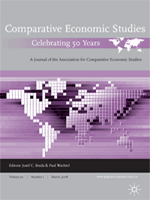
Comparative Economic Studies
Innovating Comparative Analysis in EconomicsComparative Economic Studies is a prominent academic journal dedicated to the field of economics, published by Palgrave Macmillan Ltd. Now in its converged years from 1996 to 2024, this journal provides a robust platform for innovative research and critical analysis within the economics and econometrics arenas. With an ISSN of 0888-7233 and an E-ISSN of 1478-3320, it has established itself as a vital resource for scholars and practitioners interested in comparative economic analysis, policy evaluation, and theoretical advancements. Recognized for its quality, the journal is classified in the Q3 category in 2023, reflecting its solid standing within the field, with a Scopus rank of 390 out of 716 journals in economics and econometrics. Although it currently does not offer open-access options, the journal is committed to disseminating significant findings that influence policy and scholarship globally. Its well-curated articles play an essential role in shaping contemporary economic discourse, making it an indispensable resource for researchers, professionals, and students alike.
Forum for Social Economics
Fostering Critical Thought in Economic ResearchForum for Social Economics is a premier academic journal published by Routledge Journals, Taylor & Francis Ltd, dedicated to advancing the discourse in social economics, a field that bridges the gap between economic theory and social realities. With an ISSN of 0736-0932 and an E-ISSN of 1874-6381, this journal serves as a vital resource for researchers, professionals, and students interested in the multifaceted intersections of economic and social phenomena. Recognized for its academic rigor, it holds a Q3 ranking in Economics and Econometrics and Q2 in Sociology and Political Science as of 2023, further emphasizing its influential position within these disciplines. Although not open access, the journal offers a wealth of insightful articles and empirical studies, fostering a deeper understanding of social issues through an economic lens. Since its inception in 1971 and with convergence years extending to 2024, the Forum for Social Economics continues to attract contributions that provoke critical thought and innovation in economic research. Based in the United States, the journal is pivotal for those looking to explore and contribute to the evolving landscape of social economics.
Economic Notes
Cultivating a Deeper Understanding of Economic ForcesEconomic Notes is a peer-reviewed journal published by WILEY, focusing on the dynamic field of economics and econometrics. With an ISSN of 0391-5026 and an E-ISSN of 1468-0300, this esteemed journal offers a platform for researchers, professionals, and students to explore theoretical advancements, empirical studies, and policy implications within the economic landscape. Established in the United Kingdom, Economic Notes has become a noteworthy publication, currently ranked in the Q3 category in the 2023 Economics and Econometrics quartiles, and situating itself at the forefront of the field with a respectable 60th percentile ranking in Scopus. The journal spans a remarkable convergence of scholarship from 2001 to 2024, fueling academic discourse and providing insights into pressing economic issues. Although it does not provide open access options, it remains a crucial resource for those seeking to enhance their understanding and contribute to economic theory and practice.

CAMBRIDGE JOURNAL OF ECONOMICS
Fostering Knowledge in Economics and EconometricsCambridge Journal of Economics, published by Oxford University Press, is a premier academic journal in the field of economic theory, policy, and applications, catering to researchers, professionals, and students alike. With a rich history dating back to 1977, this journal has established itself as a notable contributor to critical discourse in the arena of Economics and Econometrics. With an impressive Scopus ranking of #210 out of 716 in its category, placing it in the 70th percentile, the journal maintains a solid Q2 classification, reflecting its significant impact and contribution to the field. Although it operates on a subscription basis, the Cambridge Journal of Economics is accessible through a range of academic databases and libraries, ensuring that its high-quality research reaches a wide audience. The journal aims to advance the understanding and application of economic principles, making it an essential resource for anyone looking to deepen their knowledge or stay updated with the latest research trends in economics.

Indian Journal of Economics and Development
Innovating Solutions for Global Development IssuesIndian Journal of Economics and Development, published by SOC ECONOMICS & DEVELOPMENT, stands as a noteworthy platform for scholarly discourse in the fields of economics, business management, and development studies. With an ISSN of 2277-5412 and an E-ISSN of 2322-0430, this journal, based in Ludhiana, India, has been dedicated to advancing research and dialogue since its inception in 2019 and is poised for convergence until 2024. Although currently ranked in the Q4 categories across various disciplines in Business, Management and Accounting, Economics and Econometrics, and Geography, Planning and Development, the journal’s commitment to fostering impactful research is evident in its wide-ranging aims and scope, which seek to explore contemporary economic challenges and developmental issues. While the journal operates without an open-access model, it provides a valuable resource for academics and professionals, and encourages contributions that address both theoretical and empirical questions. Researchers, students, and professionals will find this journal critical as it serves a vital role in the dialogue surrounding economic and developmental dynamics, particularly in an increasingly complex global landscape.
CONTEMPORARY ECONOMIC POLICY
Shaping the Future of Economics through Rigorous AnalysisCONTEMPORARY ECONOMIC POLICY is an esteemed journal dedicated to advancing the discourse in the realms of economics, public administration, and management. Published by Wiley, this influential journal has been contributing to the field since 1982 and continues to provide valuable insights and research findings through its rigorous peer-review process. With a commendable impact factor placing it in the Q2 category across multiple fields—including Business, Management, and Accounting, as well as Economics and Econometrics—CONTEMPORARY ECONOMIC POLICY is positioned as a vital resource for scholars, practitioners, and students alike. The journal not only fosters academic collaboration but also addresses pressing economic policies and practices impacting the global landscape. Researchers and professionals can benefit from a subscription-based access model, ensuring they remain at the forefront of current economic debates and innovations.
International Review of Applied Economics
Illuminating Contemporary Economic ChallengesInternational Review of Applied Economics is a leading journal dedicated to the dissemination of innovative research in the fields of economics and econometrics. Published by Routledge Journals, a renowned name in academic publishing under Taylor & Francis Ltd., this journal has established itself as a key resource for scholars, practitioners, and decision-makers. With an impressive Q2 ranking in the category of Economics and Econometrics, and positioned in the 70th percentile based on Scopus rankings, it provides a platform for high-quality, peer-reviewed articles that address contemporary economic issues. The journal aims to facilitate the understanding of applied economic theory and practice, and it accepts a diverse range of contributions including empirical studies, theoretical analyses, and methodological advancements. Operating from the United Kingdom, it has been a significant contributor to the academic dialogue since its inception in 1987, fostering knowledge exchange through rigorous scholarship. Researchers, professionals, and students alike will find valuable insights that inform policy-making and economic strategy in its pages.