Journal of the Knowledge Economy
Scope & Guideline
Exploring the Nexus of Knowledge and Economic Growth
Introduction
Aims and Scopes
- Knowledge Economy Dynamics:
Research exploring the mechanisms and factors that drive knowledge economies, including the role of innovation, human capital, and institutional frameworks. - Sustainable Development and Environmental Impact:
Studies investigating the relationship between economic activities and environmental sustainability, including the impact of policies aimed at reducing carbon footprints and promoting green technologies. - Digital Transformation and Technological Innovation:
Exploration of how digital technologies transform industries and economies, focusing on the implications for productivity, efficiency, and competitive advantage. - Entrepreneurship and Economic Growth:
Analysis of the role of entrepreneurship in fostering economic development, addressing barriers to growth, and exploring the interplay between innovation and market dynamics. - Policy Analysis and Governance:
Evaluating the effectiveness of governmental and institutional policies in promoting knowledge-based growth, addressing issues of governance, transparency, and public sector efficiency. - Globalization and Economic Integration:
Research on how globalization affects knowledge transfer, foreign direct investment, and economic performance, with a focus on emerging markets. - Human Capital Development:
Investigating the role of education, training, and skills development in enhancing workforce capabilities and driving economic competitiveness. - Social Innovation and Community Engagement:
Studies examining the impact of social entrepreneurship and community participation on economic resilience and innovation.
Trending and Emerging
- Digital Financial Inclusion:
The increasing focus on how digital finance can enhance access to financial services, particularly for underserved populations, is emerging as a critical area of study. - Circular Economy and Sustainability:
Research exploring the principles of circular economy and its application in various sectors is trending, highlighting the need for sustainable practices in economic development. - Artificial Intelligence and Automation:
The role of AI and automation in transforming industries and driving innovation is gaining momentum, with studies exploring both opportunities and challenges. - Impact of Remote Work and Digital Transformation:
The COVID-19 pandemic has accelerated research into remote work practices and the broader implications of digital transformation on productivity and organizational behavior. - Knowledge Management in Organizations:
There is a growing emphasis on the importance of knowledge management practices in enhancing organizational performance and innovation capabilities. - Interdisciplinary Approaches to Economic Challenges:
Research that integrates insights from various disciplines, such as sociology, psychology, and environmental science, to address complex economic challenges is increasingly prevalent. - Health Economics and Public Policy:
The intersection of health, economic development, and public policy is trending, particularly in the context of global health crises and their economic implications. - Socio-Environmental Governance:
Emerging studies are focusing on the governance frameworks needed to balance economic growth with social equity and environmental sustainability.
Declining or Waning
- Traditional Industrial Growth Models:
Research focusing solely on traditional models of industrial growth without integrating knowledge and innovation perspectives has become less prevalent, as the emphasis shifts towards knowledge-based and sustainable economic frameworks. - Static Economic Analysis:
There is a noticeable decline in papers that employ static models of economic analysis, as dynamic and adaptive approaches that consider fluctuations and uncertainties are gaining more traction. - Single-Factor Economic Studies:
Research that examines economic performance through a single lens, such as labor or capital, is waning in favor of multifactorial analyses that incorporate technology, knowledge, and institutional influences. - Localized Economic Studies:
Studies focusing strictly on localized economic phenomena without consideration of global interconnectedness are becoming less frequent, as globalization and interconnectedness are increasingly recognized as critical factors. - Overly Theoretical Frameworks:
There has been a decrease in the publication of papers that rely heavily on abstract theoretical frameworks without empirical validation, as the journal seeks to emphasize practical implications and real-world applications.
Similar Journals
Spatial Economic Analysis
Unraveling Economic Trends Through Spatial LensesSpatial Economic Analysis, published by Routledge Journals, Taylor & Francis Ltd, stands at the forefront of interdisciplinary research bridging economics, geography, and environmental science. With a notable impact factor reflected in its prestigious Q1 quartile rankings across key categories such as Earth and Planetary Sciences, Economics, Econometrics and Finance, and Geography, this journal is pivotal for scholars seeking to understand the intricate dynamics of spatial phenomena and their economic implications. Its comprehensive scope and rigorous peer-review process ensure that only high-quality research is disseminated, fostering innovative solutions to pressing global challenges. As of 2024, and since its inception in 2006, Spatial Economic Analysis continues to thrive as a vital platform for researchers, professionals, and students alike, facilitating access to cutting-edge studies that shape the future of spatial economics and policy.
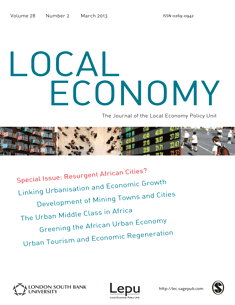
Local Economy
Illuminating Pathways to Economic ProsperityLocal Economy is a prestigious academic journal published by SAGE Publications Ltd, specializing in the dynamic field of local economic development. With an ISSN of 0269-0942 and an E-ISSN of 1470-9325, this journal has established itself as a leading source of interdisciplinary research from 1986 to 2024. Based in the United Kingdom, the journal boasts a remarkable Q1 ranking in the category of Economics, Econometrics, and Finance, reflecting its significant impact and influence in the field. Researchers and practitioners alike value Local Economy for its rigorous peer-reviewed studies that address key issues related to local economic policies, practices, and community resilience. With a Scopus rank of 72 out of 288, positioning it in the top 75th percentile, this journal is essential reading for those seeking to deepen their understanding of economic development at the local level. The absence of open access reinforces its commitment to quality scholarship, making the journal a reputable platform for disseminating important research findings and engaging discussions.
International Journal of Emerging Markets
Advancing Insights into Global Economic ShiftsThe International Journal of Emerging Markets, published by Emerald Group Publishing Ltd, stands at the forefront of the Business and International Management field, providing a vital platform for the dissemination of innovative research from 2006 to 2024. With an ISSN of 1746-8809 and an E-ISSN of 1746-8817, this esteemed journal has earned recognition for its impact within the academic community, showcasing a commendable Q2 quartile ranking in both Business and International Management and Business, Management and Accounting categories as of 2023. Its strategic positioning in Scopus rankings—placing 55th out of 218 in General Business, Management and Accounting, and 117th out of 443 in Business and International Management—highlights its significance in the competitive landscape of business research. Aiming to bridge the gap between theory and practice, the journal encourages contributions that explore emerging market dynamics, fostering a deeper understanding of global economic shifts. While it currently does not offer open access, subscribers gain exclusive insights into the latest trends and developments shaping the arena of international business. Whether you are a researcher, industry professional, or student, The International Journal of Emerging Markets is essential reading for those looking to stay ahead in this rapidly evolving field.

Global Economic Review
Elevating research in global economic discourse.Global Economic Review, published by ROUTLEDGE JOURNALS, TAYLOR & FRANCIS LTD, is a pivotal academic journal that serves the fields of Business, International Management, Economics, Econometrics, and Political Science. With an ISSN of 1226-508X and an E-ISSN of 1744-3873, this esteemed journal has been disseminating vital economic research since 1996, and is set to continue until 2024. The journal holds a notable presence in academic circles, achieving a Q3 quartile ranking in the 2023 category assessments across various disciplines, including Business and International Management, Economics, and Political Science. Notably, it ranks in the top 60th percentile for Political Science and International Relations, showcasing its significant contribution to the discourse within the social sciences. Although not an open-access publication, the Global Economic Review remains accessible to a wide range of researchers, professionals, and students, acting as a critical platform for innovative and impactful economic ideas. Its rigorous peer-review process ensures the publication of high-quality research that responds to the challenges of a rapidly evolving global economy. Scholars seeking to engage with pertinent economic issues will find this journal to be an invaluable resource.

Scientific Papers of the University of Pardubice-Series D-Faculty of Economics and Administration
Pioneering Research in Business and ManagementThe Scientific Papers of the University of Pardubice - Series D: Faculty of Economics and Administration is a peer-reviewed academic journal published by the University of Pardubice, situated in the heart of the Czech Republic. With an Open Access policy since 2015, this journal promotes the dissemination of high-quality research in the fields of economics, business, management, and administration. It has established itself in the academic community, reflected by its placement in the Q3 category for 2023 in both Business, Management and Accounting as well as Economics, Econometrics and Finance, along with commendable Scopus rankings. Covering a converged timeline from 2014 to 2024, the journal serves as a vital platform for scholars, researchers, and professionals seeking to share innovative findings and methodologies that shape our understanding of economic and administrative practices. For those looking to contribute to a growing repository of knowledge or to stay abreast of the latest trends in these disciplines, this journal offers a valuable resource.
Global Economy Journal
Exploring the intersection of economics and policy-making.Global Economy Journal, published by World Scientific Publishing Co Pte Ltd, is an authoritative platform dedicated to advancing research in the fields of economics, econometrics, and finance. Established in 2006 and operating from Singapore, this journal aspires to address comprehensive topics that shape both global and local economic landscapes, making significant contributions to academic discourse and policy-making. With an ISSN of 2194-5659 and an E-ISSN of 1553-5304, the journal is recognized for its rigorous peer-review process and is currently ranked in the Q3 quartile of economics journals as of 2023, placing it within the top half of scholarly publications in the field. The Scopus ranking positions it at #132 out of 288, showcasing its growing influence among researchers and professionals alike, embodying a percentile of 54. Although it does not offer open access, the journal plays a pivotal role in disseminating cutting-edge research, fostering a profound understanding of economic trends, challenges, and innovations that impact societies worldwide. Researchers, professionals, and students are encouraged to engage with the latest findings and discussions published in the Global Economy Journal to stay at the forefront of economic thought and practice.
Economics of Innovation and New Technology
Pioneering Research in the Economics of InnovationEconomics of Innovation and New Technology, published by Routledge Journals, Taylor & Francis Ltd, stands as a premier scholarly resource in the dynamic intersection of economics, innovation, and technology. With an ISSN of 1043-8599 and an E-ISSN of 1476-8364, this journal has proudly maintained its influential position, currently holding a Q1 ranking in the field of Economics, Econometrics and Finance and Q2 in Management of Technology and Innovation as of 2023. This prestigious publication, established in 1990 and converging to its latest volume in 2024, offers insightful research articles that explore technological advancements and their economic implications. The journal's impactful content is reflected in its Scopus rankings, placing it notably within the top percentiles across its categories. By fostering an understanding of innovation's role in economic progress, Economics of Innovation and New Technology serves as a vital resource for researchers, professionals, and students aiming to navigate and contribute to this evolving field.

Journal of Innovation & Knowledge
Pioneering pathways in the realms of knowledge and innovation.Journal of Innovation & Knowledge is a leading peer-reviewed, open access journal published by Elsevier España, dedicated to advancing the fields of innovation and knowledge management. Since its inception in 2016, this journal has rapidly established itself as a premier platform for innovative research, evidenced by its impressive Q1 rankings in key categories such as Business and International Management, Economics and Econometrics, Management of Technology and Innovation, and Marketing as of 2023. With an exceptional impact reflected in its Scopus ranks, including a remarkable 13th position in Economics and Econometrics, the journal stands out in the academic landscape, ensuring that high-quality research reaches a global audience. Authors benefit from the open access model, enhancing visibility and accessibility of their work, and ultimately fostering collaboration and knowledge sharing among researchers, professionals, and students. For more information, please refer to our editorial policies and submission guidelines.

Economics Ecology Socium
Advancing sustainable solutions for a thriving planet.Economics Ecology Socium is an impactful open-access journal focused on the intersection of economic systems, ecological sustainability, and societal dynamics. Published by Dr. Viktor Koval, this journal aims to foster interdisciplinary research that addresses contemporary challenges in environmental economics and social policies. Since its inception in 2017, Economics Ecology Socium has become a vital platform for scholars, practitioners, and students to disseminate novel insights and data-driven findings. With a commitment to advancing eco-socioeconomic knowledge, the journal encourages contributions that promote sustainability and improve decision-making processes across various sectors. Its open-access model allows for broad dissemination of research, making crucial knowledge available to a global audience. With an ISSN of 2616-7107 and an E-ISSN of 2786-8958, Economics Ecology Socium is positioned to contribute meaningfully to the global dialogue on economic and ecological issues, ensuring that research reaches those who need it most.
SINGAPORE ECONOMIC REVIEW
Exploring the forefront of economic research since 1983.SINGAPORE ECONOMIC REVIEW, published by WORLD SCIENTIFIC PUBL CO PTE LTD, stands as a prominent platform for research in the fields of economics and econometrics since its inception in 1983. With an ISSN of 0217-5908 and an E-ISSN of 1793-6837, this journal caters to a diverse audience by presenting high-quality, rigorously reviewed articles that address pressing economic issues both in Singapore and globally. Currently classified in the Q3 category for Economics and Econometrics for 2023, it ranks #265 out of 716 in Scopus, placing it in the 63rd percentile among economic journals. Although not open access, the articles published here contribute valuable insights into the evolving dynamics of economic theory and practice, making it an essential resource for researchers, educators, and policymakers alike. The journal's commitment to advancing economic research continues to foster dialogue and inspire innovative approaches within the academic community.