
Journal of the Philosophy of History
metrics 2024
Charting New Territories in the Philosophy of History
Introduction
The Journal of the Philosophy of History, published by BRILL, is a premier academic journal that focuses on the interdisciplinary field of philosophy as it pertains to historical study, and it has garnered a reputation for excellence since its inception in 2007. With an ISSN of 1872-261X and an E-ISSN of 1872-2636, the journal is committed to advancing scholarly discourse by publishing innovative research that explores the philosophical underpinnings of historical narratives and methodologies. Based in the Netherlands, the journal ranks in the Q1 category in History and Q2 in the History and Philosophy of Science in 2023, reflecting its significant impact in the field, with a notable Scopus ranking placing it at #263/1760 in History and #79/223 in History and Philosophy of Science. This journal not only serves as a critical resource for researchers and scholars but also encourages engagement from students and professionals seeking to deepen their understanding of the philosophical dimensions of history. Although it operates under a subscription model, the quality and rigor of its scholarly contributions play a pivotal role in shaping ongoing debates and developments in the philosophy of history.
Metrics 2024
 0.240.400.6014
Metrics History
Rank 2024
Scopus
IF (Web Of Science)
JCI (Web Of Science)
Quartile History
Similar Journals
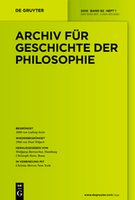
ARCHIV FUR GESCHICHTE DER PHILOSOPHIE
Exploring the Evolution of Philosophical ThoughtARCHIV FUR GESCHICHTE DER PHILOSOPHIE, published by WALTER DE GRUYTER GMBH, is an esteemed journal that delves into the rich historical landscape of philosophy, tracing conceptual evolution from 1888 through to the present day. With an impact factor reflective of its significance in the field, this journal has achieved a commendable Q2 ranking in Philosophy according to the latest bibliometric assessments. By offering insights into philosophical discourses ranging from the late 19th century to contemporary analysis, the journal serves as an essential resource for scholars, students, and professionals alike. While the journal is not currently Open Access, it remains a critical platform for fostering dialogue and disseminating research in philosophical history, solidifying its reputation as a pivotal source in the humanities. Explore its volumes to gain valuable perspectives on the evolution of philosophical thought and to contribute to an ongoing discourse that spans generations.
HISTORY AND PHILOSOPHY OF THE LIFE SCIENCES
Unraveling the Threads of Life Sciences Through Time and ThoughtHISTORY AND PHILOSOPHY OF THE LIFE SCIENCES, published by SPRINGER INT PUBL AG, stands as a leading peer-reviewed journal dedicated to exploring the intricate relationships between historical narratives and philosophical frameworks in the life sciences. With its robust impact factor and recognized position as a Q1 journal in key categories such as Arts and Humanities, History, and History and Philosophy of Science, this journal provides a vital platform for researchers, professionals, and students seeking to delve into the theoretical underpinnings and historical trajectories shaping contemporary life sciences. Established in 1979 and evolving through its converged years until 2024, it reflects the journal's enduring commitment to advancing scholarly discourse in its field. While the journal is not open access, it nonetheless attracts a diverse readership, facilitating meaningful research exchanges and interdisciplinary dialogues. Located in the picturesque country of Switzerland, the journal invites contributions that foster critical examination and innovative thinking in the historiography and philosophy of life sciences, ultimately enhancing our understanding of this dynamic and significant discipline.
British Journal for the History of Philosophy
Advancing Critical Insights into Philosophical TraditionsThe British Journal for the History of Philosophy, published by ROUTLEDGE JOURNALS, TAYLOR & FRANCIS LTD, is a leading academic journal dedicated to the exploration and critical examination of historical philosophies and their implications. Founded in 1993 and operating through 2024, this quarterly publication holds a prestigious status, being ranked Q1 in Philosophy with a Scopus rank of 188 out of 806, placing it in the 76th percentile within the arts and humanities domain. The journal is unique in its commitment to showcasing interdisciplinary research, catering to scholars, professionals, and students interested in philosophical history's complexities and developments. Although it does not currently offer Open Access options, it remains an essential resource for contemporary debates and historical insights in philosophy, contributing to the wider academic discourse on ethical, epistemological, and metaphysical inquiries.
European Journal for Philosophy of Science
Pioneering Critical Discussions in the Philosophy of ScienceThe European Journal for Philosophy of Science, published by SPRINGER, stands as a prestigious platform for scholars in the realms of philosophy and history of science. With an impressive impact factor and categorized in the Q1 Quartile for both History and Philosophy of Science and Philosophy, this journal ranks among the top 10% of its peers, reinforcing its critical role in advancing academic discussions and insights within these fields. With its composition of rigorous peer-reviewed articles and a commitment to fostering interdisciplinary dialogue, the journal navigates foundational and contemporary issues that shape scientific inquiry. Although currently not Open Access, it provides invaluable access to researchers, professionals, and students who seek to deepen their understanding of the philosophical underpinnings of scientific practice. Housed in the Netherlands, the journal continuously engages with the evolving landscape of philosophy in the scientific domain, making it a key resource for anyone invested in the intersection of science and philosophy.
RETHINKING HISTORY
Challenging Narratives, Shaping FuturesRETHINKING HISTORY is a prestigious academic journal published by Routledge Journals, Taylor & Francis Ltd from the United Kingdom. With an ISSN of 1364-2529 and an E-ISSN of 1470-1154, this journal serves as a vital platform for critical discourse and innovative scholarship in the field of history. Since its inception in 1997, RETHINKING HISTORY has continuously strived to push the boundaries of historical study, providing a forum for interdisciplinary research and theoretical exploration. It holds an impressive Q1 ranking in History, reflecting its high impact and influence, with a Scopus rank of #203 out of 1760, placing it in the 88th percentile among history journals. The journal publishes original articles, reviews, and theoretical pieces that challenge conventional narratives and encourage new perspectives on historical events and methodologies. Although it is not currently an Open Access journal, RETHINKING HISTORY plays an essential role in shaping contemporary historical research and thought, appealing to a diverse audience of researchers, professionals, and students committed to the exploration of history’s complexities.

VOPROSY FILOSOFII
Navigating the Intersection of Philosophy and ScienceVoprosy Filosofii, published by the prestigious Russian Academy of Sciences - Institute of Philosophy, is a leading journal in the fields of Philosophy, Cultural Studies, and History and Philosophy of Science, boasting an impressive standing in its category with a Q2 rank across various disciplines as of 2023. This journal serves as a crucial platform for the exchange of innovative ideas and scholarly research, addressing key philosophical inquiries and cultural narratives that shape contemporary thought. Despite its lack of Open Access options, the journal's commitment to rigorous academic standards ensures that it remains a vital resource for researchers, professionals, and students seeking to engage with critical philosophical dialogue. With a history of publication reaching back to 2002 and a diverse scope covering linguistics, philosophy, and social sciences, Voprosy Filosofii continues to foster intellectual exploration from its base in Moscow, Russia.
HISTORY AND THEORY
Fostering Critical Thought Across Historical ContextsHISTORY AND THEORY, published by Wiley, stands as a premier journal in the realms of history and philosophy, consistently recognized for its scholarly contributions since its inception in 1968. With an impressive Q1 ranking in both History and Philosophy categories for 2023, it represents the top tier of academic rigor and impact in the field. This esteemed journal, indexed under ISSN 0018-2656 and E-ISSN 1468-2303, offers a platform for innovative research and critical discourse that challenges conventional interpretations and fosters rich theoretical explorations. Despite being a subscription-based journal, its broad array of contributions plays a pivotal role in shaping intellectual discussions among researchers, professionals, and students alike. With its central hub located in Hoboken, New Jersey, HISTORY AND THEORY engages an international readership, making it an influential voice for those immersed in understanding the complex interplay of historical contexts and philosophical thought.
Croatian Journal of Philosophy
Engaging Minds, Expanding Philosophical HorizonsCroatian Journal of Philosophy is a distinguished academic platform dedicated to the advancement of philosophical discourse, published by KRUZAK D O O. With an ISSN of 1333-1108 and an E-ISSN of 1847-6139, this journal has been a key player in the field since its inception in 2008, continuing to progress through its converged years until 2024. Recognized for its scholarly contributions, it holds a prestigious placement in Q3 within the philosophy category for 2023 and ranks #571 out of 806 in Scopus, reflecting its engagement with a broad spectrum of scholarly discussions and ideas. Though it operates without an Open Access model, the journal remains a vital resource for researchers, professionals, and students who are keen to explore contemporary and traditional philosophical issues from diverse perspectives. The journal's commitment to expanding the boundaries of philosophical inquiry emphasizes the significance of interdisciplinary dialogue, making it a reputable choice for those seeking to deepen their understanding of philosophical thought.

Oeconomia-History Methodology Philosophy
Unveiling the Complexities of Society Through ResearchOeconomia-History Methodology Philosophy, published by ASSOC OECONOMIA, is a distinguished academic journal focused on the interdisciplinary study of economics, history, methodology, and philosophy. With its ISSN 2113-5207 and E-ISSN 2269-8450, this Open Access journal has been committed to disseminating high-quality research since 2011, enabling widespread accessibility to its content. Based in Paris, France, the journal holds impressive rankings, including a Q1 quartile in History and a Q3 quartile in both Economics, Econometrics and Finance, as well as Sociology and Political Science for 2023. This diversity highlights its multifaceted approach to understanding complex societal issues. With significant visibility in leading databases, including Scopus, it appeals to researchers, professionals, and students alike, fostering robust discussions and innovative insights in their respective fields. The journal currently spans from 2018 to 2024, offering a platform for critical analyses and theoretical advancements that challenge established norms and encourage new perspectives.

Logos
Illuminating Philosophical PerspectivesLogos, published by the GAIDAR Institute for Economic Policy, is a pivotal journal serving the fields of Cultural Studies, Literature and Literary Theory, and Philosophy. Operating under the ISSN 0869-5377 and E-ISSN 2499-9628, Logos provides a rigorous platform for intellectual discourse and scholarly contributions from Russia and beyond. With a Q3 ranking in 2023 across its categories, this journal is recognized for its commitment to advancing research and dialogue in the humanities, evidenced by its Scopus rankings where it places in the 59th percentile for Literature and Literary Theory and the 37th percentile for Philosophy. Since its inception in 2016, Logos has become a significant resource for researchers and students alike, offering access to a wide array of theoretical perspectives and empirical studies. While currently not an open access journal, its relevance in contemporary academic discussions ensures it remains a vital reference point for those seeking to understand the complexities of cultural and philosophical narratives.