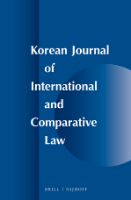
Korean Journal of International and Comparative Law
Scope & Guideline
Advancing global legal discourse.
Introduction
Aims and Scopes
- Judicial Decisions Analysis:
The journal frequently publishes analyses of major judicial decisions from Korean courts, offering insights into the legal reasoning and implications of these rulings on various issues, including human rights, international adoption, and compensation matters. - International Law and Comparative Law:
A core focus of the journal is the examination of international law in the context of Korea, including comparative studies that highlight the interactions between domestic and international legal frameworks. - Marine Environmental Law:
The journal places a significant emphasis on marine environmental law, exploring issues related to the conservation of marine biodiversity, the obligations of states under international conventions like UNCLOS, and the impact of regional practices on global marine governance. - Human Rights and Migrant Issues:
Another important area of focus is the analysis of human rights issues related to migrant workers and refugees, particularly in the context of South Korea's obligations under international law. - Regional Security and Law:
The journal also addresses themes of regional security, exploring the legal implications of geopolitical tensions in Northeast Asia, including the South Korea-Japan conflicts.
Trending and Emerging
- Environmental Law and Biodiversity:
There is a growing trend towards the publication of articles addressing environmental law, particularly in relation to biodiversity conservation and the legal frameworks governing marine environments. This reflects a heightened global awareness of environmental issues and the need for legal mechanisms to address them. - Human Rights Advocacy:
The journal has increasingly focused on human rights advocacy, especially concerning migrant workers and vulnerable populations. This trend underscores a commitment to examining the intersection of domestic law and international human rights obligations. - Geopolitical Legal Studies:
Emerging themes include the legal implications of geopolitical tensions in Northeast Asia, particularly involving South Korea, Japan, and regional security dynamics, indicating a responsive approach to current international relations and their legal ramifications. - Integration of Science and Law:
The interface of science and law, particularly regarding marine scientific research and its regulatory frameworks, has gained prominence, highlighting the need for interdisciplinary approaches to address complex legal challenges in the marine environment.
Declining or Waning
- Traditional Maritime Disputes:
There has been a noticeable decrease in publications specifically addressing traditional maritime disputes, particularly those centered on historical grievances and territorial claims, as attention shifts to broader environmental and cooperative legal frameworks. - Historical Legal Practices:
Studies focusing on historical legal practices and their applications in contemporary law have become less frequent, possibly due to an increasing emphasis on modern legislative frameworks and current legal challenges. - Domestic Labor Law:
Research on domestic labor law, particularly in the context of local labor rights and practices, appears to be declining, as the journal's focus has shifted more towards international and comparative perspectives.
Similar Journals

GEORGETOWN LAW JOURNAL
Navigating Complex Legal Landscapes TogetherGEORGETOWN LAW JOURNAL, published by the Georgetown Law Journal Association, is a premier academic journal dedicated to advancing scholarship in the field of law. With its long-standing history dating back to 1973, this esteemed publication facilitates critical discourse on a wide range of legal issues, contributing significantly to both theoretical and practical advancements within the legal community. The journal, bearing the ISSN 0016-8092, operates exclusively in print and does not offer open access, allowing it to maintain a rigorous standard of peer-reviewed content that is well-regarded amongst legal scholars, practitioners, and students alike. Ranked in the Q2 category of law journals as per the 2023 category quartiles, and positioned at 746th out of 1025 in Scopus rankings, it provides a valuable platform for the dissemination of high-quality research. The journal's commitment to excellence is reflected in its broad scope, covering topics from constitutional law to international matters, ensuring it remains a vital resource for anyone engaged in legal studies. As we navigate complex legal landscapes, the GEORGETOWN LAW JOURNAL stands out as a critical conduit for emerging ideas and scholarly debates in the ever-evolving domain of law.
Comparative and International Law Journal of Southern Africa-CILSA
Innovating Comparative Law Perspectives in Southern AfricaComparative and International Law Journal of Southern Africa (CILSA) is a prestigious academic publication dedicated to advancing the understanding of comparative and international law within the Southern African context. Published by the University of South Africa, Institute of Foreign & Comparative Law, CILSA serves as a critical platform for scholars, practitioners, and students to explore significant legal issues and developments that impact the region and beyond. The journal's ISSN is 0010-4051, ensuring its visibility and accessibility within academic circles. While CILSA currently operates under a traditional publishing model, it remains committed to providing high-quality, peer-reviewed research that addresses pressing legal challenges and promotes informed discourse. With a mission to bridge the gap between different legal systems and encourage comparative analysis, CILSA is essential reading for anyone invested in the evolution of law in a globalized world.

German Law Journal
Elevating Legal Research with Impact and AccessibilityGerman Law Journal, published by Cambridge University Press, stands as a leading open-access platform for scholarly discourse in the field of law, having made its content freely available since 2019. With an impressive impact factor that places it in the Q1 category for Law as of 2023, and a robust Scopus ranking of #164 out of 1025 in the social sciences category, this journal is recognized for its high-quality research and significant contributions to legal scholarship. The journal encompasses a wide array of topics pertinent to the German legal system, European Union law, and comparative legal studies, thus catering to researchers, legal practitioners, and students alike. Located in the heart of the UK, at Edinburgh Building, Shaftesbury Rd, Cambridge, this journal not only fosters academic engagement but also promotes interdisciplinary dialogues that enrich the understanding of legal principles in an evolving global context. Emphasizing accessibility and high academic standards, the German Law Journal serves as an essential resource for those seeking to explore and contribute to contemporary legal discussions.
Pacific Focus
Navigating the Complexities of International RelationsPacific Focus is a renowned academic journal published by WILEY, focusing on the dynamic fields of Political Science and International Relations. Established in 1986, it has developed a reputation for disseminating innovative research and critical analysis pertinent to the geopolitical landscape of the Pacific region and beyond. With an impressive rank of #370/706 in Political Science and International Relations, notably achieving a Q2 category rating in 2023, it serves as a vital resource for scholars and practitioners alike. The journal also holds a respectable Q3 status in Sociology and Political Science, reflecting its broad interdisciplinary appeal. While currently not offering Open Access, Pacific Focus maintains a commitment to high-quality scholarship through rigorous peer-review processes. Researchers, professionals, and students will find it an essential platform for exploring contemporary issues, fostering academic dialogue, and contributing to the field's evolution.
JOURNAL OF CONFLICT & SECURITY LAW
Advancing Understanding in Legal and Security FrameworksThe Journal of Conflict & Security Law, published by Oxford University Press, is an essential source of scholarly information in the fields of law, conflict studies, and security policy. With an ISSN of 1467-7954 and an E-ISSN of 1467-7962, this journal has been a significant platform for rigorous academic discourse since its inception in 2005. It is recognized for its contributions to the legal frameworks surrounding conflict and security, currently holding a Q3 ranking in Law and Q4 in both Safety Research and Safety, Risk, Reliability, and Quality for the year 2023. With its Scopus rankings placing it in the 61st percentile in Social Sciences Law, the journal serves as a key reference point for researchers and professionals looking to navigate the complexities of contemporary security challenges. Though the journal is not open access, its detailed analyses are critical for informed policy-making and academic inquiry, making it indispensable for students, scholars, and practitioners alike. For comprehensive insights and empirical studies, Journal of Conflict & Security Law remains at the forefront of legal and security research.
Indonesia Law Review
Innovating Legal Scholarship for a Global AudienceIndonesia Law Review is a premier open-access academic journal dedicated to advancing knowledge in the fields of law and social sciences, with particular emphasis on the Indonesian legal landscape. Established by the Indonesian Law Review, this journal has made significant strides since becoming open access in 2014, ensuring that research is freely available to a global audience. Based in Depok, West Java, the journal seeks to foster scholarly discourse on legal issues pertinent to Indonesia, while also contributing to the broader field of education and social sciences. With its current Scopus rankings placing it within the top tiers of law and social sciences, including a Q3 categorization in law and a Q4 classification in education and miscellaneous social sciences, the **Indonesia Law Review** serves as a vital platform for researchers, professionals, and students to disseminate their findings and engage with contemporary legal dilemmas. The journal is committed to providing a robust forum for innovative legal scholarship and is an essential resource for anyone seeking to understand the complexities of law in Indonesia and beyond.

Revista de Derecho Civil
Bridging Theory and Practice in Civil LawRevista de Derecho Civil is a distinguished academic journal dedicated to the field of civil law, published by NOTYREG HISPANIA in Spain. With an ISSN of 2341-2216 and E-ISSN of 2341-2216, it has established itself as an essential platform for scholarly discourse since gaining Open Access status in 2014, thereby ensuring a wider dissemination of knowledge and increased accessibility for researchers and practitioners alike. The journal has been recognized in the Q2 category in the field of Law for 2023, reflecting its contribution to the academic community and competitive standing within the discipline, evidenced by its Scopus rank of 683 out of 1025 in the Social Sciences and Law category. Covering a wide range of topics and converging from 2018 to 2024, Revista de Derecho Civil invites contributions from legal scholars globally, fostering an environment that promotes in-depth analysis, critical thought, and innovative research in civil law. As such, it holds an important place for students, researchers, and professionals aiming to engage with contemporary legal issues and doctrines.

Canadian Yearbook of International Law
Advancing the Discourse of International LawCanadian Yearbook of International Law, published by Cambridge University Press, serves as a vital platform for scholarly discourse within the realms of law and international relations. With a rich history dating back to 1989, the journal engages a diverse audience of researchers, academics, and practitioners by offering insightful analyses of contemporary legal issues and policy debates. Although the journal currently holds a Q4 quartile ranking in both the law and political science categories, it remains an essential resource for understanding the evolving landscape of international law. Despite the current limitations in access options, the journal's rigorous peer-review process ensures that each publication maintains high academic standards, encouraging thoughtful discussions that contribute to both theoretical and applied aspects of international law. The Canadian Yearbook helps bridge gaps in knowledge and fosters greater understanding among scholars worldwide, enhancing its significance in the academic community.
Chinese Journal of Comparative Law
Innovating Legal Scholarship for a Global AudienceWelcome to the Chinese Journal of Comparative Law, a premier academic journal dedicated to the field of comparative law, published by Oxford University Press. Since its inception in 2013, the journal has provided a crucial platform for scholars and practitioners to engage with the intricacies of legal principles across different jurisdictions, emphasizing both traditional and contemporary issues relevant to the field. With an impact factor reflecting its influence—ranked Q2 in Law and Q3 in Economics and Econometrics—the journal continues to foster innovative research and dialogue among legal professionals. The Scopus rank positions it well within the top 69th percentile of law journals, illustrating its significant contribution to the social sciences. While not open access, the journal's commitment to disseminating high-quality, peer-reviewed research ensures it remains an essential resource for researchers, practitioners, and students interested in the evolving landscape of comparative law. As the journal converges through 2024, it invites contributions that not only challenge existing paradigms but also enhance the understanding of law in a global context.

University of Western Australia Law Review
Transforming Legal Perspectives Through Rigorous AnalysisThe University of Western Australia Law Review is a prestigious academic journal dedicated to the critical examination and exploration of legal issues in Australia and beyond. Published by the Law School of the University of Western Australia, this journal has become a significant resource for legal scholars, practitioners, and students alike, contributing to the rich discourse in the field of law. With an ISSN of 0042-0328 and a current categorization in the Q3 quartile in the field of Law as per the 2023 rankings, it stands among a cohort of respected legal publications. The journal, though not open access, facilitates a sharing of unique insights and research from 2019 to 2024, aiming to address emerging and traditional legal challenges within a global context. With a Scopus rank of #651 out of 1025 in Social Sciences Law, it holds a percentile of 36, reflecting its valuable contributions to legal scholarship. The University of Western Australia Law Review invites researchers, practitioners, and students to engage with its rich content and to contribute to the ongoing dialogue shaping the future of law.